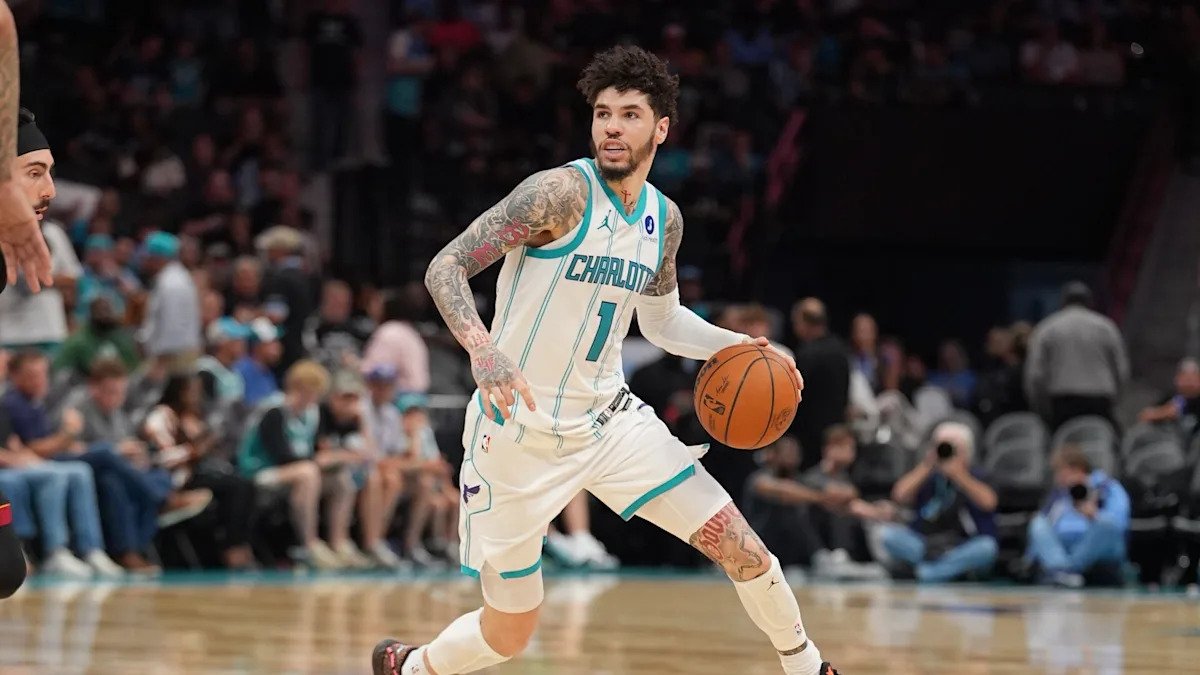
This was no Giannis Antetokounmpo “let’s drag this out over months and years” situation — discussions of LaMelo Ball being available in a trade popped up after the second round of the NBA Draft Wednesday night, and by Thursday morning, the deal was done.
It’s a big swing by both teams, but who were the winners and losers from this massive trade? Let’s break it down, but first is a reminder of exactly what this trade looks like:
Advertisement
Minnesota receives: LaMelo Ball, Josh Green
Charlotte receives: Naz Reid, 2033 unprotected first-round pick, three first-round pick swaps (2028, 2029, 2030), three second-round picks (2029, 2032, 2033)
Winner: Minnesota’s potential upside
Minnesota president Tim Connelly and the entire organization stepped back and made an honest assessment of the past three seasons: This is a good team. Just not good enough. They made two Western Conference Finals and have a superstar entering his prime in Anthony Edwards, but they also see Oklahoma City and San Antonio and realized their team, as constructed, had reached its ceiling.
So they swung for the fences.
Advertisement
Julius Randle and Naz Reid are gone (as was Nickeil Alexander-Walker a year before them), and in comes LaMelo Ball and his dynamic offensive game. Minnesota has shifted philosophy from a defensive team with hopefully enough offense to an offensive team with hopefully enough defense.
The potential upside of having Anthony Edwards and Ball share the offensive load is obvious — this could be one of the most entertaining and potent offensive teams in the league. Ball has become an offense unto himself, one of the on-off gods ine. If one thing is sure, these Timberwolves are going to be a highlight factory and a League Pass favorite.
For the past couple of years, Minnesota has clearly needed another shot creator to play with Edwards. Now with Ball and just re-signed Ayo Dosunmu, it has two guys next to him who can score from all three levels. Minnesota is now running its offense through two good and one elite passers, three forces in transition, and with a little more shooting around them this will be nearly an impossible offense to stop.
Advertisement
There are risks here. That starts with Minnesota needing Ball to continue down the path he did a year ago of deferring more, making the right read and trusting his teammates. Your old-school coach would say he was “playing the right way.” Ball did much better with that last season, the Timberwolves need that trend to continue.
Minnesota is going to lean heavily on Jaden McDaniels and especially Rudy Gobert in the paint to shore up the defense. This trade also is a big get on LaMelo’s health, he played 70 games last season but no more than 47 the previous 3. Minnesota needs him on the court.
But if it all comes together, this is a Minnesota team that is a bigger threat to Oklahoma City and San Antonio than it was 48 hours ago. The potential upside for this team is now higher.
Loser: Minnesota in the longer term
Things can all click into place at the right time, and a team can go on a magical postseason run — we just saw the New York Knicks ride that all the way to a title.
Advertisement
That is also not the norm. Ball and Edwards both have three full seasons on max contracts locked in, the Timberwolves have a little time to figure everything out around them, but they don’t have the assets to make another big swing. Minnesota has traded away its picks and financial flexibility to get here. This has to work.
In the short term, they have gone small with Ball, Edwards and Dosunmu playing 1-3, Jaden McDaniels now is the four with Rudy Gobert the five (they will miss Donte DiVincenzo this season as he recovers from a torn Achilles). Terrence Shannon Jr. and Josh Green have to step up, as does young big Joan Beringer.
There’s a reason that both Brooklyn (in the Julius Randle trade) and Minnesota wanted their picks further down the line, there is a conviction in league circles that Edwards is going to move on from Minnesota after this contract. That speculation isn’t fair to Edwards, the Timberwolves or the team’s fans, but it’s also very real.
If the goal was to win over Edwards long-term, this trade feels like a huge roll of the dice, one more likely to come up snake eyes.
Advertisement
The instinct here is to say Charlotte was a dynamo last season, going 18-9 after the All-Star break and winning 44 games, its most in a decade. Why not build on that? Why break it up and trade away the biggest star on your team?
However, Charlotte also saw the play-in games. Their red-hot team needed overtime to beat Miami then get run out of the building by Orlando. This Hornets squad had incredible highs but was not a genuine threat. And then there are the concerns about LaMelo staying fully healthy for another season (he hadn’t the previous three).
So Charlotte bet that it could sell high on Ball (and that Anthony Edwards would not be in Minnesota when many of the picks and swaps are conveyed).
Advertisement
The Hornets have set out to build something more stable, constructed around Kon Knueppel and Brandon Miller. They now also have Coby White at the point and Nas Reid at the four — that’s a lot of shooting and floor spacing — and Moussa Diabate at the five.
The Hornets’ offense likely takes a step back next season, but their defense should improve, and they gained flexibility for the future. They have a $40.7 million trade exception (the largest in NBA history) plus cap space, and they added a first-round pick that can be traded later if needed.
Charlotte may not be better next season, they might even be a little worse. However, in the long term, they are better set up to build a genuinely threatening team in the East.
Winner (for now): Anthony Edwards
Minnesota has needed a high-level secondary shot creator for years. Consider the point guards Anthony Edwards has played next to in Minnesota: Ricky Rubio, D’Angelo Russell, Patrick Beverley and Mike Conley. Not exactly an offensively dynamic group.
Advertisement
Now Edwards gets to play next to an offensive force in his own right in LaMelo Ball. Edwards can spend time working off-ball in some matchups, and can take over a game in the clutch if needed. Throw in Dosunmu and this is a group that is going to be entertaining, and we could see Edwards put up the best numbers of his career.
Will this make him happy long-term? That depends on how much they win. But in the short term at least, Edwards is a winner.
Winner: Coby White
There are 74 million reasons White is a winner.
Part of what made this trade possible, from Charlotte’s perspective, was that they could lock up White to come in at the point without taking a massive step backward. White is not LaMelo, but he’s a good starting-level point guard who can be dynamic, and he’s got scorers around him in the backcourt in Knueppel and Miller.
Advertisement
White is getting paid — he just re-signed for three years and $74 million — and getting handed the ball to run a team. That’s the definition of a win.
Losers: Young Hornets fans
It is nearly impossible to overstate how popular LaMelo Ball is with fans of a certain age across the nation, and especially in Charlotte. For a generation who often view the NBA through highlight packages on Instagram and TikTok, LaMelo is a legend. He has swagger, style, and a game with flair that is a perfect social media fit.
Those fans are going to be crushed by this move.
Ball next to Edwards is still going to be a highlight factory, but for those young fans in Charlotte, it will not bear with their team. It will be a heartbreaking day — they will not care that this trade can not only be defended but called a win in basketball terms. Their favorite player is gone, and that sucks. (It sucks when it happens to any of us.)
Advertisement
I feel for those fans. I could say “give the new team a chance,” but I understand that might take a little time. They can take all the time they need.

