Jan 1, 1990, Miami, FL
His voice neither wavered nor showed any twinge of anxiety. His step was slow but deliberate as he paced before his assembled troops, outlining the battle plan for how the war would be won. This was a man in all his MacArthuresque glory. This was not the Lou Holtz that the public, much less Colorado, was supposed to see.
“Let me tell you what, they’ve been living a lie, they’ve been living a lie all season,” Holtz declared in reference to the Buffaloes, unaware of the Denver television crew filming his pep talk four days prior to the Orange Bowl. “Remember, I told you.”
Holtz’s public concern over his team’s ability to bounce back from last month’s 27–10 loss to Miami gave way to (seemingly) private conviction. “They’re expecting an outstanding football team and they’re going to see one,” he told his players. “They’re going to see the best Notre Dame. And we’re going to whip ’em.”
As the six o’clock news aired Holtz’s comments, the emotion-charged Buffs now had added incentive to go along with their season-long quest for a national championship for their spiritual leader, Sal Aunese, who died last September of inoperable stomach cancer. Aunese’s parting request to his teammates was simple: “Go get ’em, and bring home the Orange Bowl.”
If anything, though, Holtz’s remarks may have contributed to emotional overload for Colorado this New Year’s Night. For all the lessons they learned, for all the detractors they proved wrong on their way to an 11–0 mark in 1989, the Buffs forgot Rule #1 in approaching a sleeping giant.
If you’re going to kill him, make sure you do it in less than three attempts. Otherwise, the big guy just might wake up.
Colorado learned the hard way. Three times in the first half they had the gun loaded, aimed and ready. Three times they misfired.
After an exchange of possessions to open the game, the Colorado offense took its second turn and marched the ball down to the Notre Dame 35-yard line. On second and five, tailback Eric Bieniemy received the hand-off from Darian Hagan and rambled 16 yards through the right side of the defense, headed for an apparent touchdown. But as he tried switching hands, the ball popped loose and Irish free safety Pat Terrell recovered. Strike one.
Notre Dame’s running attack got them no further than their own 42, and the Buffaloes had the ball again on their own 18 following a 49-yard punt by Craig Hentrich. Hagan complemented Colorado’s impressive option attack with long pass completions to John Perak and Erich Kissick. Suddenly the Buffs found themselves knocking on the door again with a first down at the Irish 12.
But Scott Kowalkowski, Jeff Alm, and Ned Bolcar helped stuff three successive running plays short of the first down marker, and Colorado had to settle for Ken Culbertson’s 23-yard field goal attempt. Culbertson turned the chip shot into a nightmare, hooking it wide left. Strike two.
The Irish offense followed that up with a futile three-play, eight-yard drive. The Buffalo defense, led by the inspired play of Alfred Williams, Michael Jones, and Kanavis McGhee, once again stuffed the Irish attack deep in its own territory, and Hentrich’s shanked punt gave Colorado prime field position at its own 41. From there Hagan, Bieniemy, and J. J. Flannigan combined to pound the ball over the right side to the Irish 1-yard line. What followed was one of the greatest goal-line stands in Notre Dame history.
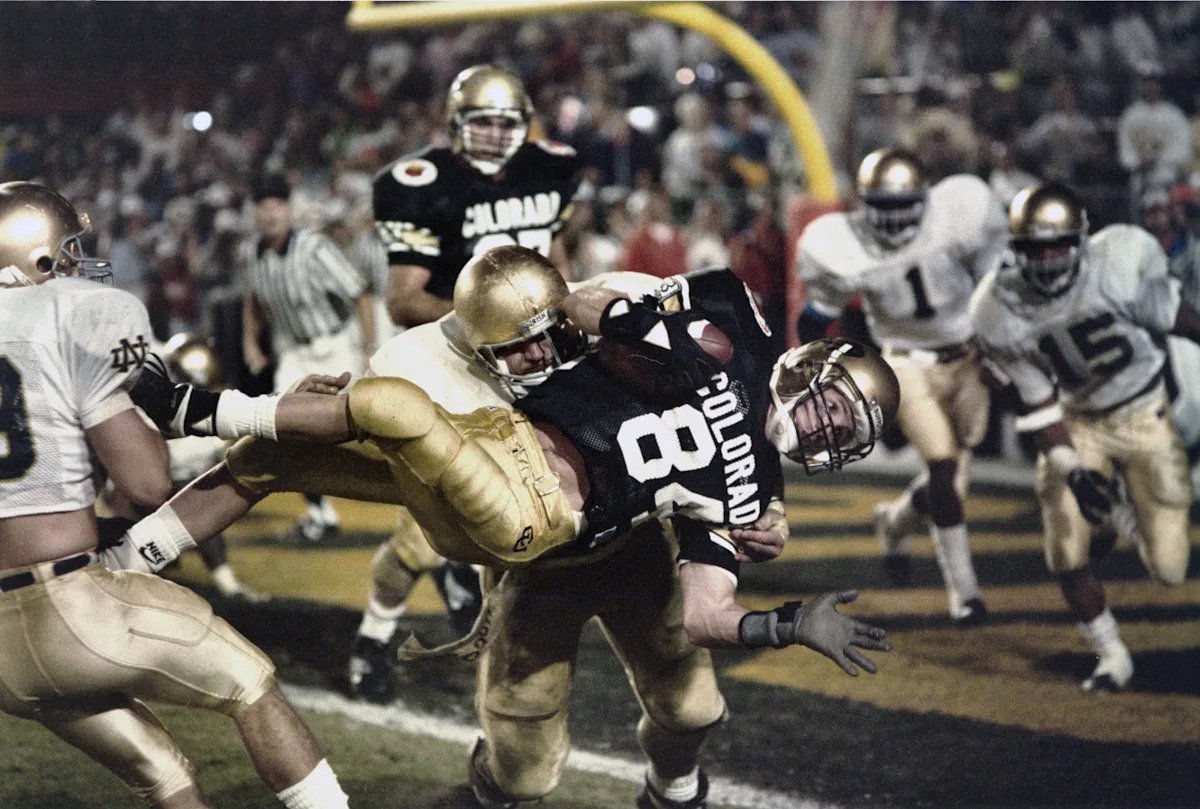
First and goal. Bieniemy makes a spectacular leaping effort over the right side, only to be stopped in more spectacular fashion head-on by strong safety D’Juan Francisco.
Second and goal. Hagan tries his luck on a keeper up the middle. Chris Zorich & Co. say no.
Third and goal. Hagan rolls right, finds a wall of Notre Dame defenders in his face, and pitches in desperation to Bieniemy. The ball flutters out of bounds for a loss of two.
Frustrated and scoreless, the Buffs lined up for an apparent field-goal attempt on fourth and three to get something, anything on the scoreboard. Instead, Colorado head coach Bill McCartney reached into his grab bag of tricks and pulled out a lemon.
Normally a linebacker, Chad Brown lined up at tight end on the play and was supposed to release from the line of scrimmage when the ball was snapped, making himself an eligible receiver on the fake. But when holder Jeff Campbell took the snap and looked for an open receiver, Brown didn’t release. With no one to throw to, Campbell ran to the right in desperation and Troy Ridgley flattened him a yard short of the end zone.
Strike three.
“He (Brown) said he got jammed,” McCartney explained dejectedly as he tried to justify the play. “It looked like a broken play, but it wasn’t.”
If anything, it was the alarm clock the Irish needed. Notre Dame proceeded to march the ball downfield in their own attempt to crack the scoreboard. Long runs by Tony Rice and Ismail set up Rice’s first two pass completions of the day—12 yards to Derek Brown and 29 to Pat Eilers over the middle. Colorado blocked Billy Hackett’s 27-yard field goal attempt two plays later to end the scoreless first half, but Notre Dame entered the locker room confident. Colorado’s failure to score on its last drive convinced the Irish they had the Buffs where they wanted them.
“If you try a fake play, that means you’ve gone away from your game plan,” said Zorich. “Once they didn’t score on that, we knew we were in good shape.”
“When it came down to ‘crunch time’ in the first half, we (the defense) just dug a little deeper,” said Bolcar. “We went into the second half 0–0, but we knew that as soon as our offense got into a rhythm that we would be fine.”
The Irish came out for the second half as if their lives depended on it—which, according to their bespectacled leader, it did. “How you respond to the challenge in the second half will determine what you become after the game,” Holtz told his troops at the intermission, “whether you are a winner or a loser, for the rest of your life.”
The offense got the message, picking up where it left off at the end of the first half and marching down the field with the help of the big play. Rice found Tony Smith over the middle for 27 on third and 11, followed two plays later by Anthony Johnson’s 29-yard run to the Colorado 11. Johnson scored on a two-yard plunge soon after, and the Irish had their first offensive touchdown in the Orange Bowl since 1985.
Bolcar picked off a deflected Hagan pass on Colorado’s opening series of the half, giving Notre Dame the ball at the Buffalo 46. Time for Rice to show once again, as he did in the Fiesta Bowl last year, that his throwing was more than adequate. His pass to Johnson on third and nine for a gain of 13, and his perfect strike to Eilers for 18, pulled the Irish out of a first-and-32 hole created by two penalties.
With Rice having found success against the Buffalo secondary (5 of 9 completions, 99 yards), many expected him to be throwing again on third and 14 at the Colorado 35. Instead, Holtz crossed everyone up by calling for “Reverse 8.” A simple name for a play with a simple purpose: give it to the Rocket, and see if anyone can catch him.
Rice dished off to Ismail streaking right from his flanker position, and, with key blocks from Johnson and Tim Grunhard, the Rocket scorched a path down the right sideline quicker than you can say “touchdown.” Following a halftime spectacle of six breakdancing elephants and a guy named Chubby, the Irish were suddenly putting on a show of their own. Call it “14–0.”
Ismail’s run typified the kind of grief he caused the Buffs all evening long. Still nursing a sore right shoulder he dislocated against Miami, his status remained uncertain until game time. But when tailback Ricky Watters went down with a knee injury on Notre Dame’s third play from scrimmage, the Irish had to press the Rocket into backfield action.
“I was going to play a lot more at tailback, but (my) injury put a damper on the game plan,” said Ismail. “(But) Coach told me that after a few hits he wanted me to go a few plays in the backfield.” From there he inflicted much more pain than he felt, pounding out 108 yards on the ground on 16 carries.
“He was terrific,” observed McCartney. “He’s very, very dangerous. We saw more of him in the backfield than I would have wanted.”
But Hagan responded to Ismail’s score with his own phenomenal effort. On first and ten at the Notre Dame 39, Hagan rolled right to the short side of the field. With little room to maneuver, he eluded the reaches of Terrell and Devon McDonald and cut back left, scrambling 39 yards for the touchdown and the longest rush against the Irish this season. Culbertson’s point-after attempt hit the left upright and bounced away, ending the third quarter at 14–6 and prolonging the kicker’s disastrous evening.
Each team exchanged possessions to begin the fourth quarter, and Notre Dame had the ball once more at their own 18 with 10:27 remaining. With an eight-point lead and the running game hitting its stride, Holtz had no more surprises for Colorado. Just a return to smash-face football.
Ismail right for ten. Johnson right for nine. Rice right for eight. Rodney Culver left for four. When the dust finally settled after Johnson’s seven-yard touchdown run, the Irish had consumed almost nine minutes to drive 82 yards on 17 plays, all on the ground. Hentrich’s extra point put Notre Dame up by 15, leaving only 1:32 on the clock and a long off-season for Colorado to reflect on what could have been.
“Coming away from the first half without any points after controlling the game for a while was too much to overcome,” mused McCartney. “Anytime you’re playing a team like Notre Dame, you’ve got to capitalize on your chances. We didn’t.”
“That’s something that’s going to haunt us for a long time, knowing we had three or four opportunities to score,” said Flannigan, looking away in disgust. “We gave the game away. You just don’t not score when you’re inside the 20-yard line that often.”
For the Irish, victory in the Dade County Snakepit tasted ever so sweet. “Everyone kept on saying that there was a jinx on us in here,” said Rice in I-told-you-so fashion. “Well, the jinx is definitely over.”
Only the final polls remained for Notre Dame to mull over. A Miami loss in the Sugar Bowl would have erased any doubts. But with the Hurricanes handing Alabama a 33–25 loss in New Orleans, Holtz was left to state the case for his 12–1 team.
“I can honestly say we have the best record and have played the toughest schedule,” said Holtz emphatically. “If you’re going to vote on a national champion in October, give it to Florida State.
“But we were number one 11 weeks, and the one week we were out of number one we came back and beat number one by 15 points. I believe in my heart if you have the best record with the toughest schedule… I rest my case.”
Thus began the debate that won’t end until October 20, when Notre Dame and Miami lock horns in South Bend one last time—presumably to determine once and for all who really is number one.
Stay tuned.

