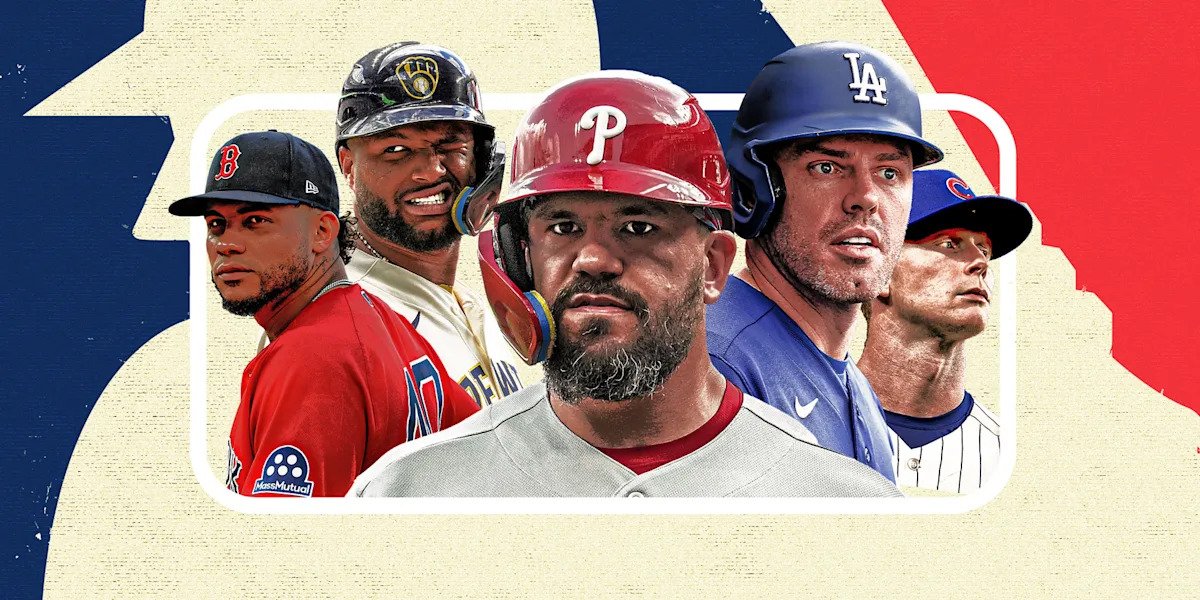
Don’t get too comfortable — MLB’s All-Star break is especially short this year, with the regular season resuming Thursday night in the same city that just hosted the Midsummer Classic as the Mets and Phillies engage in an NL East clash on ESPN. This marks the start of what is commonly called the second half, but in reality, there’s a lot less than 50% of the schedule remaining, as clubs have fewer than 70 games left to play before the postseason arrives.
The Aug. 3 trade deadline will provide some much-needed clarity regarding which teams will be pushing for a spot in October and which will be shifting their focus to 2027 and beyond, but we’ll learn plenty over the next couple weeks of play as well.
Advertisement
For now, here’s how the 30 major-league ballclubs stack up, and what the first three-plus months have told us about their chances of chasing a World Series in 2026.
Jump to a team by clicking on the links below:
1. Los Angeles Dodgers (61-36)
The Dodgers went 36-19 across May and June, building an enormous lead atop the NL West that dwarfed any other division lead in baseball. This has put the Dodgers in strong position to coast for the remainder of the regular season and gear up for another deep postseason run. A comfy cushion remains for the defending champs, but July has been less smooth, as Los Angeles suffered its first sweep of the season at home against Arizona in its final series before the break. Still, this is a team that even without several key contributors due to injury, ranks among the league’s best in every aspect of the game: first in OPS (.777), third in ERA (3.55) and fifth in FanGraphs’ all-encompassing defensive rating. The Dodgers hold onto the top spot until another team emphatically takes it from them.
Advertisement
2. Milwaukee Brewers (59-37)
Much like last season, the Brewers continue to do everything well except hit home runs — only Boston has gone deep less often (85) than Milwaukee (89), and the Red Sox have played two fewer games — which makes them a difficult team to evaluate as we head toward October, when the long ball becomes paramount. Even as the divisional competition has improved around them, the Brewers remains the class of the NL Central. Like the Dodgers, they too went into the break on a dour note getting swept in Pittsburgh, but the Brewers’ +126 run differential is second-best in the league to only L.A. and miles ahead of the rest of their division. The reported trade for Lance McCullers Jr. and Colton Gordon underscores their need for pitching reinforcements due to some injuries on the mound, but we can usually count on the Brewers patching it together on the mound no matter the personnel.
3. Tampa Bay Rays (56-38)
A skid in early June suggested the Rays may have been playing over their skis in the early going, but Tampa Bay has since regained its stellar early form and taken advantage of an ugly stretch from the Yankees to reclaim first-place in the AL East. The rotation is a clear strength and the Rays are finding ways to score without much over-the-fence pop beyond Junior Caminero. The biggest question for Tampa heading into this part of the season: How aggressive will the Rays be in upgrading at the trade deadline? They have more often been a mix of buyers and sellers this time of year rather than boldly leaning in either direction. It’d be nice to see the Rays take a big swing at this deadline considering the opportunity in front of them, but they may be a bit gun-shy after trading Joe Ryan for two months of 41-year-old Nelson Cruz while chasing a division title in 2021. More discipline may be preferred regardless of the standings.
4. Philadelphia Phillies (54-43)
The Philadelphia crowd may have not been totally satisfied with their hometown stars’ performances during All-Star week, but they still have to feel pretty good about where the team is at after the break considering how the season began. The Phillies were 9-19 and 10.5 games back on April 26. They have rallied under interim manager Don Mattingly to get within striking distance of the Braves atop the division and firmly back in the mix for a spot in the National League postseason field. Right field remains an enormous weak spot and there are some concerns on the mound to sort out, but the Phillies still have the opportunity to make this a worthwhile season, which seemed unlikely through one month of play.
Advertisement
Owners of the league’s best record for much of the first two months, Atlanta has started to show cracks more recently, going 15-20 since the start of June. The rash of injuries on both sides of the ball have finally started to catch up, despite the rock-solid efforts of veteran All-Stars Matt Olson and Chris Sale. Getting star sophomore Drake Baldwin back on track will be crucial, as the 25-year-old catcher has hit just .154/.252/.220 across 24 games since being activated from the injured list. This is another team to watch closely as the deadline approaches, as the bevy of injury absences certainly call for some external upgrades (or replacements) via trade.
(Bruno Rouby/Yahoo Sports)
(Yahoo Sports)
6. New York Yankees (54-42)
The Yankees are 18-19 since Aaron Judge went on the injured list at the end of May, which has allowed the Rays to surpass them in the AL East standings. With Judge’s timeline to return still unclear — not to mention several other key veterans still sidelined like Giancarlo Stanton, Max Fried and Carlos Rodón — the Yankees need to find a way to play better shorthanded or risk Tampa Bay building an insurmountable lead atop the division. New York’s ceiling is still higher than any other team in the American League, but we have no clue when we’ll next be seeing the Yankees at full strength.
Advertisement
7. Chicago Cubs (54-42)
The treacherous task of navigating pitcher ailments throughout the season is hard reality of the modern game, but the Cubs have been hit particularly hard in this regard, entering the break with 12 (!) pitchers on the injured list (six on the 15-day, six on the 60-day). This may make it difficult for Chicago to chase down the rival Brewers atop the NL Central, but the Cubs’ position player group is still plenty strong enough to make a return to October look likely. Bringing in David Peterson is a modest start, but more help on the mound will need to be acquired before the deadline.
8. Chicago White Sox (50-45)
It has already been a wildly successful season on the South Side, but now we’re going to find out whether the White Sox are satisfied enough with their organizational step forward to float toward the finish line or if they are eager to chase down an unlikely division title. The weak AL Central competition offers a real opportunity at the latter, but their upcoming trade deadline activity — namely, how much pitching they add vs. subtract — will tell us a lot about this squad’s ambitions.
Advertisement
Cleveland rode into a break on a much-needed high note, taking all three from the Marlins in Miami to complete its first sweep since mid-May against Detroit. Rookies Parker Messick, Travis Bazzana and Chase DeLauter have driven the bus while face of the franchise José Ramírez recovers from a broken hamate bone. Most remarkable in this era of pitcher injuries and rotation shuffling: the Guardians have used the same five starting pitchers — Messick, Gavin Williams, Tanner Bibee, Joey Cantillo, Slade Cecconi — all yearlong. By contrast, 23 teams have used at least 10 different starting pitchers this season.
On the opposite end of the spectrum of early summer performance has been Miami — no team in MLB has a better record than the Fish since the start of June at 26-11, and that’s including getting swept at home by the Guardians heading into the break. The Fish have found ways to score without the long ball, but we’ll see if their top-heavy pitching staff can hold up well enough to stay in the NL wild-card mix. If not — and if some regression comes over the next couple weeks — the Sandy Alcantara trade rumors will resurface.

JJ Wetherholt has the look of a future star in St. Louis. (AP Photo/Scott Kane)
(AP Photo/Scott Kane)
11. St. Louis Cardinals (50-45)
Like the White Sox, the Cardinals appear to be ahead of schedule amid what many expected to be a transition year of sorts in their first season under new president of baseball operations Chaim Bloom. The All-Star breakouts of Jordan Walker and Ivan Herrera plus the arrival of JJ Wetherholt inspire confidence and excitement in the short and long-term on offense. Questions remain about whether this pitching staff resembles that of a postseason team — either this year, or anytime soon.
Advertisement
It has been a strange year for the Buccos, as the overhauled offense has been far better than expected (tied for first in runs per game, second in OPS) while the Paul Skenes-led pitching staff that looked promising on paper has underperformed (20th in ERA). This is the first time the Pirates have had a winning record at the All-Star break since 2016, and though the NL wild-card race is crowded, Pittsburgh seems to have the pieces to make a serious run at ending the National League’s longest postseason drought.
13. Arizona Diamondbacks (49-47)
It has been odd to watch the Snakes struggle so much on offense after years of reliable run production — Arizona ranks 19th in runs per game, 25th in OPS and is tied with Milwaukee for 28th in home runs with just 89 in 96 games. On the mound, we’ll see if the D-backs’ bevy of key injured arms (Mike Soroka, Corbin Burnes, AJ Puk, Justin Martinez, to name a few) can return in time to fuel a push for a wild-card spot or if external additions will be required sooner.
Advertisement
Yes, it was just three years ago that the Rangers caught fire en route to their first World Series championship. But Texas hasn’t won the AL West since 2016, and may have a chance to end that division title drought thanks to its improved offense, steady pitching staff and lackluster showings from the primary competition in Seattle and Houston. The farm system isn’t loaded with trade chips, but this is still a front office I’d expect to be aggressive in pursuing upgrades at the deadline.
15. Seattle Mariners (48-49)
There is stiff competition in the running for the most disappointing team in the American League relative to preseason expectations, but the Mariners certainly have a strong case. And yet, because the AL West has failed to fully capitalize on the Mariners’ underwhelming performance, the window is still wide open to defend their division crown. This is still perhaps the second-best roster in the AL on paper beyond the Yankees, but far more of Seattle’s biggest names will need to either get healthy or start performing much better to validate that status.
Advertisement
The Padres climbed as high as 11 games over .500 and even held a 0.5 game lead over the Dodgers as late as May 18, but San Diego has tumbled down the standings to a losing record and miles behind its Southern California rivals entering the break. The loaded bullpen has largely lived up to the hype (second in fWAR), but the offense (30th in OPS) and rotation (27th in ERA) have been so bad that it hasn’t much mattered. Will AJ Preller empty the farm system (again) to try to salvage this season? We’ll find out soon enough.
17. Boston Red Sox (46-48)
It wasn’t long ago that the Red Sox probably would’ve been begging for the All-Star break to come as soon as possible to get a reprieve from the constant chaos and disappointing play. But the tides suddenly turned in late June, first with a four-game sweep of the Yankees at Fenway Park followed shortly thereafter by a nine-game winning streak to finish the first half, making the All-Star interruption something of a vibe-killer once it actually arrived. Boston remains under .500 but is on the doorstep of a wild-card spot — a shocking reality considering how bad things were going early on.
Advertisement
An overmatched bullpen has repeatedly undermined the efforts of a dynamic young offense that ranks as one of MLB’s best in multiple categories. Teams will inevitably call regarding the availability of star shortstop CJ Abrams in a trade, but in order to maintain the organizational momentum gathered by the new regime, the Nats would likely be best-served limiting their selling of players on expiring contracts, even if that includes All-Star starter Foster Griffin.
It is funny to think about where Minnesota would be had it not traded away its entire bullpen last deadline and barely made any effort to backfill it, as this year’s Twins relief corp is the only obvious weak spot (29th in ERA) for a team that is otherwise perfectly competent (sixth in wRC+, 13th in rotation ERA). That said, this is also a team with some tantalizing trade chips (Joe Ryan, Ryan Jeffers, Trevor Larnach) that may be worth cashing in if a push for a postseason spot is deemed too fanciful.
Advertisement
20. Houston Astros (47-51)
The numbers on the mound still aren’t pretty and probably never will be because of how ugly things were early on. But the Astros have finally gotten healthy enough to resemble a more respectable pitching staff. Can they find enough offense beyond MVP candidate Yordan Alvarez to be taken seriously in the AL West or wild-card races? This is another front office to monitor as especially aggressive in trade talks.
Injuries, the worst season of Vladimir Guerrero Jr.’s career, and Boston’s recent surge have put Toronto in last place in the AL East at the break, far from the encore many expected from the reigning American League champions. It’s hard to believe how bad things have gone considering the Jays’ three biggest offseason additions have been smashing successes: Dylan Cease just started the All-Star Game for the AL, Kazuma Okamoto has hit 22 home runs (no other Blue Jay has hit more than nine), and Tyler Rogers has a 1.65 ERA. Toronto will have to heat up in a hurry to avoid this being on the short list for the most disappointing teams in MLB in 2026.
Even with their much-improved play lately — the Tigers have the best record in the American League since June 1 at 22-14 — all eyes will be on Detroit and its playoff odds as the deadline approaches due to Tarik Skubal’s presumed availability in trade talks should the Tigers completely fall out of it. That said, Detroit’s five series leading up to Aug. 3 — Angels, Cubs, Royals, Orioles, A’s — offer the Tigers ample opportunities to stack enough wins to quiet the Skubal rumors and instead pursue a late-season wild-card push.
Advertisement
23. Baltimore Orioles (46-51)
It may not seem like much, but Baltimore’s four-game winning streak heading into the break is the Orioles’ longest heater of the season. This speaks to how maddeningly inconsistent this club has been despite most of its most important players (Pete Alonso, Gunnar Henderson, Taylor Ward, Shane Baz, Kyle Bradish) being healthy and available for the entire season. That the Orioles are only two games out of a wild-card spot says way more about the American League than the team itself.
24. Cincinnati Reds (43-52)
Sending 22-year-old Sal Stewart and 23-year-old Chase Burns to the All-Star Game suggests a bright future in Cincinnati to some degree, but so much else has faltered on both sides of the ball that it is hard to conjure up too many positive feelings about this season. We’re far past the honeymoon phase in Terry Francona’s tenure as skipper; last year’s unlikely run to a wild-card spot feels like a distant memory. And the road ahead won’t be easy, as the Reds face one of the toughest remaining schedules, including a ton of divisional games — every other NL Central team has a winning record — plus seven against the Dodgers.

It has been a rough start for first-year MLB manager Tony Vitello. (AP Photo/Thien-An Truong)
(AP Photo/Thien-An Truong)
It says a lot that after treading water around .500 for four consecutive years the Giants have somehow taken a huge step backward despite substantial roster turnover featuring several bold additions made by president of baseball operations Buster Posey. It has also been a hugely disappointing introduction to professional baseball for new skipper Tony Vitello, though it is difficult to properly evaluate his performance considering the state of the roster. Bryce Eldridge is a promising bright spot to build around, but otherwise, yikes.
Advertisement
26. New York Mets (40-57)
The Mets haven’t played much better since firing manager Carlos Mendoza on June 26, but that doesn’t come as much of a surprise considering how poorly this roster has been functioning for much of the season. It shouldn’t be this challenging to construct a competent offense around a generational hitter like Juan Soto, and yet the Mets clearly need to go back to the drawing board in those efforts after this year’s haphazard roster construction backfired in spectacular fashion. And that’s before even delving into the future on the mound, which invites a whole other menu of concerns beyond right-handers Nolan McLean and Christian Scott.
27. Athletics (41-55)
Floating around .500 was good enough for the A’s to stay relevant in the painfully underwhelming AL West race for nearly three months, but they’ve started to spiral lately, losing nine games in a row and 17 out of their last 20 contests heading into the All-Star break. Now the Yolo County outfit has the worst run differential in MLB at -106 and is missing star slugger Nick Kurtz due to a thumb injury, an absence the A’s cannot afford considering the paltry state of their pitching staff. This has not been the step forward many were hoping for as the franchise’s move to Las Vegas in 2028 draws nearer.
Advertisement
The extension of the league’s longest postseason drought and an 11th consecutive losing season is all but certain in Anaheim. But the removal of Perry Minasian from the general manager role and the hiring of a highly accomplished executive in John Mozeliak has invited at least a semblance of optimism that the Angels may slowly start moving in the right direction, even if a bunch more losses are still to come this season. This is another team that could emerge as a main character at the trade deadline.
As Bobby Witt Jr. keeps chugging along at an MVP level, almost everything else has gone wrong around him. No team has been swept more times this season than the Royals, who have gone winless in eight separate series, most recently including a meek showing in Baltimore heading into the break. Without an especially deep farm system to find optimism in for the near-term future, Kansas City would be best served adding as much long-term talent as possible at the deadline. They don’t have an abundance of appealing trade chips outside of veteran All-Star right-hander Michael Wacha. What a mess.
Advertisement
30. Colorado Rockies (39-59)
Are the Rockies tied for the most losses in the majors, ranked 29th in position player fWAR and 30th in team ERA? Yes. It’s not great. But at last year’s All-Star break, Colorado was an unfathomable 22-74, needing to rally with a spurt of competence down the stretch to avoid finishing with a worse record than the 2024 White Sox. This year’s club is on pace to win 64 games, which is still a bad record but if achieved would prevent the Rockies from the ignominy of losing 100 games for a fourth consecutive season. For this new front office regime, that’s not nothing.

