NASCAR All-Star Race weekend began on May 15 with an interesting quote from Chase Elliott after practice.
“It feels like a normal weekend,” Elliott said. “I would say it feels the least like an All-Star weekend than it ever has in my career. I don’t know if it’s just because I’m not used to having an All-Star Race here (at Dover).”
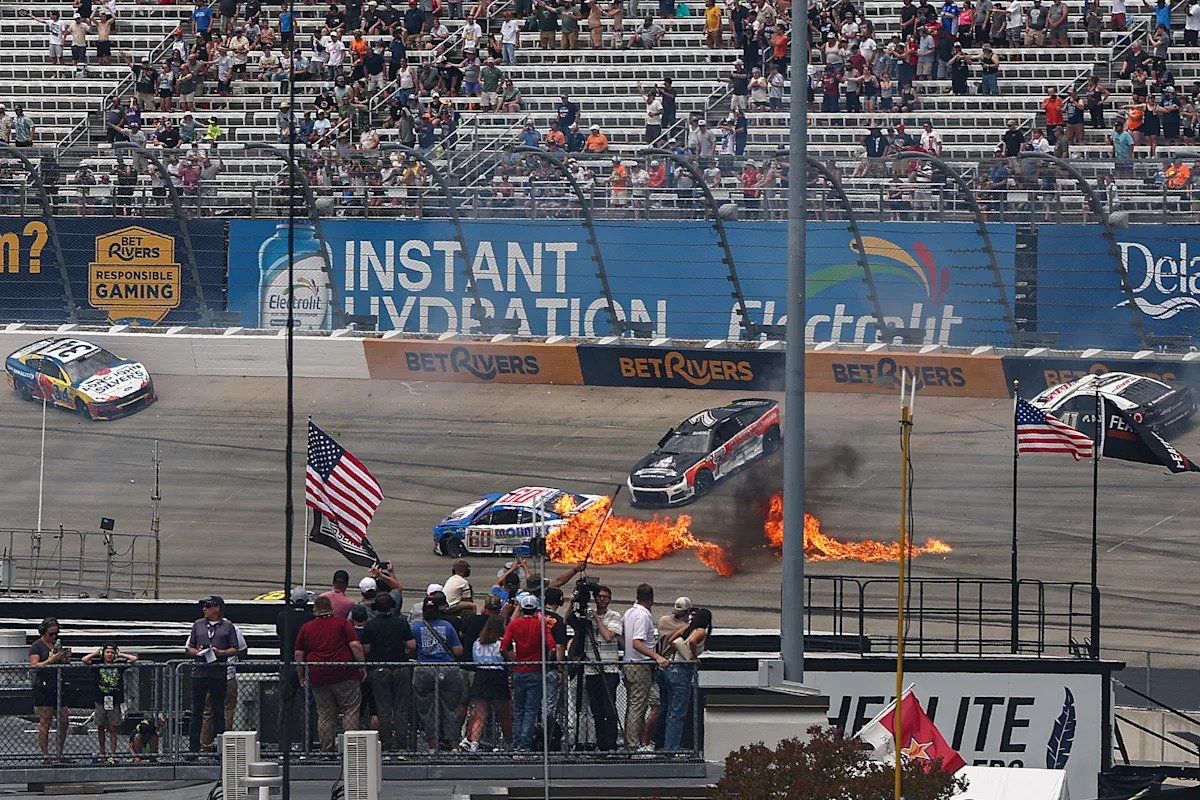
That feeling continued through the NASCAR All-Star Race at Dover Motor Speedway on May 17, a four-hour event featuring multiple multi-car crashes and a choppy format.
Advertisement
There is some sort of wretched poeticism in Elliott being involved in both nine-car crashes in the first segment after those comments.
The NASCAR All-Star Race was long and eventful, but not necessarily high on entertainment value.
Among the weird characteristics of an odd All-Star weekend at Dover:
-
A 90-minute practice, one of the longest of the year, for a non-points paying race.
-
Pit-road speeding penalties during the three-lap qualifying format, which included a pit stop.
-
A 1 p.m. Eastern time Sunday start for a 350-lap NASCAR All-Star Race, after years of social-media prodding by fans for more points-paying races to start around that time.
-
22 cars available for a 26-car invert after Segment 1.
-
Ryan Blaney, Kyle Larson and Chase Elliott’s all-star race chances ended before the end of Segment 1 after crashes caused by drivers not locked into the 26-car final segment.
-
The rules allowed for cars who wrecked in Segment 1 to get repaired during the first two segments and return in the final segment without penalty other than their starting spots. Blaney, Larson and others took advantage of this, though none factored into the race for the win.
RACE RECAP: NASCAR All-Star Race at Dover live updates, highlights, leaderboard
NASCAR should get a lot of credit for its scheduling changes in the 2020s. Largely, the changes have been positive with new tracks and new track styles. The Chicago and San Diego street courses are good ideas, and re-integrating North Wilkesboro and Bowman Gray Speedway into the schedule is an appropriate historical nod.
Advertisement
But the sanctioning body has not yet found a way to elevate its all-star race to stand out on the schedule in 2026.


Stage racing has robbed NASCAR All-Star Race of some uniqueness
Segments and field inverts are not uncommon in the all-star race dating back to the start of the event.
But until a decade ago, the NASCAR All-Star Race was the lone event with segments/stages. That helped the race stand out on its own from the other 30+ races on the schedule.
Now, each week has stages and stage breaks that dictate strategy and context behind each race.
Could this format work? With adjustments, sure. But there are more obstacles now than when the NASCAR All-Star Race was created in 1985. And the usage of the $1 million prize to win the race has aged out after first being introduced 23 years ago.
Advertisement
A 200-lap final segment following two 75-lap segments created a very lengthy afternoon at Dover, especially with the amount of early cautions. (It wasn’t the worst version of the all-star race, with a hat tip to the 2022 edition at Texas. That was a lowpoint for NASCAR in total.)
NASCAR has shown that it is willing to try different ideas to liven up the schedule, from adding tracks to creating the in-season tournament.
Its biggest challenge now is to find the right mix for its all-star race. The search continues after a long day in Dover.
This article originally appeared on Nashville Tennessean: NASCAR All-Star Race lacks identity after aimless Dover weekend

