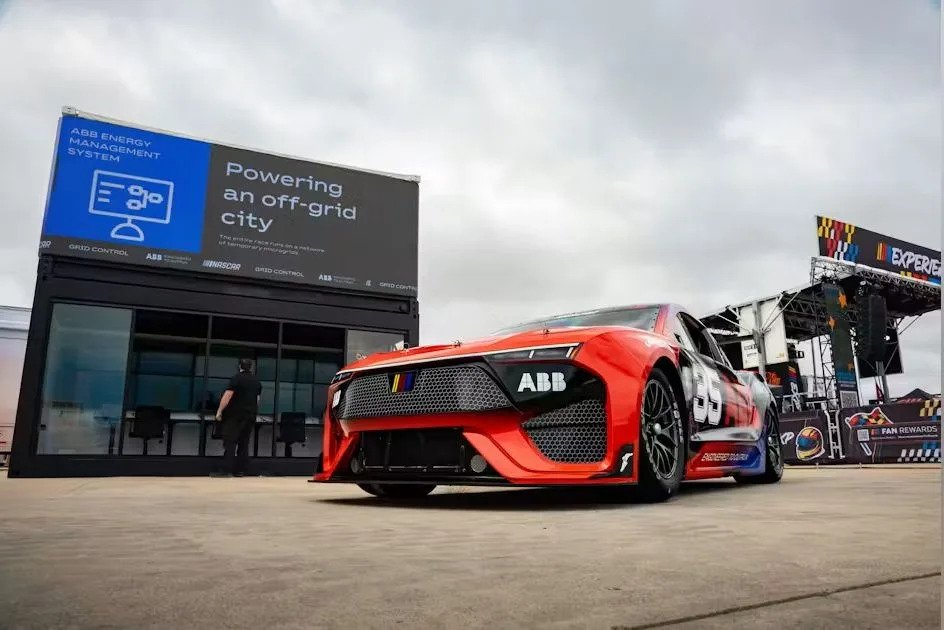
There was much about the logistics of the NASCAR weekend in San Diego that was remarkable but none greater than the fact that the power supply of all racing operations needed to be self-supplied.
Since the races took place on Naval Air Station North Island, an active military installation, the Anduril 250 Race the Base weekend could not compromise Air Force readiness in any capacity.
Advertisement
The layout of the circuit was strategically wrapped around the perimeter of the base mostly because running through it was not feasible. Practically, this prevented the facility from being overrun with civilians too.
Fans were stationed on the southernmost perimeter of the base.
But again, everything related to NASCAR could not draw power from the NAS North Island electrical grid, meaning the Sanctioning Body needed to collaborate with partners ABB on a viable and sustainable solution.
Advertisement
What they came up with was a network of microgrids, which was best articulated that weekend by ABB’s vice president of strategic partnerships, Chris Shigas.
“A microgrid is a self-contained power system,” Shigas said. “That means the power generation, the power transmission, and the power distribution.
“When you don’t have access to utilities and you’re off grid, you need to build a microgrid and we built a giant network of microgrids out here. And actually, the only bigger microgrid on Coronado Island is the United States aircraft carrier, and that’s nuclear powered, but it’s also self-contained.
Advertisement
“What we’re doing is an incredibly modern and innovative way to utilize hybrid battery energy storage to actually power this race. And it’s just more energy efficient.”
Specifically, the microgrid designed for San Diego weekend were 30 Battery Energy Storage System (BESS) combined with the corresponding traditional diesel generators. The diesel generators connected to each BESS only turned on for two hours a day and the BESS powered each microgrid for the remaining 22 hours each day over the weekend.
Advertisement
The spikes in the image below represent the generator kicking on and off throughout the day.
This is actually technology born from the inaugural Cup Series street course events in Downtown Chicago from 2023-to-2025. NASCAR’s managing director of vehicle systems CJ Tobin likened it to moving a ‘roving city into a market’ anytime they need more power than the local infrastructure can provide.
For NAS North Island, the ABB BESSes powered all motorsport activities for teams across all three national tours, everything that required electricity and pit road, fan experiences and all behind-the-scenes operations.
Advertisement
Tobin says NASCAR can take this model anywhere around the world to conduct a race.
“With the hybrid generators, bringing remote race controls to the track, we can carry this wherever we would like,” Tobin said. “It took an entire industry to be able to do this so kudos to everyone that had a hand in this — ABB, Suburban Propane, NASCAR, NASCAR R&D.
“All of us put our heads together and said, ‘How can we make this the most productive way to showcase what we’re doing together in this partnership with ABC?'”
Advertisement
That also meant showcasing NASCAR’s ability to do it in a sustainable way that builds on its continued efforts to be more green. That falls under the sanctioning body’s NASCAR Impact department, which aims for net-zero operating emissions by 2035 through the pursuit of 100 percent renewable energy, low-carbon sustainable bioethanol fuels, recycling and waste reduction.
This is the domain of longtime NASCAR executive Eric Nyqusit, who now serves as Chief Impact Officer, and all things sustainability. It’s also important to Nyquist that the pursuit of these goals do not compromise the racing product.
San Diego race weekend was proof of that on a scale.
Advertisement
“2035 is an ambitious goal, but we fully intend to get it done in a way that if you’re a race fan, it’s not going to have one iota of an impact on what you’ve observed and the product on the track, the way we continue to race, the combustion engines, all that,” Nyqust said. “None of that needs to change. What we’re doing is the other parts of it that we can do.
“So finding more efficient ways with our long haul transportation fleet, that will be a benefit to race teams as we work on that. Finding ways that we can power our racetracks more smartly. Reducing diesel generators and replacing them with electric power. … Less diesel fumes, brings down our dependence on fuel. It’s more energy efficient. It reduces our carbon emissions.
“Those are things we’re going to do to try to get win-wins across the board.”
Advertisement
Nyquist also said these sorts of endeavors are all about data. It was import for NASCAR and ABB to know exactly how sustainable that weekend was so they can continue to target ways to improve that model.
The final numbers from that weekend are in the graphic below.
Fans were able to see these figures in real time as part of ABB’s NASCAR Grid Control display. The display was a 20-by-8-by-18-foot glass pod that featured 11 live video feeds and data dashboards.
Advertisement
The display was modeled after a remote race control module.
The pod also featured displays similar to those are the legitimate remote race control room at NASCAR Productions in Concord, North Carolina but also live telemetry, advanced analytics and various camera angles.
It did not display anything proprietary to teams but the entire package showed fans what NASCAR is working towards from both a sustainability and enthusiast engagement perspective.
Advertisement
“This is obviously the first time we’ve ever done this and given fans access to see what we’re looking at,” Tobin said. “And we want to do this again, with more transparency, and at other tracks. We want to be more efficient, which is what we’re doing with ABB and tell their story too.
“But we also want to share what NASCAR is looking at behind the scene with folks the travel to our races the decisions that are being made and the data that supports it. We think people want to see that.
“Penalties get called and this is our way of showing ‘hey, this is what we saw,’ and ‘this is the data provided by our engineers, officials, and this is why we are making this decision.’ All of this are initiatives that we want to continue to push and I don’t think this is the last time you’ll see this at the race track.”
To read more Motorsport.com articles visit our website.

