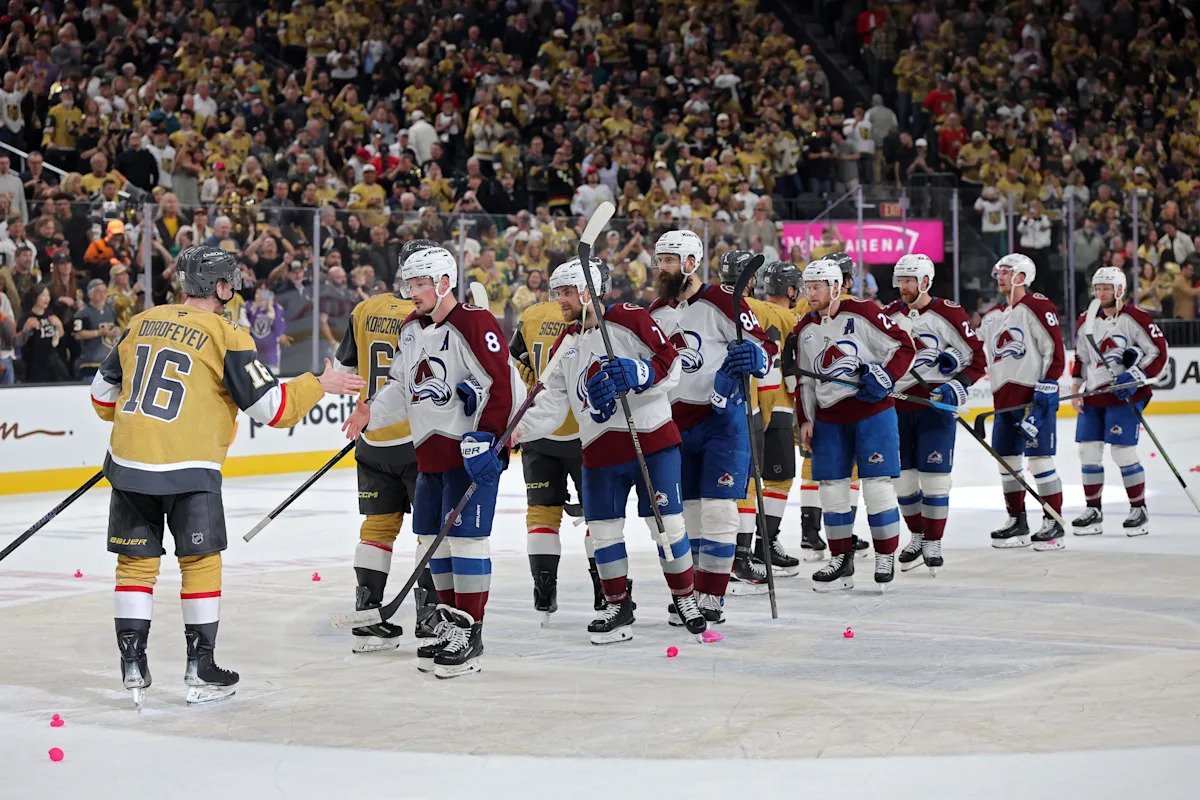
We are now a few days removed from the Colorado Avalanche being eliminated via sweep from the Stanley Cup Playoffs. After reading through a catalog of blame game articles and social posts, I’ve decided to make an entry of a different sort.
I’m not here to blame any one individual for what happened during Colorado’s cataclysmic meltdown that saw a team that was 8-1 through two rounds of playoff hockey waste 8 days and leave the bracket with an 8-5 record.
Advertisement
I’m more curious about how it happened and why.
The Avalanche and their fans got handshakes and heartbreak rather than the glitz and glory of another cup run, but what led to this collapse?
Cognitive Dissonance
If you ask me, it boils down to saying what you do, and doing what you say, and how the Avalanche as a whole has failed to live up to their systems-first messaging.
We are beaten over the head with “next man up” and “Buy into the system and the system will take care of itself”, but have seen management leverage young talent for “the perfect fit,” the coaching staff lean on and deploy top groups more than ever and when not even fully healthy, and top players refuse to embody the message in the most crucial moments.
Now consider that the bottom of the Avalanche forward group, which embodied the system and approach, was clearly the most effective group, yet still sat and watched an uncomfortable, hobbled Nate MacKinnon and Cale Makar attempt to wince their way to a comeback in the closing seconds of games three and four.
Advertisement
I’ll be super clear on one thing. I’m not suggesting you bench either Nathan MacKinnon or Cale Makar, but rather that you reward the guys who are buying in and give yourself the best shot of winning by doing so.
Problems Perculate on the Power Play
You know where I see contradiction most obviously? How Colorado approaches the power play.
Anyone who has followed the Avalanche season from start to finish knows that the power play was a hot-button topic all season after the Avalanche and their failure to execute on the man advantage last postseason dominated offseason narratives.
The power play struggled again during the majority of the regular season and in the postseason.
Advertisement
Adjustments were made to try to enable the highly talented top group, but in general, the Avalanche’s power play, with world-class talent, was nowhere near as effective as it should have been.
None of those adjustments panned out, yet it was still the first unit that consistently held the majority of the advantage. The second power play group that has a few players you just had to trade for hardly ever saw a look at more than 30 seconds of a power play. Most of the time, it takes 5-10 seconds just to enter and cycle. So basically, the second group constantly got one crack at making a difference, even when the top group clearly wasn’t.
Working Up the Leaderboard
Now that I’ve laid it out, I want to talk a bit about the power dynamic in Colorado, as I see leadership from players all the way up to management having a hand in the separation between philosophy and practice.
Advertisement
Let’s start with Captain Gabe Landeskog, who definitely bought into the system and was among Colorado’s most effective postseason players for two consecutive seasons now. Gabe no doubt has a unique perspective given his storied return to hockey, and was obviously in various shades of disappointment/frustration throughout the Vegas series.
When Jared Bednar was first brought on, here’s what Landeskog had to say about Bednar’s approach: “He wants to play fast. He wants to play quick and play in the O-zone and get on the forecheck. With our speed up front, I think it will benefit us. Spending less time in the D-zone will be something we’ll all be looking to do. The systems are going to work to our advantage.”
Based on Landeskog’s performance, he clearly appreciates Bednar’s strategy, and on paper, all of what he saw does fit this Avalanche squad. But what happens when your top guys try to red-cape it when the going gets tough?
Gabe is doing plenty, as far as I’m concerned, by leading by example and by saying what needs to be said. With that, I turn to the head coach and how he could empower Landeskog and get the top guys to hold the big picture dear, no matter how competitive and capable they are, or how much adversity they face.
Advertisement
Playoff hockey is like playing a game of stygian chicken, and Vegas never, not once, thought about changing course. They were going to go for a head-on collision or force the Avs to veer out of desperation.
The Avalanche did veer off course, playing like an insecure club without any answers for what was being thrown at them.
Vegas clogged the middle of the ice, stayed home, capitalized on Colorado’s mistakes, and said, “We can do this all night.”
Colorado responded by being perfectly content with the fool’s gold of perimeter looks, time and time again.
The message was “we gotta keep playing our game,” but in my opinion, they stopped playing Avalanche hockey in game two of the Western Conference Final.
Advertisement
Does the undeniable shelf life of Nathan MacKinnon and Cale Makar as Avalanche mainstays require that Jared Bednar cater to them to a fault for survival? Would he be let go quickly if he stood his ground or made more public statements about the specifics of his displeasure?
Did we see a passive-aggressive version of that with the “It’s up to Cale” phiasco? It’s impossible to say for sure, as vagueness is among the most-used tools in Bednar’s press bag.
If Bednar isn’t comfortable sticking to his guns to foster a pleased elite core, that presents a real problem.
The Great Divide
You don’t need to be a part of an NHL hockey team to know what a lack of accountability or consistency can do to a team. In business, if one employee sees another employee afforded benefits despite poor performance, it can be demoralizing. Moreover, if the message is “do your job,” but some are enabled not to do so, the whole group begins to lose respect for the process and leadership.
Advertisement
No one goes above and beyond for a boss who seems to do things that contradict his message.
The lack of accountability may lead to some division in the room, though I have no insight into that. On the surface, everything seems peachy (outside of disappointment), but that’s rarely the case when a team implodes like this.
I could apply this thinking to Jared Bednar as it pertains to his stars, but I really don’t think he, at his core, believes in catering to superstars over the team. If his actions contradict that, I have to look further up the leadership ladder to find a reason why, and I think I have one.
Starts at the Top
We can’t say Chris MacFarland caters to superstars if he traded one, right?
Advertisement
Well, from my vantage, MacFarland has officially leveraged every shred of futures for the Avalanche in hopes of getting at least one more cup from the current core, and it’s all been for not.
After dealing more picks for specific roles, the Avalanche are both without hardware or a clear path into the future.
If your coach says it doesn’t matter who plays and that it’s about the system, wouldn’t it be better to develop more young guns and play the long game?
We have examples of exactly that already working in Colorado.
Logan O’Connor, Sam Malinski, and others have survived being traded long enough to develop into effective NHL players, with LOC being a huge part of the team’s identity. Or at least that’s what we are told.
Advertisement
This whole article is riddled with hindsight and recency biases, but let’s take a look at some of the deals I view as challenging the idea that anyone can fill the roles in this system.
MacFarland leveraged Alex Newhook for Mikael Gulyayev, Ross Colton, and Gianni Fairbrother back in 2023, as Newhook was asked to fill in at 2C along with J.T. Compher when Kadri couldn’t be retained after a cup win.
Because he was unable to do so immediately and the pressure of a win-now window, Colorado elected to swap Newhook’s budding talent for a bona fide Stanley Cup Champion talent in Ross Colton. Rosco was good, but he was also scratched to start the playoffs, and Newhook has 10 points and has been Montreal’s clutchest player of the postseason in the here and now.
Advertisement
That youthful scoring touch and gamer mentality would have been nice this year, and, to be fair, Newhook showed he had it in 2022; otherwise, we wouldn’t have thought he could be a 2C for a competitor for 3 months.
Management also infamously swapped Bowen Byram in a one-for-one for Casey Mittlestadt, who lands pretty high on the list of biggest trade flops ever.
He now plays for the Bruins, as he was traded for Charlie Coyle ahead of last year’s playoff disappointment.
Charlie Coyle was subsequently traded with a throw-in of Miles Wood for Gavin Brindley (nice) and a couple of picks.
So, inevitably, Bowen Byram is traded for a young player with potential, but one that’s likely 2 to 3 years away (at the time of the trade) from being an NHL mainstay.
Advertisement
What was Bo up to this year?
Oh, just playing a pivotal role in getting the Buffalo Sabres back to the playoffs for the first time in 15 years, and posting 7 points in 13 playoff games.
I reiterate that I know I have the benefit of hindsight here. Still, the justification for leveraging Colorado’s fleeting surplus of back-end talent and young, not-quite-there forwards is that winning now matters. The Avalanche haven’t won anything beyond the regular season during this window. That’s a fact.
The Way Forward
This article sucks. It’s just me saying the easiest thing you can easily say about a team that didn’t live up to the hype, but it’s the hype I blame.
Advertisement
My colleague Ezra Parter at the Mile High Hockey Lab coined our catchphrase: “Hockey is random and difficult,” and I think it’s a bit of wisdom that the Avalanche should take into the thought process from top to bottom.
We officially know you can build a stacked roster, but you have enough small vulnerabilities that allow a team to dismantle the NHL’s scoringest regular-season team. Bednar himself said it takes some luck, but what it really takes is resolve and patience. Luck makes its appearance inside that mindset more often than not, but remember, luck is when preparation meets opportunity.
I see a way forward for this Avalanche team, but it’s going to hurt. Believe it or not, this loss may be just what the now-mature core needs to recommit to the process.
The Avalanche organization can’t buy the hype and has to get back to its philosophical foundations. They aren’t a team looking to change the culture and become competitive, as they were back in 2022. Now they are a high-flying, heavily decorated group of individuals set on living up to expectations.
Advertisement
I say get back to the mindset of never being bigger than the game, or the process, or your team. You win as a team, and you lose as a team. When you leave the team behind, losing happens much more often and quickly.

