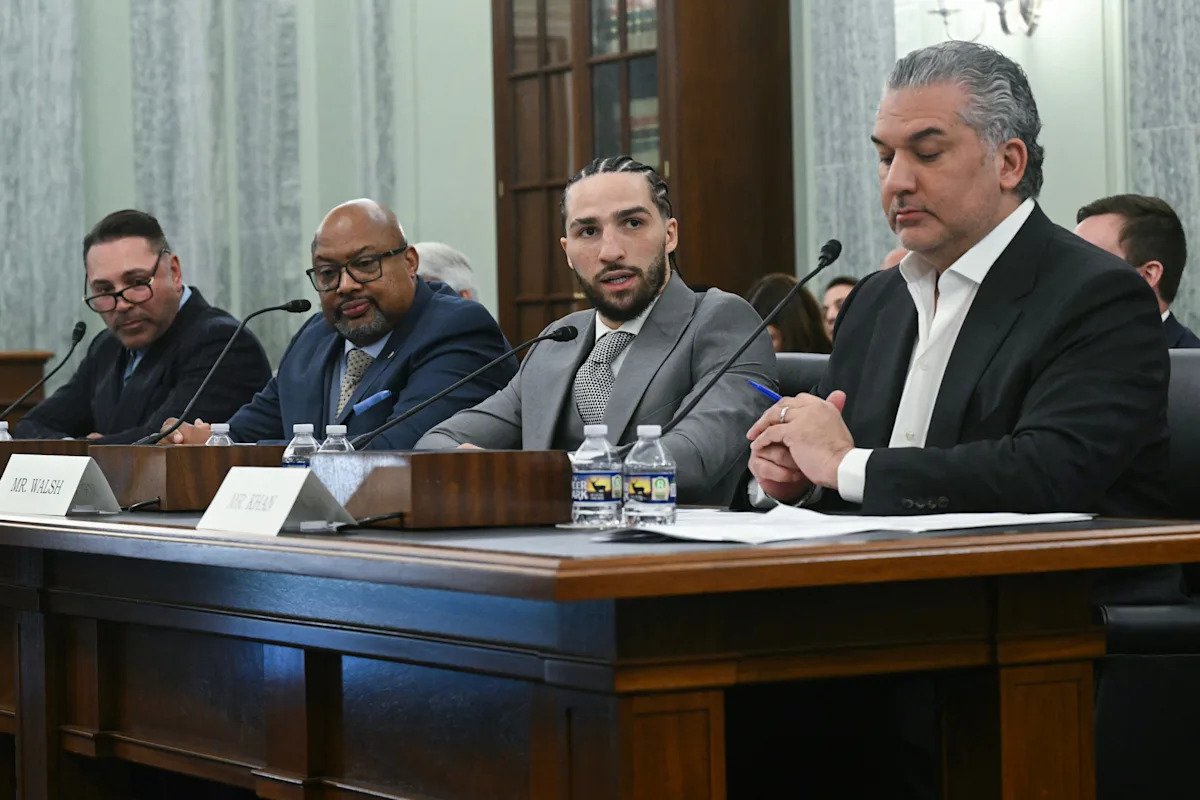
The Muhammad Ali American Boxing Revival Act of 2026 continues to make its way through Congress, with a stop Wednesday before a Senate committee.
Two proponents and two opponents of the proposed amendment testified before the Senate Committee on Commerce, Science and Transportation and answered follow-up questions from a few members, including Texas senator Ted Cruz (R), Nevada senator Jacky Rosen (D), and Ohio senator Bernie Moreno (R).
WWE president Nick Khan, TKO Holdings Group board member, and Florida Athletic Commission executive director Timothy Shipman, who serves as acting president for the Association of Boxing Commissions and Combative Sports (ABC), voiced strong support for the amendment that would allow for the entry of Universal Boxing Organizations (UBO) into the space, among other components.
In staunch opposition to the bill were boxing legend-turned-promoter Oscar De La Hoya and current boxer Nico Ali Walsh, the grandfather of the iconic boxer for whom the original 2000 bill was named. They cited the potential for a lopsided fighter-promotion revenue split, industry monopolization, and degradation of transparency.
Oscar De La Hoya, former professional boxer and CEO of Golden Boy Promotions, testifies during a Senate Committee on Commerce, Science, and Transportation hearing to “examine federal boxing laws” on Capitol Hill in Washington, DC, on April 22, 2026. (Photo by SAUL LOEB / AFP via Getty Images)
Khan, who is most directly attached to the bill’s construction, centered his arguments around health standards and perceived lack of organization in boxing, painting a picture of chaos and citing how weight classes have multiple champions. He argued the amendment would allow for bigger fights to take place, and said things like television deals, live events, and boxer merchandise would flourish.
“This bill delivers concrete protections that are long overdue,” Khan said. “… It’s for safety and fair treatment of the boxers. If that disqualifies you from forming a UBO, the problem is not this bill.”
De La Hoya and Walsh, however, offered different takes. De La Hoya forecasted the amendment would allow for the boxing industry to begin down a path similar to that of MMA, also comparing it to LIV Golf. He pointed to the recent antitrust lawsuits against the UFC, including the $375 million settlement the promotion reached with a class of former fighters.
“This is a fundamental shift in power, that if changed, would put corporate profits first and fighters second,” De La Hoya said.
Walsh echoed many of De La Hoya’s sentiments and brought up the frequent occurrence of MMA fighters chasing boxing fights and begging for more money. He said that if the bill passes, his grandfather’s name should be removed from the name.
“Fighters are labeled independent contractors,” Walsh said. “As a result, people will say fighters will have options, that we can just go elsewhere. But when the same company controls who you fight, how you’re promoted, and whether fans ever see you, it’s not much of a choice. When one system controls access, choice becomes theoretical – not real. The Ali Act was built on a simple principle.
“… We can protect fighters more effectively than we do today without concentrating control over them. If this bill is passed in its current form, it should not have my grandfather’s name on it, as it would betray the principles that his act was created to protect.”

Nick Khan, President of World Wrestling Entertainment (WWE), testifies during a Senate Committee on Commerce, Science, and Transportation hearing to “examine federal boxing laws” on Capitol Hill in Washington, DC, on April 22, 2026. (Photo by SAUL LOEB / AFP via Getty Images)
The proposed amendment has already passed in the U.S. House of Representatives in March, but now needs Senate approval. Senators Cruz indicated at the conclusion of Wednesday’s hearing that the bill would likely be modified prior to it going up for a vote.
Senators will have until April 29 to submit questions, with witnesses having until May 13 to provide answers to those questions.
Should the Senate pass the amendment, it will go to the desk of president Donald Trump, who then could sign it into law.
You can watch the full hearing in the video above.

US professional boxer Nico Ali Walsh testifies during a Senate Committee on Commerce, Science, and Transportation hearing to “examine federal boxing laws” on Capitol Hill in Washington, DC, on April 22, 2026. (Photo by SAUL LOEB / AFP via Getty Images)
What is the Muhammad Ali American Boxing Revival Act?
A bill co-authored by Republican congressman Brian Jack and Democrat congresswoman Sharice Davids was introduced in July.
The amendment would allow for the operation of UBOs or Unified Boxing Organizations, which could operate outside of the bounds of a sanctioning body. This system would operate with minimum pay per rounds for boxers and allow for organizational titles, rather than sanctioning body titles.
Opponents of the amendment say it would allow TKO to gain control of the market and suppress fighter pay by skirting around the current Ali Act’s constructs intended to elevate competition in the marketplace and lead to more protections for boxers.
This article originally appeared on MMA Junkie: Oscar De La Hoya, Muhammad Ali’s grandson testify against TKO-backed boxing bill

