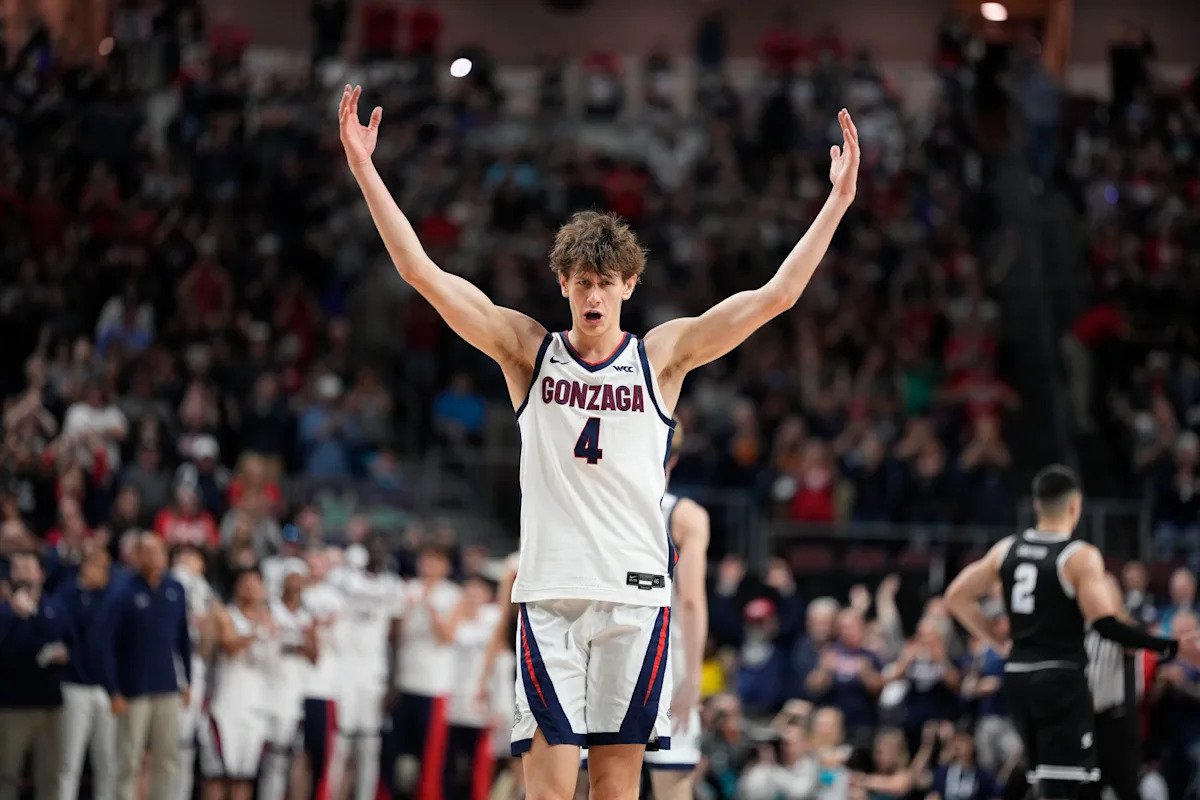
In August of 2024, I published the first article I ever wrote for this site. It was a preview of Davis Fogle, Gonzaga’s most exciting incoming recruit, and I spent most of it arguing that fans should cool their expectations. Few rarely plays freshmen, I wrote. Fogle would probably come off the bench. He might have to learn a new position. He was closer to Dusty Stromer than Jalen Suggs. The hype, I implied, was getting ahead of the reality.
I wasn’t wrong exactly. But I wasn’t entirely right either, and the gap between those two things is, in retrospect, the most interesting part of Davis Fogle’s freshman season.
Fogle finished 2025-26 having played in all 30 games with one start, averaging 8.6 points, 3.1 rebounds, and 1.3 assists in 16.8 minutes per game on 51.8% shooting from the field and 35% from three. Those are solid numbers for a freshman coming off the bench, and they don’t fully capture what those of us who watched every game already know: Fogle didn’t just survive his first year in Spokane. He grew into it, steadily and visibly, until by March he was one of the more dangerous players on the floor in the WCC Tournament and a genuine factor in the NCAA’s first round. He enters his sophomore year with significant momentum and, among the people paying attention, a reputation as one of the more likely breakout candidates in the conference.
The Season: Before and After January 14th
Davis Fogle’s freshman season happened in two distinct phases, and the dividing line between them was January 14, 2026, the day Braden Huff dislocated his left knee in practice.
Advertisement
Before Huff’s season-ending injury Fogle was a bucket-getter in blowouts. Through the opening stretch of the season, the 20z25-26 Zags looked like the deepest team Few had ever assembled, with nine different players averaging between 16 and 26 minutes per night. Fogle appeared in nine of the team’s first 13 games mainly in garbage time, averaging just eight minutes but nearly seven points per contest in that span. When he got bigger minutes he was hard to ignore: 45 points in 43 total minutes across three games against Texas Southern, Southern Utah, and North Florida, shooting 67.8% from the field. The honest read on those performances, though, was that they did not necessarily translate to tighter games, stiffer competition, or a bigger stage. On the year to that point, while he was lighting up teams in the final 10 minutes, he had also recorded four assists and five turnovers.
Before his injury, Huff was averaging 17.8 points per game on 66.2% shooting, leading the nation in total field goals. His absence created a scoring vacuum and, for Fogle, a path into meaningful minutes. January 22nd against Pepperdine: 17 points, 8-of-10 from the line. January 25th against SF: 15 points and 9 rebounds in 32 minutes, the first time Few trusted him in a close game. February 11th against WSU: 17 points, 8-of-11, three blocks, three steals, his most complete performance of the season. Over the 11 games following Huff’s injury, Fogle averaged 10.9 points, 4.0 rebounds, 1.5 assists, and 0.9 steals in 22.5 minutes, scoring in double figures six times.
Defensively, his length produced real results by the season’s post-Huff second half: 14 blocks and 21 steals on the year, a steal-to-turnover ratio of 1.1. The WCC Final against Santa Clara (13 points, eight rebounds, six assists, two steals in 27 minutes) was his broadest stat line of the year. Over the final 14 games including the postseason, he averaged 24 minutes and 11 points per game. That’s not a role player who found a niche. That’s a player who was, by March, one of the five most impactful guys on a 30-win team.
Advertisement
What I Got Right, What I Got Wrong
In the 2024 preview, I made several specific, falsifiable predictions about what fans could reasonably expect from Fogle. The bench call was correct. Fogle started one of 30 games and averaged 16.8 minutes. That’s roughly where my accuracy peaks.
I wrote that he was “skills-wise more akin to Dusty Stromer than he is Jalen Suggs,” and offered the Hunter Sallis scenario as a genuine risk: “a player of jaw-dropping potential who just never got comfortable with his role in the rotation.” Neither comparison held. Fogle shot 52% from the field in under 17 minutes a night, which is a player being selective and efficient, not a player searching for his footing. His scoring efficiency ranked fifth on the roster, ahead of veterans Braeden Smith, Tyon Grant-Foster, and Adam Miller. I spent a fair amount of words in that piece urging fans to temper their expectations. Fogle spent the season making me look like an idiot for it, and I couldn’t be happier about that.
The one prediction that held up was the Julian Strawther parallel, specifically that Fogle’s size and shooting profile would push him toward the wing regardless of how he was recruited. He’s still listed as a guard, but his 1.2 offensive rebounds per game in 17 minutes, his 14 blocks on the season, and the way his best scoring performances came in space rather than off ball screens all point to a player already functioning like a wing. That one I’ll take.
Advertisement
Why 2026-27 Could Be Something Special
In 2024 I suggested that Davis Fogle was probably closer to Dusty Stromer than Jalen Suggs, urged reasonable expectations, and got humbled for it. So when I tell you the case for a breakout in 2026-27 is genuinely compelling, understand that I am a man who has learned his lesson.
Jalen Warley, Emmanuel Innocenti, Tyon Grant-Foster, Steele Venters, and Adam Miller are all gone. Fogle is understood to be one of the focal points of Gonzaga’s offense as a sophomore, expected to contribute in a much bigger way. He enters the year as a likely starter alongside a healthy Braden Huff and Mario Saint-Supery on a roster that will otherwise be extremely inexperienced and new to the system.
The Strawther parallel is worth taking seriously in this specific context. Strawther averaged 3.4 points per game as a freshman before stepping into the starting lineup as a sophomore and averaging 11.8 points and 5.4 rebounds. By his junior year he was averaging 15.2 points and 6.2 rebounds and went in the first round of the NBA Draft. That trajectory is precisely the arc Fogle is now positioned to follow, with the difference that Fogle’s freshman efficiency was already better than Strawther’s was at the same stage.
Since the season ended, Fogle has been putting up 500-600 shots per day and has been in the film room with assistant coach Stephen Gentry twice daily. His stated priorities are adding strength, refining his three-point shot, and deepening his film work. His 35% from three is functional but not yet a weapon. If that number climbs toward 40%, opposing defenses will have a significantly harder problem on their hands.
Advertisement
The one real caveat is the Pac-12. The competition is meaningfully stiffer than the WCC, and players who look dominant in one conference sometimes need an adjustment period in another. Fogle’s athleticism and finishing should translate. The three-point shot and defensive consistency will be tested more rigorously than they were last year.
The hype two years ago was not misplaced. It was just early.
What Comes Next
Fogle’s 2027 NBA Draft stock has already been climbing, with scouts projecting him as a potential lottery pick if his three-point shooting develops. The consistent scouting concern is an inconsistent release from three and a frame that still needs to fill out. Those are fixable problems. If the sophomore season goes as expected, there is a real chance this is the last full year we get to watch him in a Gonzaga uniform.
Advertisement
Based on his late-season production, his projected starting role, and the departure of the veterans ahead of him, here is a reasonable stat line for 2026-27: 30-32 minutes a night, 15-17 points, 5-6 rebounds, 2.5-3 assists, shooting 48-52% from the field and somewhere in the 38-40% range from three if the offseason work pays off. His 3.1 rebounds per game in limited minutes last year already suggested someone with real instincts on the glass, and more floor time should push his rebounding numbers up significantly. The Pac-12 is a legitimate step up in competition, and a slight efficiency dip wouldn’t be surprising or alarming. What would be alarming is if the three-point shot didn’t improve, because a credible threat from deep is essentially a prerequisite for the next level.
Two years ago I wrote that Davis Fogle had “a tough row to hoe.” He did, and he hoed it. If the sophomore season goes the way the evidence suggests it might, I may be writing a very different kind of recap this time next year, probably one that includes the words “NBA Draft” and “lottery pick.” In the meantime, unlike I did in August of 2024, I am not going to be the one urging reasonable expectations for the 2026-27 season.

