The Seka ExAero GR frame aims to compete with the best gravel bikes. It bears a striking resemblance to the Chinese brand’s Spear aero race bike, its answer to the Specialized Tarmac SL8. There is good reason for this. When developing the Spear, Seka introduced the WindEye aero element at the rear of the bike, designed in conjunction with AeroCoach. Not only does this result in lower drag figures, especially with a rider fitted to the bike, but it also boosts rear compliance significantly, which is important for gravel riding.
Design details
Seka states it has designed the frame using a mix of CFD (computational fluid dynamics) and wind tunnel testing. We can confirm that the Seka Spear performs well in the wind tunnel, at 40km/h anyway, as tested by our sister publication Cyclingnews. Seka also provides a highly transparent White Paper on the design and testing of the frame, something refreshing to see. Testing in the wind tunnel was conducted at yaw angles from -20 to +20 degrees in 2.5-degree increments at a speed of 40km/h, the upper-end average for professional gravel races based on post-race analysis. Using the aero bottles, which are claimed to save 4.6w at 39km/h compared to round bottles, tested against a Seka Spear with round bottles, similar-width bars, but with road wheels and tyres vs the ExAero GR with 45mm tyres, the ExAero GR was only 9.9w slower. This increased to 14.5w once you account for the bottles, but then some of that added drag will be the 45mm tyres. Regardless, impressive for a gravel bike.
When designing the frame, Seka first looked at the speeds and equipment used at the world’s biggest gravel races. This led to the quoted tyre clearance of 56mm at the front and 52mm rear. Based on the measured widths of the tyres fitted, this rings true with 4mm clearance either side to account for excessive mud to avoid any frame rub. Impressively, the chainstays are so thin that, as well as accepting 52mm tyres, they also allow for a crank-based power meter such as a 4iiii; on a gravel frame like the Cannondale Topstone, for example, the wider chainstays don’t allow for this without frame rub on the power pod.
Latest Videos FromCycling Weekly
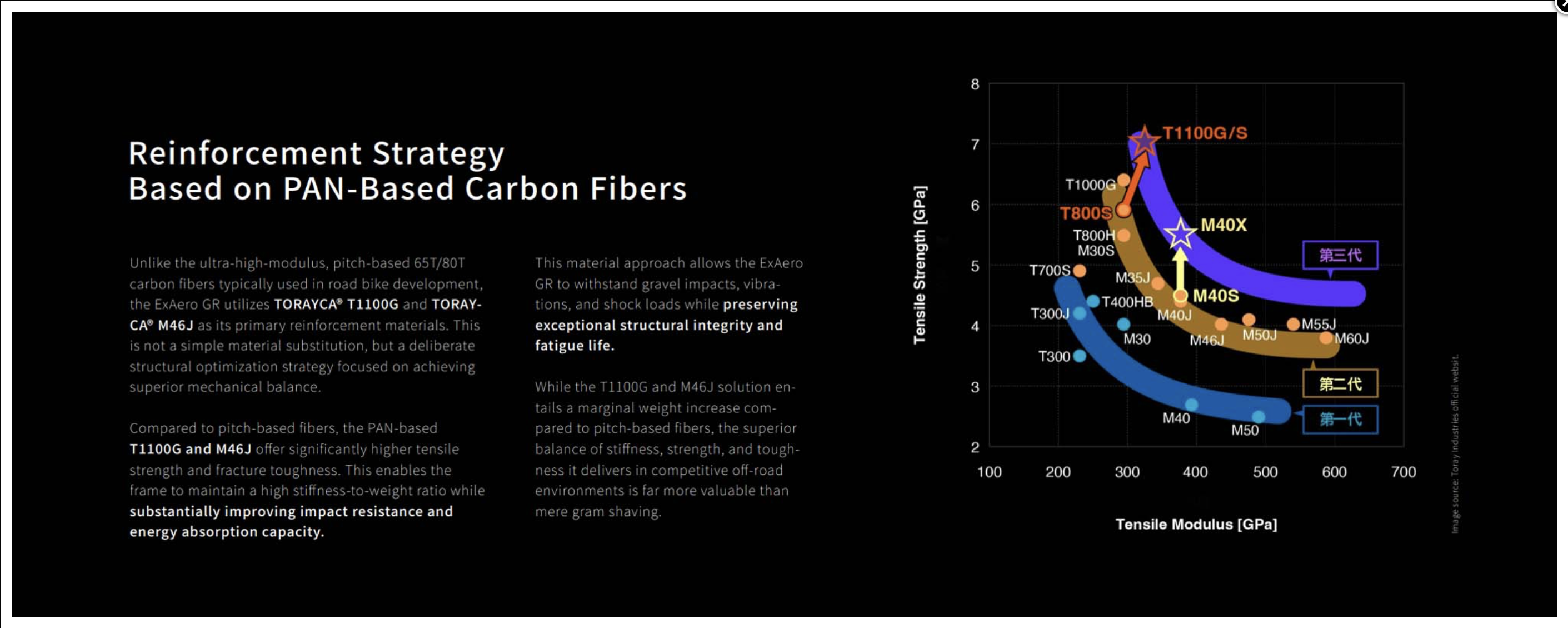
Details around the carbon used and the reasons why in the frame. Part of a fairly transparent White Paper
(Image credit: Seka Bikes)
I will add that Seka also tested tyre widths and the effect on aero performance and found the difference between a 45mm F/R vs a 50mm F/R was only 2.5w across all yaw angles.
In terms of frame design, some narrowing of tubes, such as the chainstays, did require additional structural support. Seka claims that the lateral stiffness in this area is slightly better than the Spear. Actual numbers quoted are 25.63Nm/mm (force required to deflect the frame by 1mm laterally), while rear triangle vertical compliance is quoted at 106Nm/mm.
Added to the frame is a magnetic internal frame storage. This unlatches easily, and inside a zip-up pouch can accommodate various tools and spares. There is also mounting for bottle cages or bags on the top tube, under the down tube, or behind the seat post. The seatpost itself is clamped with two small bolts at the rear of the seat tube and comes in 0 mm and 15mm offsets. I would advise covering these with tape when gravel racing to avoid them filling with dirt. Finally, frame protectors are fitted to the down tube and BB, as well as to the drive-side chainstay.
Complementing the frame is the Gladius GR one-piece handlebar. This features a 16˚ flare, three width options, and five length options, allowing adjustability at the point of purchase. Without hardware and a computer mount, the 400/460 x 90mm combination weighs a claimed 395g. Reach is 69mm, and drop is 118mm. A rearward flare on the tops, along with an anti-slip coating, is aimed at boosting comfort and control off-road.

(Image credit: Seka Bikes)


Six frame sizes are available, from 49 to 61cm. As the wheelbase increases with size, the trail drops to maintain a balance between stability and agility.
Quoted weight is 980g for an unpainted frame without hardware in size 54cm, but of course, once the internal storage, seatpost, fork, and bars are added, that increases. For comparison, the Cannondale SuperX Lab71 is quoted at sub-900g for a painted size 56cm and ~1,000g for the non-Lab71 spec, while the new Specialized S-Works Crux 5 is quoted at 789g for a 56cm painted frame but 897g for the S-Level frame.
Specifications
For finishing the build, I opted for the Shimano GRX RX820 2×12 groupset (the frame is SRAM UDH-compatible, too). This was mainly to achieve a wide gear range without large jumps between gears so I could keep at my preferred cadence across a range of terrains, and all my wheels use a Shimano freehub. It’s not as light as SRAM Red AXS XPLR, but it costs a lot less, and functionality-wise I do enjoy Shimano. Additionally, this latest groupset includes more features in the E-Tube app as well as hardware-wise.
The bottom bracket is a T47 External BB from WolfTooth. With external and internal seals, it offers lots of protection against dirt and dust typically encountered during gravel races.
The wheels on test are the No.6 G45R 45mm deep gravel wheelset shod with Pirelli Cinturato Gravel M tyres.
Performance
Riding the Seka ExAero GR has been quite a joy in most regards. The geometry of the bike suits me very well, and my biggest plus is the customisation at the point of purchase. I do not ride in a conventional position because I have a long torso and arms and relatively short femurs. This means on larger frames I need an inline seatpost, and a long stem. However, I prefer narrower bars. If I were to get a Specialized for example, it would come with 172.5mm cranks, setback seatpost, and 42cm bars if I was lucky. Here, I can select zero off-set post, and the 120mm x 38cm bars.
Position-wise, the Seka offers a setup that feels more like modern race geometry. The stack is relatively high, but the reach is plenty long enough. It strikes a good balance between stable handling and not being either aggressively long and low or excessively short and high, which would otherwise require a super-long stem to achieve a more race-focused position. Having a 120mm stem is a nice sweet spot for me between the more relaxed steering at higher speeds and the nimbler changes in direction at lower velocities. Around the technical trails in the Forest of Dean, it proved to be snappy and agile yet stable and fast across the fire roads.

(Image credit: Finley Cole / Velo Seventeen)


The flared bars blend a narrow, aerodynamic hood position with a wider, more controlled, high-leverage position in the drops. The drop is quite shallow, so while not best suited for high-speed cornering on the road, off-road it gives you a great position of stability and strength. I also really like the semi-textured tops, which are useful over bumpy terrain in wet conditions. From my testing to date, the bars aren’t excessively stiff as to be uncomfortable, yet sprinting hard in the drops yields no tangible degree of flex.
The biggest bonus of this bike is the WindEye, which, as mentioned, is designed to offer aerodynamic benefits (I’ll get onto that later) but also add compliance. Racing the Gralloch, a notoriously bumpy gravel race, I was pleasantly surprised that by the end of the event, I frankly had no rear end discomfort, which I have had in previous gravel events while using identical width and pressures on the rear tyre. I’m comparing this to my Cannondale Topstone, a bike with a small suspension pin at the rear. The fact that the Seka feels more comfortable is impressive, but it lacks the compressed squish sensation when putting down power that the Topstone can deliver.
As for tyre clearance, the 45mm tyres I raced with measured 47mm actual, and the the 50mm tyres I fitted measured 53mm. This did cause some rub, due in part to the more aggressive tyre knobs as well as exceeding the recommended clearance. Impressively, these tyres can be accommodated along with a 2x chainring, and even the aforementioned crank arm power pod.

(Image credit: Future – Andy Turner)


Seka has achieved this with razor-thin chainstays, but it appears to come at a compromise. I am admittedly riding a larger frame, so longer tubes allow for greater movement at the end of the ‘lever’ or tube. Seka assured me that the new chainstays were designed to be stiffer than those on the Spear, while the frame geometries were adjusted to account for different frame sizes and stresses. However, I still found that the lateral stiffness at the rear was lacking. At a more regular power and pace, this was not an issue. Riding at 200-270w everything felt good and shifting worked well. However, when upping the power to higher levels, such as 360 watts and above, I found that shifting quality deteriorated; the lateral flex at the rear of the bike was so pronounced that the chainline was disrupted.
I tested this with four sets of wheels to ensure it wasn’t a wheel-stiffness or hub-bearing issue, and it occurred each time in the same manner. It is more likely to happen on a gravel frame than on a road frame, as longer chainstays mean that, for example, one degree of flex at the BB end of the chainstay results in a larger lateral distance traveled than on a shorter tube. I think the reason for this flex is, firstly, that I am a larger and more powerful rider relative to the overall cyclist population, and secondly, that the aggressively profiled downtube into the BB and the thin chainstays result in a kinetic chain that lacks lateral stiffness. Some bolstering of the BB junctions and increasing chainstay stiffness would likely go some way toward solving this, especially since lateral stiffness has limited impact on the vertical compliance associated with comfort.
I have also been using this bike on the road a lot. I generally use a gravel bike for winter riding thanks to mudguard mounts, large tyre clearances, and frame storage for added spares. No mudguard mounts here though. What has been impressive about the Seka ExAero GR is that, when riding at 30-40km/h, it really does roll along like an absolute rocket. For fast-paced group rides and longer slogs, it holds speed very well. Handling is obviously not as sharp as a dedicated road bike, but I won’t criticise it for not being as good at something it has not been designed for. Indeed, this has now become my preferred bike for riding on the road. I have a Factor Ostro VAM (Gen 1), but based on my experience, the Seka feels faster at my average ride speeds. For a bike that can be used for gravel riding and racing, as well as on the road come rain or shine, the Seka ExAero GR is an attractive offering.

(Image credit: Future – Andy Turner)


Another super feature of this bike is the fitment points, which give a great degree of flexibility. For flat-out gravel racing, you can limit the use of additional fittings. There is a bolt-on top-tube bag spot, which was common at Unbound this year for aero savings and practical storage. There are also additional bottle mounts on the seat tube (bolts not included) and on the downtube. The downtube features a rubber frame armor fitting, which is perfect for gravel, with an additional one fitted on the top and sides of the drive-side chainstay. These are both areas I have frankly pummelled on my Topstone, so this inclusion is ideal for greater frame longevity. Internally, this downtube fitting also houses the Shimano Di2 battery, which is easily accessible. This lowers the centre of mass slightly compared to the seatpost, and makes it less likely to have an issue where the battery slips down and is a pain to retrieve. This does, however, impact the downtube storage space when the battery is fitted.
As for the storage, it’s great. The magnetic clip proved incredibly secure over the roughest terrain. In terms of storage, I have been able to fit a tyre lever, tubeless plugs, TPU gravel tube, and if not for the Di2 battery, I reckon another tube could fit in there as well. It’s neat, it’s aero, and it works well.
The storage also highlights another positive. When getting the bike built up, the mechanic was very impressed by the frame’s internal quality. No messy-looking joins at the headtube or around the internal storage. The tolerances around the headset and bottom bracket were all spot on, an area that can often be lacking even in some traditionally higher-end brands. It’s something to consider when doing a frame build, as full bikes from a bike shop only make it to the shop floor if the frame has passed muster.
The frankly stunning paint job has garnered awed looks from riders on the group ride and passers-by. Whereas Chinese brand bikes have traditionally been looked down on (even though many well-established European brand frames are made in Asia), this has been a bike that has attracted interest and turned heads. It looks the part, and for much of my testing, it has played the part, too.

The bike worked very well at the notorious Gralloch race, resulting in a Worlds qualification comfortably
(Image credit: Future – Andy Turner)
I have loved riding this bike. The lateral stiffness is a limitation for a rider like me in some situations, namely big power attacks or sprints, but, quite frankly, I’m not at the pointy end of UCI races often enough to require these efforts regularly. I’ve still nabbed some Strava KOMs that require efforts of 600w+ for a minute, so although it feels less stiff, it still goes fast. Plus, based on Gralloch, chugging along at 300w average for a day on gravel, it works brilliantly. As a gravel bike that is fast at the speeds it needs to be, comfortable and capable across a broad mix of terrains, and practical for storage, this is superb. A new S-Works Crux 5 will be lighter, and maybe a bit more aero (it might not), but it won’t have adjustment at point of sale, and the frame costs £3,000 more. This entire build costs around that with high-end wheels and an electronic groupset.
I will also add that a previous concern around Chinese frames has been aftermarket customer care. This will likely still not be as straightforward as going to the local bike shop and dealing with the brand through them. However, European dealers are becoming more common for Chinese frames, so customer care should become easier, with spares more readily available without the high shipping costs.
There is a big shift in the industry now, with Chinese brands applying the same engineering skills that have created some of the best bike frames on the market to their ‘own brand’ frames. Some of these brands are now recruiting aerodynamicists and CFD specialists, testing with pro teams to gather rider input, and marketing aggressively in much the same way established Western brands do. As a result, frames like the Seka ExAero GR will become more commonplace, and at present, they are plenty good enough to compete with the big hitters. Granted, some refinements are still needed, but when you factor in the price, this is a highly competitive offering in the gravel-race market.
Value

It certainly looks premium, but the price does grow once the bars and seatpost are added, pushing it closer to those high end competitors
(Image credit: Future – Andy Turner)
At £2,205.19/ $3,299, the Seka ExAero GR is certainly not at the price point that many people would traditionally associate with a Chinese frame, with an additional $539 for the bars and $229 for the seatpost. The Seka features strong quality control, independent research to develop innovative solutions such as the WindEye, and a paint job that puts many established European or American brands to shame.
Other offerings in a similar vein include the Tavelo Grow. As a frameset, it’s a bit cheaper at £1,217/ $1,650 and features equally large clearances and internal storage. You can also get the Winspace G3 gravel frameset for £1,142/ $1,550. However, neither of these frames has quite the same finish quality as the Seka, and while I haven’t tested them, the WindEye has proven to be an impressively comfortable addition for a gravel bike that makes a big difference to performance.
Of course, there are also the high-end brand offerings that the Seka aims to dethrone. The Cannondale SuperX Lab71 (£4,950/ $4,999), Specialized S-Works Crux 5 (£5,249/ $5,799), Cervelo Aspero-5 (£5,000/ $5,500), and Argon18 Antimatter (£4,395/ $4,999) are all at least £2,000/ $2,500 more expensive for just the frameset, even with the seatpost included in those prices. They are also often limited to only the highest specification frame offerings as a frame-only build. If you do buy a complete build, you may need to change the bar width, stem length, seatpost setback, and crank length, so expect additional outlays.
I will say that compared to these bikes, the Seka is quite a close competitor. It is fast. I can’t give a wattage or savings figure, but it’s certainly not lacking compared to other aero-focused gravel race frames. The only area I feel it lacks is lateral stiffness, where even my Cannondale Topstone 3 wins out. But for gravel racing, this has not had a discernible impact on performance, while the quality of the frame, finish, and features are all genuinely up there with the best. Weight is another factor, as many of these £4k+ frames are around 100-150g lighter. But in practical terms, this makes a very small difference to performance, and likely not one worth £2,000/ $2,500 for most people.
It’s probably not the best value frame you can go for compared to lower-end offerings from the big brands, and customer care is still not as simple as going to the local bike shop. But for a high-end gravel race bike build, I’m genuinely astounded by how good this bike has been when compared to the high-end offerings from the big European and American brands.
Tech spec
- Price: £2,205.19/ $3,299
- Frame: Toray T1100 and M46J carbon fibre
- Fork: Toray T1100 and M46J carbon fibre
- Size: 49, 52, 54, 56, 58, 61cm
- Tyre clearance: 56/52mm front/rear
- Bottom bracket: T47 threaded
- Thru-axle: Front (12 x 100mm), Rear (12 x 142mm)
- Cable routing: Internal
- Weight: 980g (frameset, 54cm)

