You could say that Sweet Protection is the new kid on the block. Despite the Norwegian brand being around for the last 25 years, it didn’t actually start in cycling. Instead, Sweet Protection first launched in the worlds of skateboarding, snowboarding and freestyle kayaking.
But when the Norwegian powerhouse, Uno-X Mobility, started winning stages at the Tour de France, it was only a matter of time before Sweet Protection made its way into cycling. In addition to road racing, you may also recognise Sweet Protection helmets from gravel racing, light on the heads of PAS Normal professionals.
It’s clear that Sweet Protection sees the Falconer Aero 2Vi Mips Helmet measuring up to the rigours of professional bike racing. But is it also an ideal helmet for an everyday bike rider? Let’s find out.

Construction

(Image credit: Zach Nehr)
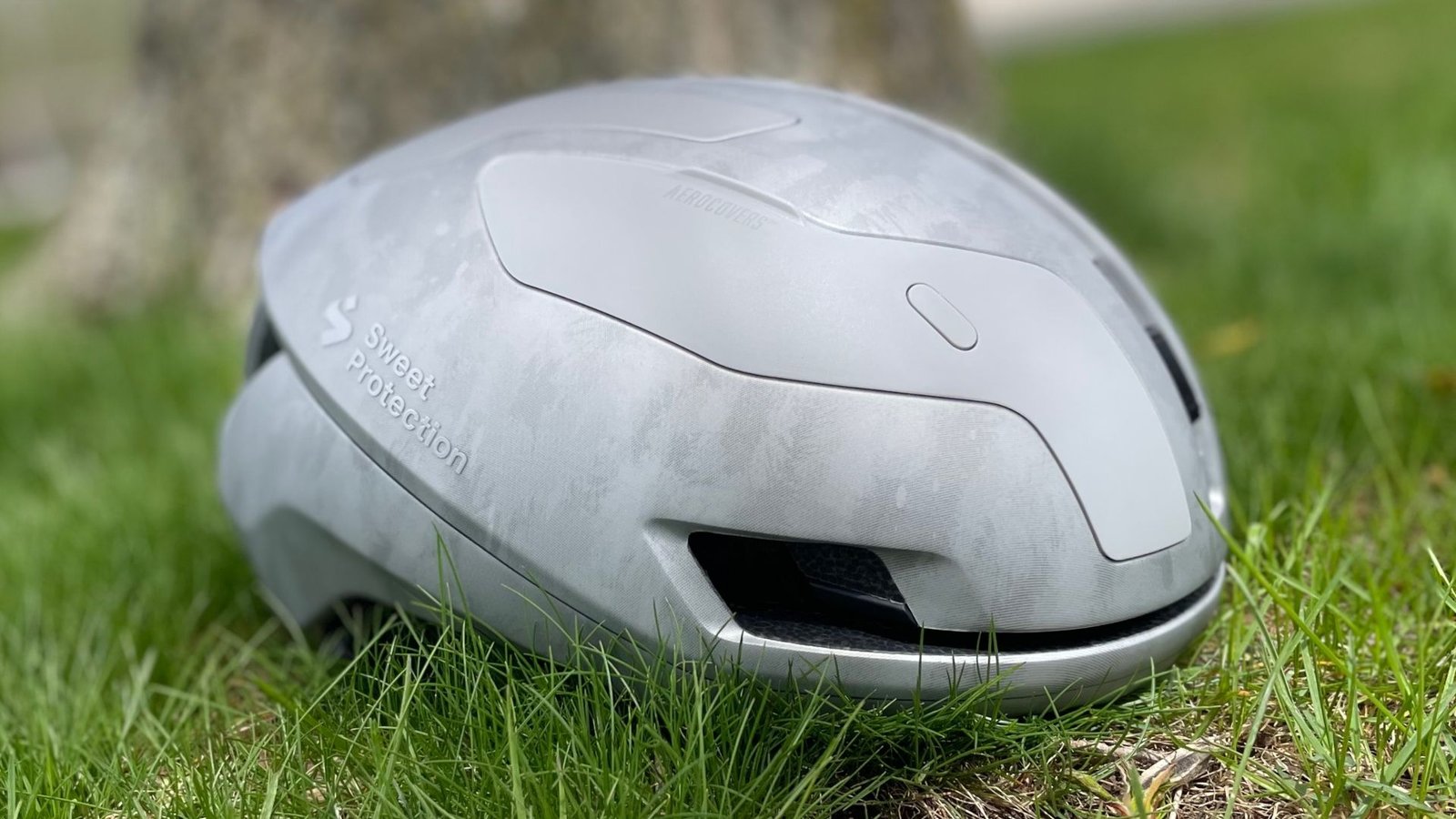
The Falconer Aero 2Vi Mips is Sweet Protection’s top-of-the-line road and gravel helmet, and it’s built around a key feature for racing and all-weather conditions: detachable magnetic Aerocovers.
These are two large covers that attach magnetically to the primary vents of the helmet, improving aerodynamics and blocking out wind and cold. You can even remove them while riding, simply by popping them off and tucking them into your jersey pocket. This could come in real handy during those long races where you line up in the cold before the day has warmed up.
Made of multi-density EPS foam with four impact shields, a variable elasticity shell and MIPS Air integration, there’s no doubt that the helmet’s construction is top-notch. We can talk all we want about aerodynamics, fit and ventilation, but in a helmet, there is one factor more important than all the others combined: safety.
The Falconer Aero 2Vi comes with a MIPS liner that helped it earn a coveted 5-star Virginia Tech safety rating — one of the most respected independent helmet safety evaluations in the world. It also meets EU, US and UK standards. The helmet comes with MIPS Air that is built directly into the padding, rather than the old and bulky yellow MIPS liner that used to snag on your hair. The helmet’s pads also have low-friction nodes that allow them to slide and absorb rotational energy in the event of a crash, and there is nothing better than a helmet with the highest possible safety rating.
One of the helmet’s standout ventilation features is what Sweet Protection calls STACC: Superficial Temporal Artery Cooling Channel. The idea is to funnel air specifically across the temporal arteries at the sides of your head, one of our most heat-sensitive areas. But the real question is: does it work?
Yes, the STACC system provided ample cooling during each of my efforts in training and racing. During harder efforts—the kind where you’re grinding up a climb and wind speed drops—the ventilation held up better than expected from a helmet with this aero profile. The only trade-off was that, at lower speeds, ventilation is noticeably reduced compared to a fully open road helmet, which is exactly what you’d expect with any aero design.
Other spec highlights: a 360 Occigrip fit system with on-the-fly height adjustment, integrated eyewear grippers, and a wider rear opening for ponytails. One of the most underrated features of any helmet is the buckle – a bad one can ruin your day by pinching your neck or finger. The Falconer Aero 2Vi comes with an excellent Fidlock magnetic buckle that works better than any buckle I’ve ever tested. Even when my gloved fingers were stiff after a muddy gravel race, I was able to easily work the buckle with one hand.
Details

(Image credit: Zach Nehr)
- Price: $300 / £269
- Weight: 300g (M/L)
- Sizes: S/M, M/L, L/XL
- We tested the limited-release Silver Smoke colourway
- Use case: Road and Gravel
The Ride

(Image credit: Zach Nehr)
The first thing that I notice in any helmet is the fit. I have quite a large head with a unique shape that slightly protrudes at the back of my skull. I’ve tried hundreds of helmets over the years, and far too many of them cause pain at the rear strap or around my forehead.
The Falconer Aero 2Vi, however, fits perfectly. As Goldilocks would say, it wasn’t too big or too small; it was just right. Riding around Wisconsin in winter and spring, I tested the helmet in temperatures between -4°C (25°F) and 30°C (86°F). I’m not sure how the helmet performs in arctic temperatures, but I’m sure the Norwegians at Sweet Protection and Uno- Mobility could provide some data on that.
I loved the removable Aerocovers, especially in variable temperatures and weather conditions. Sometimes it was cold and raining, others it was hot and sunny. Rather than choosing between an aero or vented helmet, I had both in the Falconer Aero 2Vi. There was also enough room under the helmet for a cycling cap, when needed.
In addition to the aero benefits, the Aerocovers also blocked road grit and rain, which is great for roadies, but even better for gravel riders. However, one of the few downsides of the helmet is that once mud got into the vent gap, it was not the easiest helmet to clean out. That’s a minor inconvenience to most cyclists, but something to consider if you ride in the mud regularly.
The fit held up well in a variety of conditions, and the helmet stayed in place while I was riding down bumpy gravel roads. The helmet sat close to the head with a low profile, and while I’m not a fashion expert, I tested the limited-release Silver Smoke colourway and I felt like the helmet is a genuinely good-looking piece of kit
Without an at-home wind tunnel, it’s hard to make definitive claims on that front, but the helmet felt fast. With the Aerocovers on, there was noticeably less wind noise, especially when riding in an aero position. The helmet is designed to perform across a range of head and yaw angles, which is ideal for real-world riding conditions and more casual cyclists who change positions often.
If you care about stashing sunglasses mid-ride, as many of us do, the Falconer Aero 2Vi is one of the best helmets for this. The integrated eyewear grippers are positioned low on the front of the helmet, and your glasses fit right in and stay there. I’ve lost, broken, and scratched many sunglasses while testing this with other helmets, and the Falconer Aero 2Vi was one of the best performers in terms of eyewear security.
Value & Conclusion

(Image credit: Zach Nehr)
You get what you pay for, and with the $300 / £269 Falconer Aero 2Vi Mips Helmet, you are getting a high-quality product with top safety ratings and a load of brilliant features. This price point isn’t for everyone, but it fits the serious and performance-focused mindset of most cyclists.
The standard Falconer 2Vi comes in at $250, but you’ll miss out on the magnetic Aerocovers and get a slightly different foam structure. For comparison, the MET Manta Mips runs around $230, the Trek Ballista around $200, and you can get the Van Rysel RCR-F aero helmet for under $100 if you just want something functional. All of those helmets have won races and received solid ratings in their own right. But if you’re looking at brands like Specialized and Giro, the Eclipse Pro aero road helmet will set you back $349.95. and the Evade also runs $299.99.
So is the Falconer Aero 2Vi worth the money? Honestly, it depends on what you’re after. If you want a seriously fast helmet that fits a variety of terrain and weather conditions, this could be the helmet for you. It’s quite the investment, but it also covers multiple bases. Instead of having two road helmets (one aero and one vented), you could have both in the Falconer Aero 2Vi.
The magnetic Aerocovers are a fantastic and rare feature, and when it comes to the safety rating, there is nothing better than a five out of five Virginia Tech score. In fact, there are fewer than 20 road helmets in the world with a 5-star Virginia Tech score, and that is certainly worth something.
If you are only looking for the best aero performance per dollar, there are faster options at a lower price point. But if you want a well-fitting, do-it-all helmet that you can see being worn at the Tour de France, the Falconer Aero 2Vi is a fantastic option.

