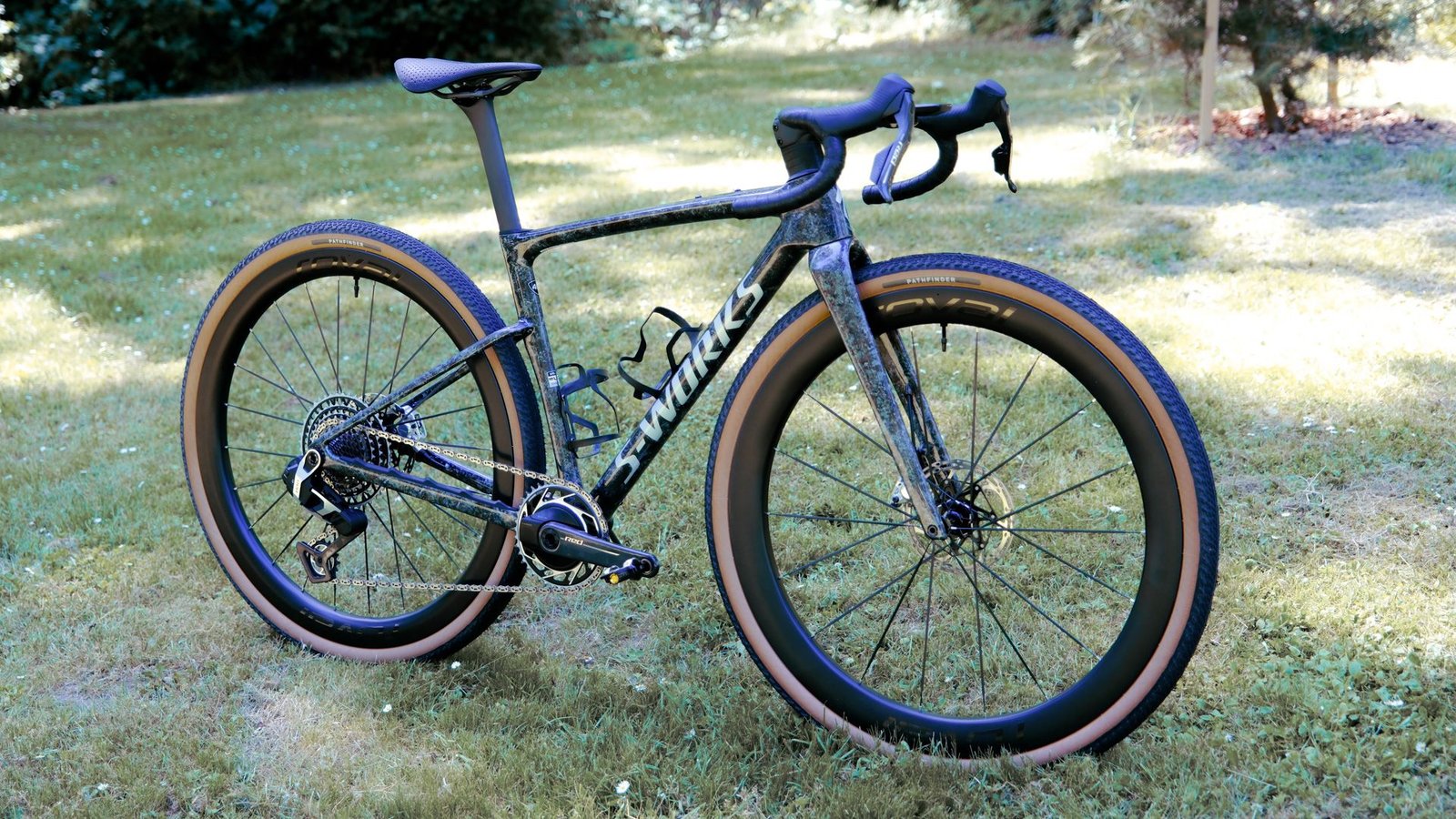
Today, Specialized officially drew back the curtain on one of the most anticipated bike launches of the year: the terribly kept secret that is the all new Crux.
By now, leaked photos had already circulated widely online, especially after Specialized Off-Road athlete Geerike Schreurs raced the new bike to victory at the Gralloch UCI Gravel World Series event.
The main storyline is that the generation 5 Crux has undergone a dramatic transformation. It’s one that, some proponents say, was long overdue, but the more practical riders may bemoan.

Gone is the classic silhouette of round tubing and a standard round 27.2mm seatpost. Gone also are the exposed wires and the build versatility that made the previous generation so easy to live with.
In their place sits a bike that looks very much like a fat-tyred Tarmac SL8, complete with sharp aerodynamic tube profiles, a proprietary aero seatpost and a fully integrated cockpit. The tyre clearance has been beefed up to 55mm (or 2.2inches if you’re running MTB rubber) but drivetrains are now limited to 1x only with a 52t cap on the chainring. Goodbye road gearing, goodbye suspension forks and dropper posts. Hello modern gravel race bike.
This is no longer the “one bike to rule them all.” It’s a bike that giveth and taketh. It’s both divisive and inevitable. It meets the demands of modern racing built around long-distance speed, aerodynamics, comfort and high-volume tyres. And in that role, I expect this bike to do very, very well.
But for riders who fell in love with the previous Crux precisely because it resisted over-specialisation, the new direction may feel bittersweet.
The Crux redefined, yet again

(Image credit: Anne-Marije Rook)
The Crux was born in 2010 as a dedicated cyclocross race bike, replacing the TriCross model. It was well-liked and successful too, with riders like Zdenek Stybar and Tom Pidcock racing aboard the bike to rainbow glory in the Elite and U23 UCI Cyclocross World Championships, respectively, over the years.
The Crux 4, launched in 2021, was a truly revolutionary product. Just as cyclocross participation was shrinking and gravel racing exploding globally, Specialized repositioned the Crux platform as the featherweight, stripped-down crossover product, and alternative to the Diverge. In doing so, the American brand created one of the most versatile drop-bar bikes of the modern era. Few bikes in recent years have been so universally loved by riders, racers and reviewers alike.
The Crux 4 struck a rare balance. It blended the playfulness and agility of a cyclocross bike with the stability needed in gravel, and a ride feel, efficiency and raciness appreciated across the board.
It is also a bike that’s easy to live with. The external cable routing on the front end, threaded BSA bottom bracket, compatibility with aftermarket seatposts, suspension forks, dropper posts and both 1x and 2x drivetrains all make it easy to service and travel with.
The same bike could, and did, be ridden to victory in both a 200-mile Unbound Gravel race and a UCI Cyclocross World Cup.
I have no doubt that the new Crux will be any less successful. In fact, I suspect it will become even more successful at the highest levels of racing but in gravel specifically.
Interestingly, throughout all of Specialized’s launch material, cyclocross isn’t even mentioned. Instead, Specialized is very upfront about what this bike was built around: Unbound Gravel.
And that tells you almost everything you need to know.
What’s new

(Image credit: Anne-Marije Rook)
The Crux 5 pivots hard toward the demands of modern racing, borrowing heavily from the Tarmac SL8 playbook while simultaneously increasing tyre clearance and stability for long-distance events on rough terrain.
Headline changes include:
- A claimed 15.2 watt aerodynamic improvement at 45kph
- New aerodynamic tube shaping inspired by the Tarmac SL8
- Fully integrated cable routing and cockpit options
- Clearance for tyres up to 55mm or 2.2in
- 1x-only drivetrain compatibility
- Maximum 52t chainring capacity
- Dropped seatstays and a slightly altered geometry
- Claimed 789g S-Works frame weight (for reference the Crux 4 was 735g)
Despite the aerodynamic redesign, Specialized says the Crux 5 retains the same stiffness and compliance targets as the outgoing model.
The bike is also no longer positioned as an all-road-adjacent gravel bike. This is now a purpose-built race machine first and foremost.
A Fat-Tyred Tarmac

(Image credit: Anne-Marije Rook)
Much of the Crux 5’s design borrows from its road sibling, the Tarmac SL8. That influence is immediately obvious in the bike’s tube shaping and overall silhouette.
“Crux 5 is the most aerodynamic gravel race bike we’ve ever tested,” Specialized says. “Drawing directly from Tarmac SL8 learnings and decades of aero research, every tube on Crux 5 was sculpted for speed at elite gravel races.”
The aerodynamic improvements are spread across the entire bike rather than isolated to the frame alone.
Specialized says roughly 50% of the aero gains come from the frame, fork and seatpost, with another 30% coming from the new Roval Terra Aero wheels and the remaining 20% from the integrated Terra cockpit.
Still, aero is only part of the equation.
Rather than chasing isolated benchmark numbers, Specialized says it focused on one overarching metric: total elapsed race time over real-world gravel courses.
The company calls this its “Equation of Speed”, a simulation model combining aerodynamic drag, rider power, rolling resistance, surface roughness, environmental conditions and total system weight into a single prediction: Time to Finish.
“Smoother is Faster” has long been an engineering philosophy at Specialized and that certainly did not go unaddressed in the designing of the Crux 5.
During the 2025 edition of Unbound Gravel, a small telemetry box mounted underneath Matt Beers’ saddle collected accelerometer data throughout the race. Specialized says it has now gathered telemetry across thousands of kilometres and multiple elite gravel events, measuring the roughness and vibration characteristics of different gravel surfaces in real time.
Why? Because gravel racing presents a very different engineering challenge from road racing. At road-race speeds, aerodynamic drag dominates the equation. On gravel, speeds are generally lower and rolling resistance becomes significantly more important, particularly over rough surfaces where tyre deformation and vibration losses increase dramatically.
Specialized says the telemetry data feeds directly into its simulation models, allowing engineers to better understand how tyre volume, wheel design, rider fatigue and frame characteristics interact over events lasting upwards of 10 hours.

The new tube shapes on the Crux 5 vs Crux 4
(Image credit: Specialized)
Rather than pursuing suspension solutions as it did with the short-lived Diverge STR, Specialized says the Crux 5 achieves comfort primarily through frame shaping, tyre volume and carefully tuned compliance targets.
Dropped seatstays, size-specific layups and the ability to run significantly larger tyres all contribute to reducing rider fatigue over long gravel races without adding the weight or complexity of suspension systems.
Specialized also credits what it calls “Flow State Design”, first introduced with the Aethos road bike. Engineers focused on optimising tube shapes so they carry loads more efficiently, reducing the need for additional carbon material.
The bike’s geometry has evolved alongside those aerodynamic changes. Though in the smaller sizes especially, these differences aren’t large.
Compared to the outgoing Crux, the new bike gets:
- A half-degree slacker head angle
- A lower bottom bracket
- A half-degree steeper seat angle
- Longer reach figures in larger sizes
- Increased tyre clearance to 55mm
Taken together, those updates point toward a bike designed to feel more stable at speed, more planted with larger tyres and more confidence-inspiring over rough terrain.
The wheel and tyre story forms a major part of the package too.
Specialized claims the new Terra Aero CLX wheels allow riders to run larger-volume tyres with effectively no aerodynamic penalty. According to the company, a 50mm Pathfinder or Tracer tyre mounted to the Terra Aero CLX wheel produces similar aerodynamic drag to a 45mm tyre mounted to the previous Terra CLX II wheel.
The result comes with some bold claims.
Using the company’s simulation model, Specialized says former Unbound winner Sofia Gomez Villafañe would have completed the 2025 edition of Unbound Gravel an impressive 9 minutes and 58 seconds faster aboard the new Crux 5 compared to the outgoing Crux 4, assuming identical conditions.
These numbers are impossible to verify, of course, but they do reveal how modern gravel racing is increasingly being approached: not as adventure riding, but as a very long time trial on unforgiving surfaces.
Introducing S-Level

(Image credit: Anne-Marije Rook)
Alongside the new Crux platform, Specialized is also introducing a new “S-Level” designation.
Positioned just below S-Works, S-Level is intended to bring flagship-level race performance to a slightly broader audience.
The Crux 5 S-Level uses a FACT 10r frame paired with a FACT 12r fork, the new Terra cockpit, SRAM RED XPLR and Roval Terra Aero CL wheels. The frame itself is claimed to weigh just 897g, with complete builds coming in at a claimed 7.7kg.
In practical terms, S-Level appears to function as a high-end performance tier sitting between the halo S-Works product and the more attainable Expert and Comp builds.
Builds & Pricing
| Row 0 – Cell 0 |
S-Works Crux 5 AXS |
Crux 5 S-Level |
Crux 5 Expert |
Crux 5 Comp |
Framesets |
|
Frame |
FACT 12r frame and fork |
FACT 10r frame and FACT 12r fork |
FACT 10r frame and fork |
FACT 10r frame and fork |
S-Works Crux 5 frameset: $5,800 / £5,249 / €5,799 |
|
Wheels |
Terra Aero CLX wheels |
Terra Aero CL wheels |
Terra CIII wheels |
DT Swiss G500 wheelset |
Crux 5 10r frameset: $3,500 |
|
Cockpit |
Terra cockpit |
Terra cockpit |
Two-piece cockpit: Terra bars + Rapide stem |
Two-piece Tcockpit – Alloy bar + Rapide stem |
Row 3 – Cell 5 |
|
Drivetrain |
SRAM Red AXS XPLR |
SRAM Red AXS XPLR |
SRAM Force AXS XPLR |
SRAM Rival AXS XPLR |
Row 4 – Cell 5 |
|
Claimed weight |
6.9kg |
7.7kg |
Row 5 – Cell 3 | Row 5 – Cell 4 | Row 5 – Cell 5 |
|
Price |
$14,000 / £11,999 / €13,999 |
$10,500 / £8,799 / €10,499 |
$7,000 / £5,999 / €6,999 |
$4,500 / £3,999 / €4,499 |
Row 6 – Cell 5 |
First Ride Impressions

(Image credit: Anne-Marije Rook)
I’ve ridden the outgoing 2021 Specialized S-Works Crux since December 2021 and, in the years since, I’ve ridden the absolute crap out of it. It remains my favourite bike I’ve ever owned. I won’t go too deep into that here, but you can read my full 1,000-word love letter to the outgoing Crux here.
So I’ll admit that I approached the Crux 5 with a healthy amount of scepticism.
I’ve not yet fully bought into the whole “aero-is-everything” approach to modern bikes. I tinker with bikes far too much to fully embrace integrated everything and proprietary parts. Show of hands for everyone who has ever lost a seatpost wedge.
And so, when I first laid eyes on the Crux 5, it wasn’t love at first sight. It looks beautifully sleek and undeniably fast, don’t get me wrong. But I’ve always loved the timeless look of rounded tubes, a two-piece cockpit and the sheer practicality baked into the whole thing.
And then I swung a leg over the new bike. In my size 49, the geometry changes are so subtle that I immediately felt at home. It fit me like a glove. And within minutes of pedalling, I had my ah-ha moment.
This bike is fast. Not just marketing copy fast. Tangibly fast.
It accelerates like a rocket and carries speed exceptionally well on both dirt and tarmac. And, fortunately, the familiar liveliness of the Crux does indeed remain intact. While the new bike feels more composed than its predecessor, it is by no means over-dampened. On my lunch loop, sprinkled with singletrack, the bike felt unmistakably like a Crux. A smidge taller perhaps, and the ever beefier types certainly don’t help with the toe-overlap, but Crux all the same.
In many ways, it feels like a more mature version of the Crux concept. The old Crux had a carefree do-it-all attitude to it. The new bike feels more focused, more deliberate and more purpose-built.
It is stiff in the places that matter, accelerates eagerly and, importantly, remains remarkably comfortable over long hours.
This is not a harsh aero road bike masquerading as a gravel bike. The Crux 5 still feels refined over rough surfaces, particularly when paired with high-volume tyres, and there’s still enough playfulness in the handling to make it genuinely enjoyable to ride.
Importantly, it also retains some crossover appeal. I would have absolutely no hesitation using this bike as a road bike alongside its gravel duties.
Gravel racing at the sharp end has become increasingly fast, tactical and aero-conscious. Today’s elite gravel racers spend vast stretches riding in tightly packed groups, or even solo, at road race speeds. The spirit of exploration has, at the highest level at least, given way to the pursuit of outright speed.
In that environment, aerodynamic efficiency is everything (aside from preventing race-ending flat tyres, perhaps). The Crux 5 reflects that evolution perfectly.
The outgoing Crux became beloved because it blurred categories. The new Crux 5 will succeed because it embraces specialisation instead.
Of course, that comes with trade-offs.
The integrated cockpit and proprietary seatpost undoubtedly improve aerodynamics and visual cleanliness, but they also reduce the ease of adjustment, customisation, travel and maintenance that made the previous bike so easy to live with.
The bike is now 1x-only and designed specifically around gravel-wide chainlines. Mechanical drivetrains remain possible, though riders using the one-piece Roval cockpit will need to stick with electronic shifting.
Whether riders embrace those compromises will depend entirely on what they want from gravel riding.
For elite racers chasing every marginal gain at gravel events like Unbound, SBT GRVL or the Gravel Earth Series, the Crux 5 makes complete sense.
After riding the new bike, I’ve come to a simple conclusion: I don’t want one or the other. I want both.

