by Karthik Krishnaswamy
Overall: 765 wickets at 25.81 ave; 4394 runs at 23.62 ave
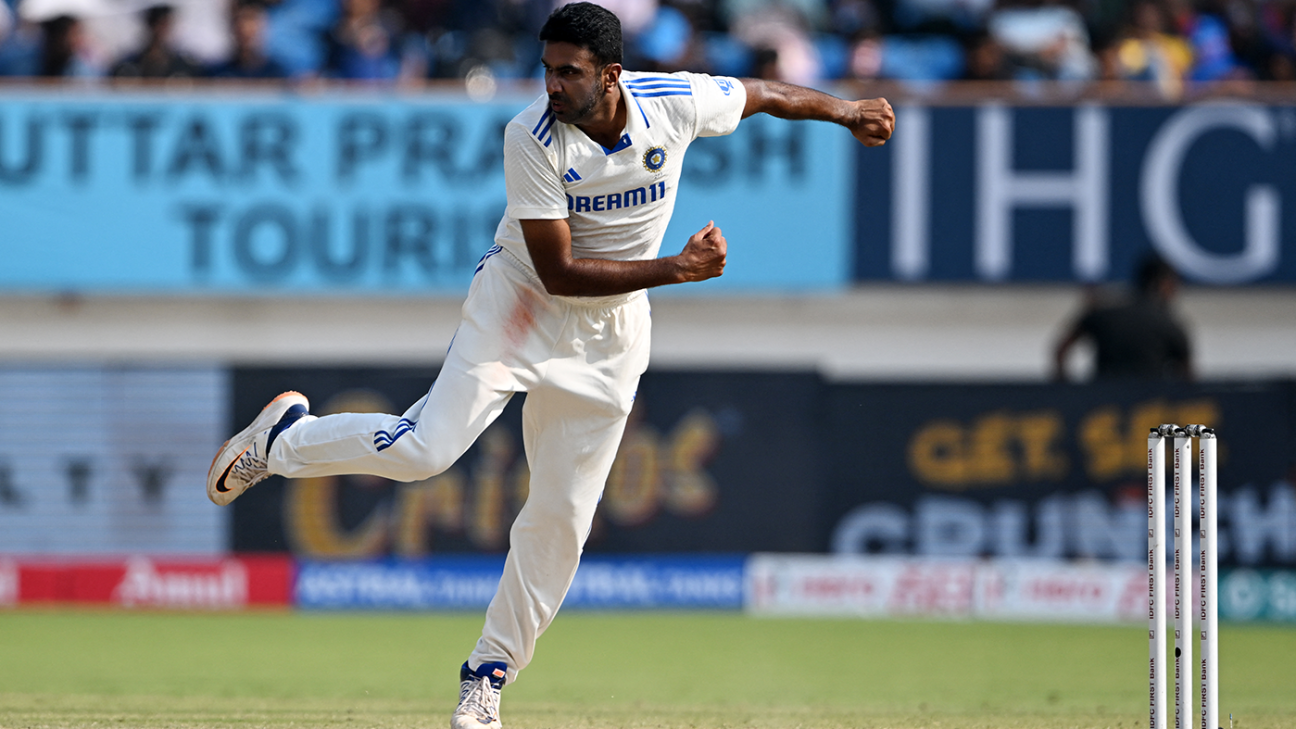
Forty spinners have taken 150-plus wickets in Test cricket. Of all of them, no one – not Muthiah Muralidaran, not Shane Warne – has taken wickets as frequently as R Ashwin, who ended his Test career with 537 wickets at a fast-bowleresque strike rate of 50.7. He was also good enough with the bat to score six Test hundreds.
The relentless pursuit of wickets turned Ashwin into cricket’s greatest innovator: at this mad scientist’s command were not just the full range of the offspin spectrum and a carrom ball but a reverse carrom ball too. In T20s, it was not unusual for him to bowl entire overs and spells as a legspinner. He was, at the same time, one of the great classicists, with mesmeric loop and drift and the ability to vary his pace all the way from the high 70s to the low 90s (kph) without losing his length.
It made him a wicket-taker in all conditions, but it was his fate that he happened to play in the same era as another great spin-bowling allrounder, Ravindra Jadeja, who happened to be almost as good a bowler while being more consistent with the bat. This meant that India often preferred Jadeja over Ashwin when conditions only allowed them to pick one spinner. When he did play, though, Ashwin made telling contributions, and took 18 wickets at 27.50 in four Tests across India’s back-to-back series wins in Australia in 2018-19 and 2020-21.
Ashwin was irresistible in Indian conditions, and the single-most influential figure in India winning 17 home series in a row, with a 40-4 record over 51 Tests from 2013 to 2024. Ashwin played each of these 51 Tests, taking 309 wickets at 20.07, striking every 44.2 balls. Each Ashwin wicket took 14 fewer balls than wickets taken by the average spinner in those Tests.
That’s how good he was.
Piyush Chawla on Ashwin: Ashwin’s self-belief was his biggest strength. There have been players with skills just as good as his, but the belief and confidence that Ashwin had throughout his career made him really special and played no small part in his extraordinary achievements, especially in Test cricket.
Consistency was key for Ash. He identified the spot that would most likely trouble batters and kept bowling there, backing his subtle skills, but most importantly for a spinner, following the basics.
The ability to revert to basics with such discipline was admirable for Ashwin, especially when under pressure. He turned that into one of his biggest strengths and usually came out on top in pressure situations.
He had the height and therefore his high-arm action and release led to extra bounce, which troubled batters; once you added fielders around the bat, it created a powerful mix, with hesitant batters doubting their defence against a highly skilled spin bowler. Increasingly he became the most difficult bowler to score against in Test matches in India.
by Alan Gardner
Overall: 847 wickets at 27.83 ave; 4309 runs
When Broad burst into the public consciousness, he appeared as the archetypal English pin-up boy. Tall and photogenic with bouncing blond locks, he cut a dash as he cut through the Australians at The Oval in 2009 with a five-wicket haul that helped England regain the Ashes and led to him being dubbed “Golden Bowls” – a nod to footballer David Beckham – by the UK tabloids.
But Broad proved himself to be a thinking cricketer of the highest order during a 17-year international career that was as notable for constant reinvention as match-winning prowess. That quality, allied to a fiery competitive spirit, and a showman’s ability to seize the moment, made him an all-formats lock for his country (and captain of the T20I side), before he narrowed his focus to scaling the peaks of Test cricket.
When Broad hit top gear, and the knees began to pump, few could match him. Seven times in Tests he claimed five wickets or more in a single spell, most devastatingly at Trent Bridge in the 2015 Ashes when he routed Australia, and in the process created his own meme: #OhMyBroad.
Behind the scenes he was relentless in his pursuit of an edge (both literal and metaphorical). Whether shortening his run-up, developing the wobble ball or working on the round-the-wicket approach that dramatically rectified a previous weakness when bowling to left-handers, Broad was dedicated to self-improvement. But his magic touch – witness the bail-switch trick in his final Test – was something that couldn’t be taught.
Chris Woakes on Stuart Broad: He’s a fierce competitor. He didn’t leave any stone unturned from a preparation point of view – who he had done well against in the past, how he’d got them out. The clear moment in his career was when he went from trying to bowl awayswingers to become more of an inswing bowler and coming around the wicket to left-handers. For him to acknowledge he needed to change something, do it, and the career he had post that, it was pretty amazing.
I think he was underestimated from a skill point of view. He had an amazing career with Jimmy [Anderson] at the other end. Stuart preferred to get into the battle a little bit more, but at the same time, he had a high level of skill, was very good at working batters out, always liked to set funky fields. That’s where I learned the most from Stuart – getting into the individual battle and not thinking about your own game too much.
He was always a good laugh on and off the field. One of England’s greats who turned up in the big moments and against the big teams – particularly against Australia. When it comes to the Ashes, he’s up there with [Shane] Warne and [Glenn] McGrath.
by Vithushan Ehantharajah
Overall: 13,797 runs at 44.08 ave
Pietersen was a box office cricketer. A term as much for diplomacy’s sake as the fact that English cricket was never boring when he was playing.
It was also never more titillating than when he was finally cut adrift in 2014, the main collateral in a dismal 5-0 Ashes whitewash, two years after he was reintegrated back into the international fold, having been axed by the ECB for sending “provocative messages” to the South Africa team about his team-mates. To this day, his axing remains one of English cricket’s most contentious storylines in the 21st century.
No English batter comes close in this period to the pull and influence of the man who upped sticks in Natal, whose pugnacious stylings went on to inspire plenty of significant batters to follow. The original skunk hair, the flamingo shot and switch hit, and the tabloid headlines were merely flourishes of the maverick side to Pietersen. The legend, ultimately, was created on the field with hall-of-fame knocks in once-in-a-lifetime accomplishments. The 158 to secure the 2005 Ashes. His 227 in Adelaide in 2010-11’s historic trip back to Australia. Earlier in 2010, he was player of the tournament in the World T20 as England secured their first ICC trophy.
In 2012 alone – his first annus horribilis – he struck three remarkable hundreds in Colombo, Headingley (in the midst of text-gate) and Mumbai. The third may rank as his best ever: a script-flipping 186 helping England win the second Test to square matters on their way to a first series win in India since 1985.
Was the rough worth the smooth? Without question. That his England career was done and dusted at 33 remains a shame. Still, 32 international hundreds, and a Test average of 47.28 from 104 caps gave fans plenty to remember him by.
Ian Bell on Pietersen: KP had an amazing presence when he walked into the middle. He possessed the ability and mentality to dominate in all conditions; add to that a fearless attitude. He was a real match-winner.
KP was such a big guy but still had incredible footwork, particularly against spin, and was yet very good against pace bowling. He had the all round package.
There were times that there was a lot of outside noise during his career. But he had an amazing ability to not let that affect his batting. Whatever the situation or whatever the noise, be it a big series against India or the Ashes, he could just focus on the ball and react and play his best style of cricket. He was always brave enough to take the game on, to be aggressive and take the positive option.
Personally, I loved batting with him, because our combination complemented each other’s strengths. The same ball that I drove through cover, he could pick up on the leg side and loft for six.
When Kevin Piteresen was on, there was no one quite like him.
Stats are for the 2000-2025 period

