The NBA’s second apron has to go.
It won’t, though, because the league likes what it does.
The second apron, set at $221,686,000 for the 2026-27 season, effectively works as a hard salary cap. Exceed that figure, and team-building essentially becomes impossible, because the restrictions are so severe on a franchise’s ability to operate in the draft, free agency and trade markets — all the ways in which an organization can improve its roster.
Advertisement
It has become the talking point in the NBA, as tanking and load management have before it, and that’s never a good thing, whenever we lose focus on the basketball itself. Many of the summer’s biggest plotlines directly result from the entrapments of the second apron.
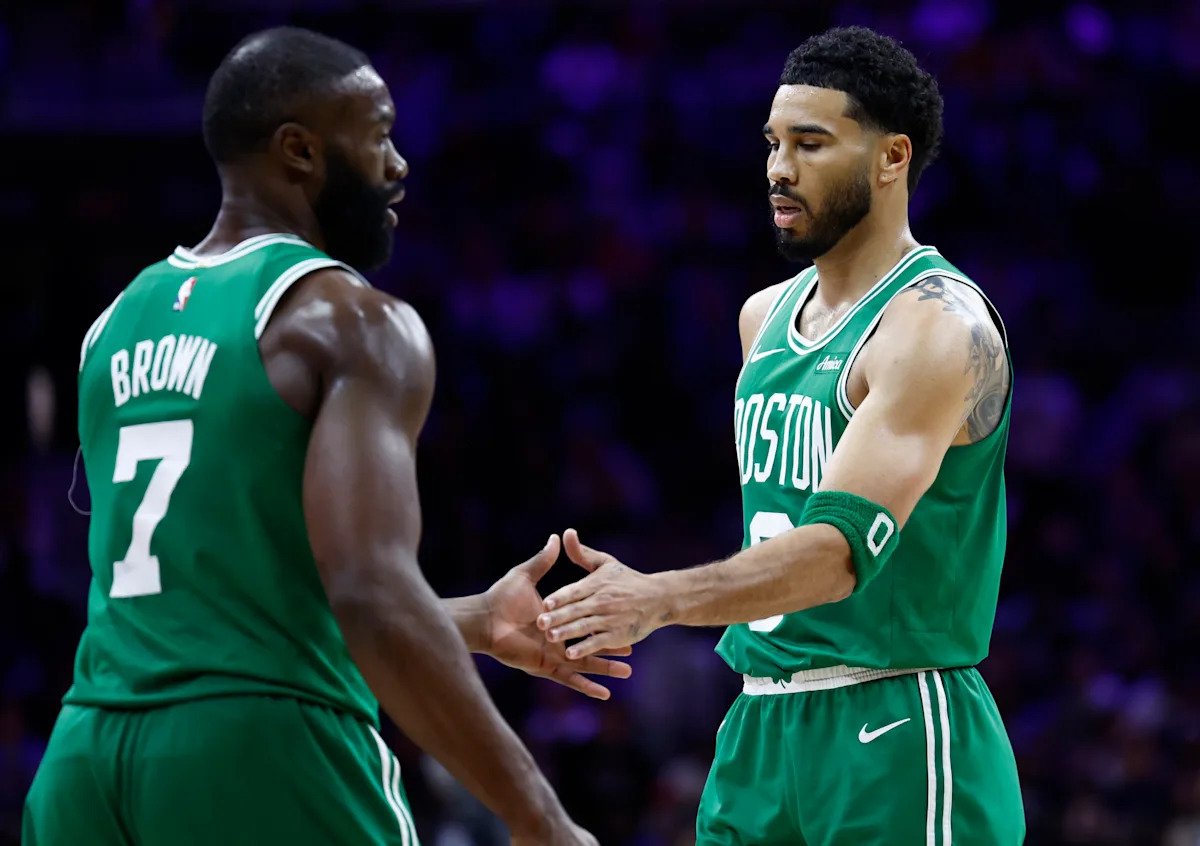
Because all you can do to get out of it, really, is sell off pieces one at a time, as the 2024 NBA champion Boston Celtics did, trading Jrue Holiday and Kristaps Porziņģis, letting Al Horford and Luke Kornet walk in free agency, and, finally, moving on from Jaylen Brown.
The Jaylen Brown-Jayson Tatum era is over in Boston, just two years after a title run. (Photo by Danielle Parhizkaran/The Boston Globe via Getty Images)
(Boston Globe via Getty Images)
“The path looked a little bit more challenging with 70% of our cap and such a high percentage of our usage tied into two players,” Celtics executive Brad Stevens said at a recent press availability, referencing maximum contracts for Brown and Jayson Tatum.
Advertisement
Isn’t that the crux of this issue? If a team cannot sustain itself with two homegrown players who have earned every penny of their max salaries — who have formed the foundation of a championship team — isn’t there something wrong with the model?
Do we want an NBA where Michael Jordan and Scottie Pippen, or any successful homegrown tandem, can no longer play a good chunk of their primes together?
There is an easy fix to this, of course. The NBA could simply allow homegrown max-salaried players to make 35% of the salary cap while only counting 30% against it.
But that is not what NBA commissioner Adam Silver wants.
Advertisement
“It’s certainly not unintended consequence,” Silver told reporters following Tuesday’s Board of Governors meeting in Las Vegas. He added, “The system is working very well.”
You see, the league wants player movement. It wants parity. It likes that it has had eight different champions in the last eight seasons for the first time in its history. The aprons level the playing fields among smaller- and bigger-market teams, or so the theory goes.
If that means this summer the New York Knicks cannot re-sign Mitchell Robinson, a core member of last month’s title team, for fear of going into the second apron, then so be it.
Advertisement
As Knicks governor James Dolan told the radio station WFAN in June, “There’s certain things in the NBA that you’d have to be suicidal to do. One of them is the second apron.”
But there are some unintended consequences. If teams become unrecognizable year over year, isn’t some of the fan experience lost? In a league that was built on dynasties — the Los Angeles Lakers and Boston Celtics of the 1980s, the Chicago Bulls of the ’90s — don’t we want fans to develop their relationships with successful players over time?
Who wants to follow a player’s career, see them flourish, and then watch them get salary dumped for diminishing returns, all because of a guardrail owners placed on themselves?
Either the 60-75 best players in the world make maximum salaries, leaving a smaller pool for the vast majority of the league’s players, or one of the best players in the world has to accept less than his value, so everyone else on the team around him makes more money.
Advertisement
That is precisely what San Antonio Spurs superstar Victor Wembanyama did, taking a drastic step, accepting a 25% maximum salary slot when he could have commanded 30%, a savings of more than $50 million. That may allow the Spurs to retain Stephon Caste and Dylan Harper into the future, while keeping a competitive roster around them.
But should it be on players to police themselves as far as team-building goes? Shouldn’t that onus be on the team owners? The National Basketball Players Association thinks so.
“Our position would be that the system should not require a player to carry all that burden,” new NBPA executive director David Kelly told reporters last week. “It should not put a player in a position where he has to carry the burden in order to keep a team together. A system that does that, we have a problem.”
Advertisement
Except, the NBPA brought this on itself, allowing the aprons to be negotiated into the last collective bargaining agreement in 2023. Now, they are in a tough negotiating position for the next CBA in 2029, because what do they give up now to get rid of a second apron?
The second apron is good for the owners, because it gives them a built-in excuse not to spend into a luxury tax they have also imposed against themselves. It is not great for the players, because they now have to choose between getting paid their worth and winning.
But the apron may be worse for fans, who can watch their teams do everything right — build a champion, even — only to have to dismantle a roster once they have gotten good. So long, continuity. Goodbye, familiarity. And welcome parity, exactly what the NBA wants.

