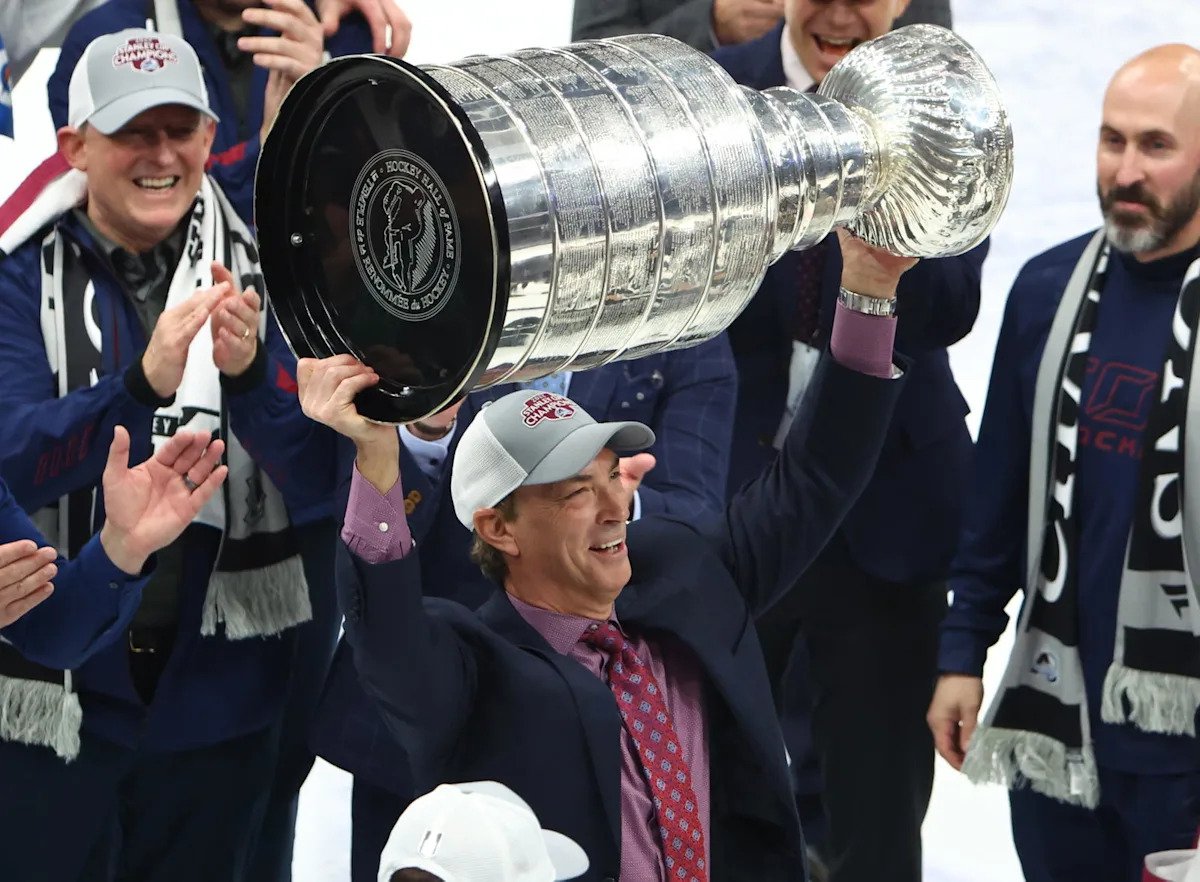
Joe Sakic now stands alone.
For years, Joe Sakic and Steve Yzerman were viewed as two of the greatest examples of superstar players who successfully transitioned into NHL front offices. They were Hall of Fame captains, Stanley Cup champions, Olympic gold medalists, and architects of championship-caliber teams.
Advertisement
Now, that comparison is over.
After the Detroit Red Wings dismissed Yzerman as general manager and executive vice president on Wednesday, Sakic is the last member of that exclusive club still standing. His legacy as both a player and executive has only grown stronger with time.
Long before he built a Stanley Cup champion from the front office, Sakic helped deliver Denver its first major professional sports championship as the face of the Avalanche.
He was the driving force behind Colorado‘s sweep of the Florida Panthers in the 1996 Stanley Cup Final, producing 34 points (18 goals, 16 assists) in 22 playoff games on his way to winning the Conn Smythe Trophy as postseason MVP.
Advertisement
As remarkable as his accomplishments were, Sakic became just as respected for the way he carried himself.
Perhaps no moment captures that better than after the Avalanche won their second Stanley Cup in 2001. Moments after NHL Commissioner Gary Bettman handed him the Stanley Cup, Sakic skipped the traditional solo celebration and immediately passed it to Ray Bourque, allowing the Hall of Fame defenseman to finally lift hockey’s ultimate prize after waiting 22 NHL seasons.
That same season marked the pinnacle of Sakic’s playing career.
He recorded a career-high 118 points with 54 goals and 64 assists while adding 12 game-winning goals, earning both the Hart Trophy as league MVP and the Lady Byng Trophy for sportsmanship and gentlemanly conduct.
Advertisement
The following winter, Sakic added another defining chapter to his résumé.
He captained Canada to its first Olympic gold medal in men’s hockey in 50 years at the 2002 Winter Olympics in Salt Lake City, defeating the United States in the gold-medal game. His performance throughout the tournament earned him MVP honors.
Years later, Sakic proved his greatness wasn’t limited to the ice.
As general manager, he assembled the roster that brought the Stanley Cup back to Colorado in 2022. Afterward, he handed day-to-day general manager duties to Chris MacFarland while remaining president of hockey operations before reassuming the GM role following MacFarland’s departure to the Nashville Predators.
Advertisement
Yzerman’s second act, however, unfolded much differently.
His seven-year tenure leading the Red Wings never produced a single playoff appearance. Detroit remained stuck in rebuilding mode, and this offseason even captain Dylan Larkin—a hometown star long viewed as the face of the franchise—requested a trade after years of growing frustration. The organization now finds itself searching for answers once again.
None of that diminishes what Yzerman accomplished as a player.
He remains one of the greatest captains in NHL history, leading the Red Wings from 1986 to 2006 while helping Detroit win three Stanley Cups and reach four Stanley Cup Finals during an eight-year stretch between 1995 and 2002.
Advertisement
As an executive, though, his résumé tells two very different stories.
During his time in Tampa Bay, Yzerman built one of the NHL’s premier organizations through exceptional drafting, shrewd trades, and under-the-radar signings. He selected Andrei Vasilevskiy, Anthony Cirelli, Cal Foote, Nikita Kucherov, Ondřej Palát, and Brayden Point, signed undrafted contributors Tyler Johnson and Yanni Gourde, and acquired Erik Černák, Ryan McDonagh, and Mikhail Sergachev to form the backbone of a future dynasty.
The Lightning reached the Stanley Cup Final in 2015, and that same year Yzerman became the first general manager in franchise history to win the NHL’s General Manager of the Year Award. Under his leadership, Tampa Bay also established franchise records with 50 wins, 108 points, 262 goals, and 32 home victories.
The success continued.
Advertisement
The Lightning captured the Atlantic Division title in 2017-18 and advanced to the Eastern Conference Final before falling to the Washington Capitals.
Then, in September 2018, Yzerman chose not to renew his contract as general manager, transitioning into a senior advisor role while assistant general manager Julien BriseBois took over.
Ironically, Yzerman wasn’t the executive who ultimately watched Tampa Bay raise the Stanley Cup.
The roster he built reached three consecutive Stanley Cup Finals, winning back-to-back championships in 2020 and 2021 under BriseBois.
Meanwhile, Yzerman returned to Detroit hoping to engineer a similar turnaround for the franchise where he became a legend.
Advertisement
Instead, the rebuild failed.
That’s the unfortunate reality of professional sports.
Recency bias has a way of reshaping legacies. Younger fans won’t remember Yzerman primarily as one of hockey’s greatest captains or the architect who laid the groundwork for Tampa Bay’s championship core. Many will remember a seven-year rebuild in Detroit that never got off the ground.
And history shows he isn’t alone.
Some of the greatest players in NHL history have struggled when moving into executive roles.
Joe Nieuwendyk enjoyed a Hall of Fame-caliber playing career that included two 50-goal seasons with the Calgary Flames and a Stanley Cup championship with the Dallas Stars in 1999. But as Dallas’ general manager, his four-year tenure produced three last-place finishes in the Pacific Division.
Advertisement
Wayne Gretzky’s post-playing career followed a similar path. Widely regarded as the greatest player the sport has ever seen, Gretzky never guided the Arizona Coyotes to a playoff appearance during his time as minority owner and head coach.
That’s what makes Sakic so rare.
He didn’t just become a successful executive after an iconic playing career—he became one of the very best. He built a Stanley Cup champion, sustained a perennial contender, and continues to shape one of the NHL’s model organizations.
Avalanche fans have never needed another reason to appreciate Joe Sakic.
But with Steve Yzerman’s tenure in Detroit now over, Sakic’s place in hockey history feels even more unique.
He isn’t just one of the greatest players the game has ever seen.
He’s one of the few who proved he could build a champion long after he stopped playing.
Image

