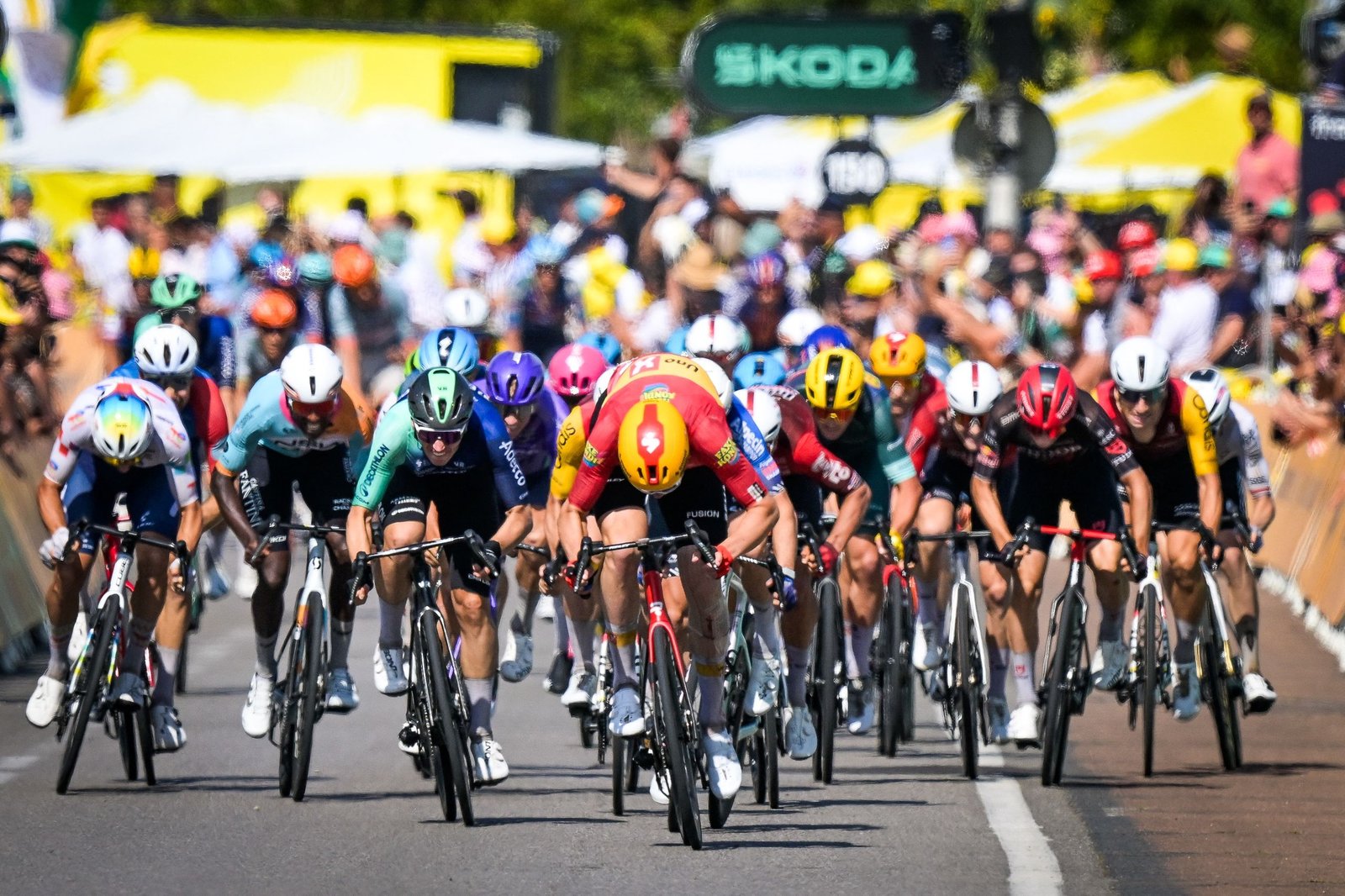
Not even the Tour de France organisers had imagined a stage as fast as Wednesday’s. Assuming perfect conditions, and a quicker than usual pace, the earliest they thought stage 11 would arrive in Nevers was 17:31 local time, which they noted in the race’s road book. Any fans that turned up then, however, would have been 15 minutes late; Uno-X Mobility’s Søren Wærenskjold was already on the podium, and the team buses were packing up to leave.
In fairness, the organisers couldn’t have known stage 11 would be record-breaking. Sprinting across the line in a time of three hours, 10 minutes and six seconds, Wærenskjold earned the honour of winning the fastest ever road stage in the Tour de France’s 123-year history. His average speed was 50.91kph over the 161.3km. The previous record had stood for 26 years, set by sprinter Mario Cipollini on stage four in 1999 – an average speed of 50.36kph.
“I was a bit surprised that it was the fastest one because it didn’t feel so hard,” Wærenskjold said afterwards. “It wasn’t a really long stage, and you see the tendency in the peloton that they always try to keep [the breakaway] at around one minute…. In all of cycling, it just goes faster and faster, but we’re quite used to it now.”


(Image credit: Getty Images)
In an era of super-bikes, nutrition gains, and evermore aerodynamic equipment, record-breaking average speeds have become a common sight on the WorldTour; last year, Tim Merlier came within 0.3kph of bettering Cipollini’s 1999 benchmark on stage nine to Châteauroux. The speed record at Paris-Roubaix has fallen four times in the last five years.
So why was Wednesday’s stage so fast? There wasn’t a roaring tailwind – if anything, weather forecasts showed a very light, almost unnoticeable headwind, around 7kph from the north; the stage was short, but it wasn’t the shortest (stage five’s sprint to Pau counted 3km fewer); the day’s profile, as flat as a carpenter’s workbench, definitely helped, although there was still 1,400m of elevation.
The main reason, according to Bahrain Victorious’s Matej Mohorič, was the nature of the day’s racing; the breakaway committed from the flag-drop.
“We all knew that, after a hard stage yesterday, there was always a chance that the sprinters’ teams would be a bit tired,” Mohorič told Cycling Weekly. “In the start, there were many riders who were really focused to try and get in the break, because nowadays with the aerodynamics and the way the sport has progressed, you never know – even a minute’s gap can be enough.
“Once the attack happens on the flat, if it’s a completely flat road, we go above 65kph, so it’s pretty hard to close a 100m gap.”
On the road out of Vichy, Mohorič tried to bridge across to the four escapees – Julian Alaphillippe (Tudor Pro Cycling), Mathis Le Berre (TotalEnergies), Anthon Charmig (Uno-X Mobility) and Nelson Oliveira (Movistar) – but couldn’t match their blistering speed to join them.
When Le Berre was told after the stage that he had helped pace a record-breaking day, he said: “I don’t doubt it. I had almost 56kph [on my GPS computer] almost the whole day. We were going really deep.”
Yellow jersey wearer Tadej Pogačar (UAE Team Emirates-XRG), though nestled in the peloton all day, felt the pull of the bunch.
“When we stopped for a pee-pee, to come back [into the peloton] it was crazy,” he laughed. “Then we were like, ‘Today, it will be fast at the finish line.’ It’s good to be part of the fastest stage in the Tour.”
Asked why he thought it was so fast, Pogačar concurred with Mohorič’s thoughts. “Ok, it was not super long, but the reason why is because there is a lot of chance for the breakaway to go to the finish line,” he said. “The sprint teams controlled, but they needed to catch them, these strong riders. Today was a strong breakaway. That’s why the speed has to be high.
“Once we caught them, we slowed down immediately, and it was so funny to ride from 5km to 2km to go – we rode the slowest of all day.”
It was then that Wærenskjold, capitalising on the lull of the bunch, launched his race-winning move. The clock read 17:16. An historic record had been set. Mohorič thinks it won’t be long until we see it broken again.
“Who knows what the limit is?” the Bahrain Victorious rider asked. “If you can push 350-370 watts into the wind, you’re going well above 55kph. Unless there’s a strong headwind, this is the new normal speed… I think it’s going to get even faster in a few years’ time.”
Explore More

