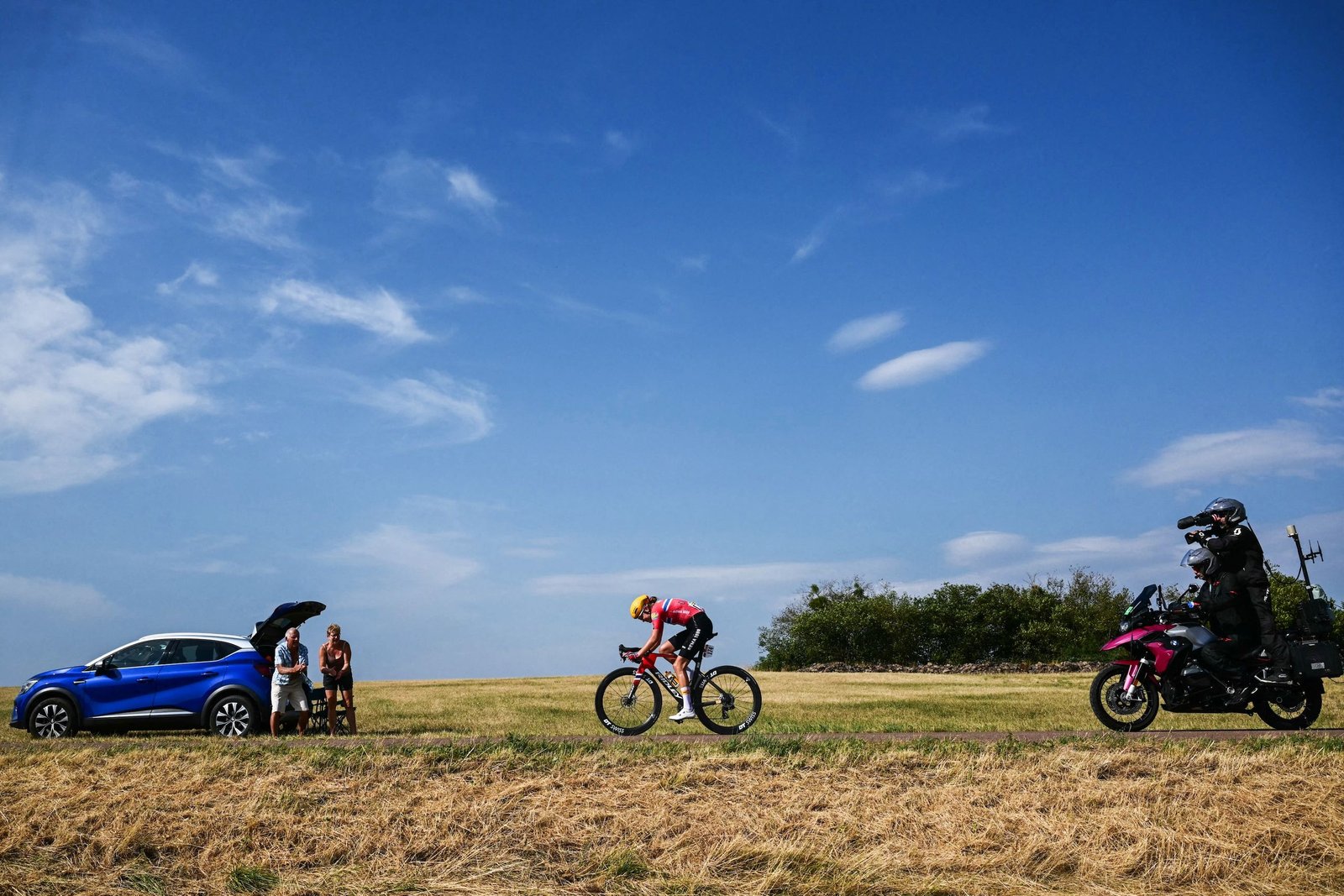
You can’t escape the tagline of the Tour de France Femmes avec Zwift. It’s everywhere, on casquettes, on musettes, on advertising. It’s simple: “Watch the Femmes”. It’s a neat idea from title sponsors Zwift to encourage people to tune in to what has quickly become the biggest women’s bike race in the world.
I wish it was that easy. Only three of the nine stages of the Tour de France Femmes have been, or will be, broadcast in full: stage one around Lausanne, five from Mâcon to Belleville-en-Beaujolais, and the closing day in Nice. It means for the other six days, fans will have to put up with reduced television coverage. On top of the fact that the race is behind an expensive paywall in the UK and the USA, “Watch the Femmes” seems more like a dream than a reality.
News editor at Cycling Weekly, Adam brings his weekly opinion on the goings on at the upper echelons of our sport. This piece is part of The Leadout, a newsletter series from Cycling Weekly and Cyclingnews. To get this in your inbox, subscribe here. As ever, email adam.becket@futurenet.com – should you wish to add anything, or suggest a topic.
Broadcasters TNT Sports (UK) and Peacock (US) cannot be bashed for this. Warner Bros. Discovery bought the rights to show all ASO races on its channel TNT in the UK; ASO commissioned France TV to produce the feed, and in that transaction made the apparent business decision that fans don’t need to see huge sections of the race.
Latest Videos FromCycling Weekly
This is the same ASO that gave us less than 90 minutes of footage from Paris-Roubaix Femmes in April. For all the deserved praise ASO gets for putting on marquee women’s races like this – albeit years too late – it is clear that the organiser should also be criticised for providing an average of less than two and a half hours a day of footage.
Screening the closing kilometres of races is nothing new, but the decision means that key moments are missed. This was made patently clear on Monday’s stage three, when Uno-X Mobility rider Sigrid Haugset attacked before the TV cameras began rolling, with 88km to go; this came well after overall favourite Demi Vollering (FDJ United-Suez) crashed, with 143km to go. Fans could see it on social media, which is exactly how women’s cycling fans kept up with races over a decade ago. Times have moved on, ASO should, too. On a stage like Monday’s, with a first-category climb in the first 24km, it was obvious that things would happen before the film crews were in action.
Start-to-finish coverage is not a pipe dream. It happened for every stage of the men’s Tour de France last month, and it’s available for plenty of WorldTour races, including the concurrently-running Tour of Poland. Fans wanting to watch all of the biggest women’s race of the year could instead watch all 232km of a forgettable sprint stage in Poland, but couldn’t see Haugset’s winning attack.
Choosing not to film huge sections of the race is a business decision made by ASO. Clearly, it’s one that holds back cycling, prevents fans from seeing key moments, denies smaller squads the opportunities to get television time by going in early breaks, and makes it harder to understand the whole picture of the race.
Stage four’s individual time trial saw 59 rider’s start’s not shown on TV, with coverage beginning at 3:45pm CEST, almost an hour after the first person headed down the start ramp. The winner could be in that cohort.

(Image credit: Getty Images)
Fortunately, the cause of start-to-finish coverage is not something that myself and Cycling Weekly are alone in arguing for. On the eve of this fifth edition of the Tour de France Femmes, The Cyclists’ Alliance (TCA), the independent body that represents the women’s peloton, warned that partial coverage would mean fans miss “the attacks, the tactics, and the moments that could define the race”.
Kate Verroneau, director of women’s strategy at Zwift, the race’s title partner, posted on Instagram on Monday: “Moments like this are exactly why I’m so passionate about getting more eyes on women’s cycling. It’s no longer enough to broadcast only part of the race.
“When we miss the opening hours, we miss the attacks, the risks, the stories, and often the very moments that define a stage. Change is coming, but only if we keep working together. Fans, sponsors, media, riders and teams all have a role to play. Keep raising your voices, keep tuning in. These athletes are putting on a show. Let’s make sure the whole world gets to Watch the (full coverage) Femmes.”
Former world champion Lizzie Deignan was perplexed by the lack of coverage on For The Love of Cycling: “It was very hard to follow from home, it was like back in the old days, refreshing newsfeeds, trying to figure out what’s going on. There’s no substitute for footage. I don’t really understand why that can happen.”
TNT Sports’ Orla Chennaoui put it simpler in an Instagram reel: “What the heck? We still, despite how proven the interest is, we cannot get live TV coverage. ASO, what are you doing?”
The beauty of a Grand Tour is to see the race play out in its entirety, to see a whole country, to understand a complete storyline. To only show part of the race is to deny fans the whole plot, the whole work of art. Imagine going to see The Odyssey and only being allowed to watch the final 90 minutes.
Women’s cycling deserves better, and we should be able to watch all of the Femmes.
This piece is part of The Leadout, the offering of newsletters from Cycling Weekly and Cyclingnews. To get this in your inbox, subscribe here.
If you want to get in touch with Adam, email adam.becket@futurenet.com.
Explore More

