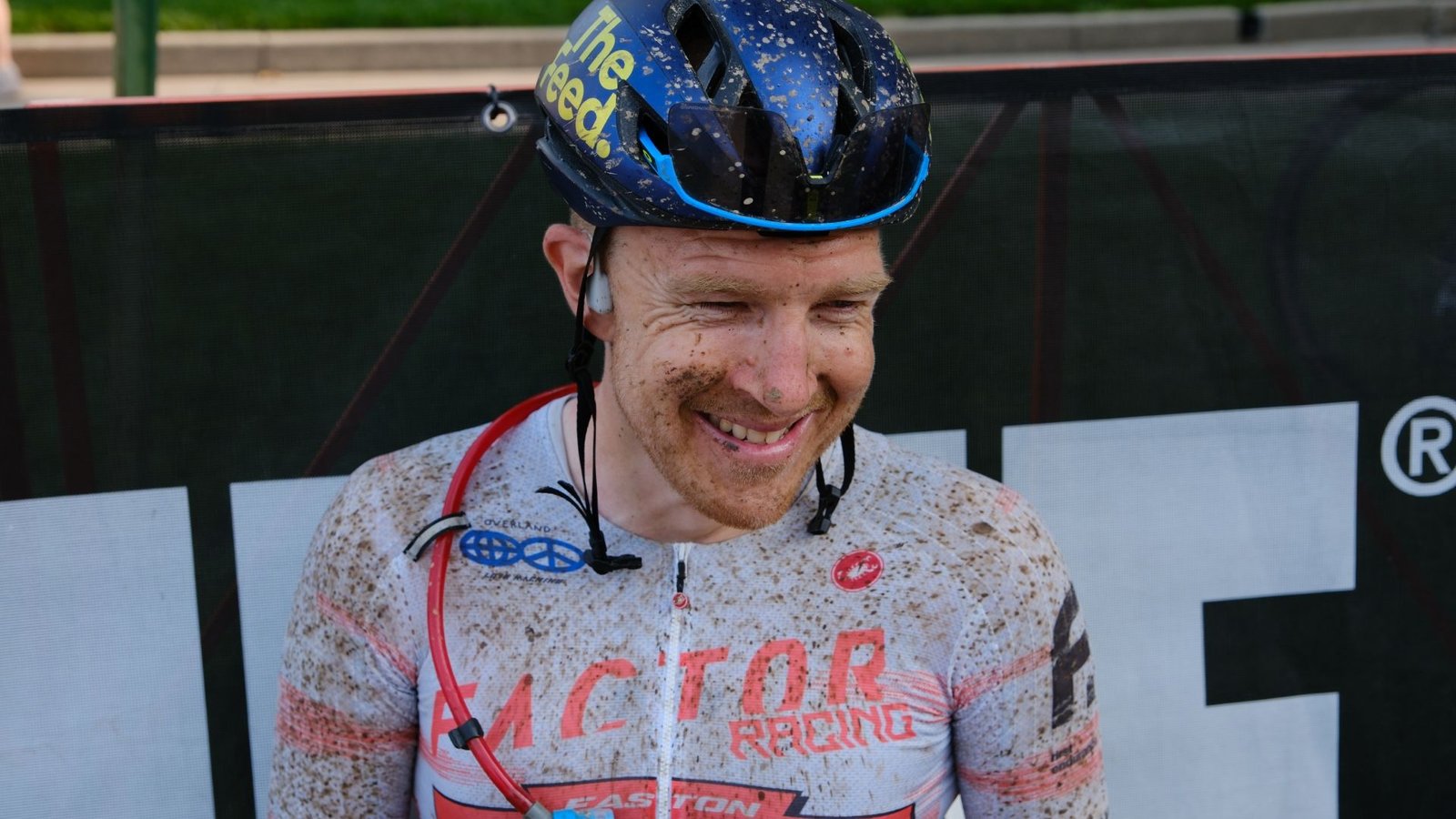
Canadian gravel racer and former professional road rider Rob Britton has spent years racing at the sharp end of cycling. But after a career built on structure, pressure and results, Britton is now chasing something very different: uncertainty.
Over the last few seasons, that philosophy has pushed Britton deeper into ultra-distance racing and further away from gravel’s increasingly polished front end. While he remains capable of competing at elite gravel races, events like Badlands, the Atlas Mountain Race and Unbound XL now hold far more appeal than traditional race formats.
“Gravel racing is becoming more and more like road racing at the front end. And that’s a world I’ve already been part of for a long time,” Britton explains.

For Britton, that is not criticism so much as reality. Before gravel exploded into the mainstream, he built his career in professional road racing, winning major North American stage races like the Tour of the Gila, and earned a reputation as one of Canada’s strongest endurance riders.
But after years inside the pressure cooker of professional road cycling, the appeal of this highly controlled environment no longer exists.
“I’ve read that book,” he says. “I know all the chapters and how it ends.”
Nowhere is that shift clearer than in his relationship with Unbound XL, the 350-mile self-supported ultra through the Flint Hills of Kansas. Britton returns this year as defending champion, but insists the label means less than people might expect.
“That has a nice ring to it, doesn’t it?” he says. “Normally, I would say it does come with pressure, but so far this season, I haven’t been able to get things right, and every race has been either disappointing or a setback. So yes, I am returning as the defending champion, but I genuinely see myself as a bit of an underdog for the win this year.”
Ultra-distance racing offers exactly the kind of unscripted challenge Britton believes modern gravel increasingly struggles to provide. At events like the Unbound XL, riders face not only 350 miles of brutal conditions but also harsh weather, fatigue and sleep deprivation. There are no team cars or carefully controlled race scenarios once darkness arrives and the field begins to splinter apart.
“It’s refreshing,” Britton says. “The people at ultras are probably the least egotistical people you’ll ever meet.”
That culture is part of what keeps drawing him back. At ultra-distance events, professional riders line up alongside ordinary cyclists using their time off simply to see if they can survive.
“They work nine-to-five jobs,” Britton says. “Then they use their vacation days to go bury themselves somewhere for four days without sleep. Honestly, that’s harder than what I do.”
Even the scale of the event itself no longer feels quite as intimidating to him as it once did.
“It’s funny, I remember the first time I did Unbound 200, and thought the people who did the XL were crazy,” he says. “My mind could not fathom having done 200 miles staying on my bike and doing another 150.”
Now, after years spent racing ultras, his perspective has shifted completely.
“In the realm that I operate, 560 kilometres isn’t actually that long, which again is kind of insane.”
That change has also altered the way he trains. While ultra-distance racing is getting dramatically faster, Britton says he has actually moved away from the high-intensity structure associated with shorter gravel racing.
“I think it’s kind of the opposite,” he explains. “As I’ve done more ultras I’ve started to train with a little less focus on intensity versus when I was training more for regular distance racing.”
Instead, he believes the increasing speeds are largely being driven by riders arriving from traditional gravel and road backgrounds.
“You’re seeing riders coming from normal-distance races and bringing some of that speed into ultra-distance events. It’s actually nice not having to do as much intensity and just being able to focus on long, steady bike rides.”
At XL, however, fitness alone rarely decides the outcome. Weather and course conditions remain the event’s great equaliser, particularly once Kansas mud enters the equation.
“Plan for the worst and hope for the best,” Britton says of his approach to race preparation. “I’ll watch the forecast before the event and see what the projected low temperature is and plan for a couple degrees cooler than that.”
But temperatures are only part of the problem.
“The biggest thing with Unbound is always whether or not you’re going to get crazy sections of mud,” he says. “I remember in 2023 there was a 10-mile section of mud early on and it blew the race apart. It was like a battle zone out there, absolute carnage.”
When conditions deteriorate badly enough, racing almost becomes secondary.
“At a certain point, you’re not riding bikes anymore, it’s a war of attrition as to who wants to hike their bike the longest,” he says. “And eventually people crack. Or in some cases, their bike does first.“
That uncertainty is precisely what fascinates him about ultra racing. Unlike traditional events, there is no way to fully control the outcome once exhaustion takes hold.
“It takes you into such a dark place,” Britton says. “You really find out how your mind reacts when things get difficult.”
Sleep deprivation has become one of ultra racing’s defining battlegrounds, although Britton admits the sport’s growing obsession with minimal sleep can sometimes push riders too far.
“Ultra racing has evolved into these sleep deprivation contests,” he says. “Whoever sleeps the least usually has the advantage.”
Experience, however, has taught him when stopping becomes necessary.
“If you start dazing off and can’t shake it, you have to stop,” he says. “Even ten minutes of sleep can completely reset you.”
That balance between ambition and survival became painfully clear earlier this season at the Atlas Mountain Race in Morocco. From a results perspective, the race unravelled almost immediately.
“Next question,” Britton laughs. “Jokes aside, that was the worst I’ve ever felt on a bike and because the event is so long, I got to feel that agony for days on end.”
Yet even in failure, he still found something valuable.
“The silver lining of just trying to get to the finish meant I was sleeping a lot more and riding during daylight hours,” he says. “Morocco was one of the most beautiful countries I’ve ever ridden my bike.”
That perspective perhaps explains why Britton remains such a relatable figure within gravel and ultra racing. He no longer presents himself as an untouchable professional athlete obsessed purely with results. Instead, he talks openly about setbacks, inconsistency and the importance of actually enjoying the experience.
“If you finish fourth somewhere, nobody really remembers,” he says. “But people remember stories. They remember things that feel real.”
As he lines up to defend his Unbound XL title, Britton knows exactly how brutal ultra racing can become. But that uncertainty is also the attraction.
For all the victories and years spent in professional cycling, curiosity still seems to be the thing driving him forward most. And for now at least, he still seems to be enjoying the ride.
Explore More

