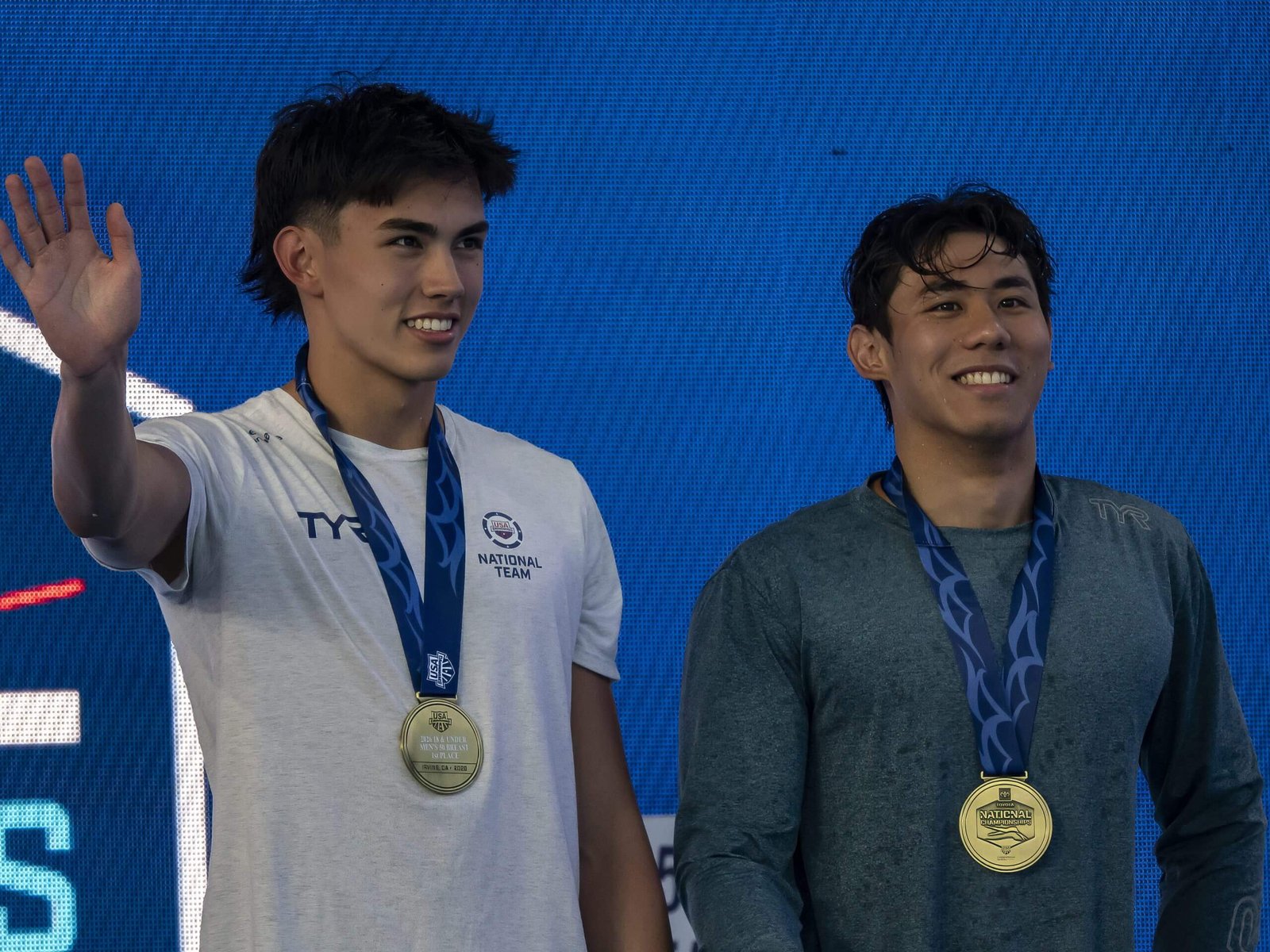
With National Title, Watson Nguyen Adds to Penn’s Breaststroke Legacy
There’s nothing easy about being a student-athlete at the University of Pennsylvania.
The academic rigor at an Ivy League school leads to hours spent studying. There is the pressing need to obtain an internship and earn job experience. And of course, there’s a simmering urge to enjoy the social aspects of college life.
Watson Nguyen felt all of these pressures as he entered the summer of his junior year. And yet, the swimmer decided to commit to a full summer of long-course training in order to prepare for U.S. Nationals.
“There’s been so much pressure in my life surrounding jobs, internships,” Nguyen said. “I felt like I owed it to swimming to compete for a full, long-course season.”
The swimmer certainly paid off his hypothetical debt to the sport, shocking the country with a recent national championship in the 50-meter breaststroke. It was a race Nguyen feels incredibly proud of, even weeks in its aftermath.
“I knew I was due for some time drops, but I didn’t think it was going to be that big,” he said. “I just wanted to improve my time, and I ended up coming home with a win.”
Nguyen was far from the favorite in the championship heat, where he raced against Olympian Michael Andrew and 100 breaststroke national champion, Alexei Avakov. But the 21 year-old’s performance shouldn’t come as a shock, either. He continues a long legacy of elite breaststrokers from Penn, including Olympian Matt Fallon and former U.S Open record-holder Brendan McHugh.
At Nationals, Nguyen produced a winning time of 26.65, which was .26 ahead of Andrew. The time is ranked 10th in the world.
“It’s wild to even be mentioned next to them,” Nguyen said. “They’ve been the gold standard (at Penn).”
After a triumphant swim, Nguyen will look to follow in his predecessors’ footsteps, and help make Penn an attractive destination.
“A lot of the recruits are starting to know our reputation,” he said. “This is a place that understands the process (to being a great swimmer).”
A Focus on the Start
For Nguyen, the “process” at Penn has always helped him deliver great collegiate performances. He finished first in both the 100 and 200 breaststroke events at last season’s Ivy League Championships, reaching the NCAA Championships for the first time. With just two years left with the program, though, the swimmer desired more.
“I hadn’t completed a long course season in years,” he said. “It kind of felt like, if I don’t do this now, when will I?”
His work this summer largely focused on sprinting, and more specifically his start. It’s an area that’s been a struggle in recent years. Nguyen felt he often took too long underwater in the 50, and looked to speed up the timing of his pullout.
“I was doing ‘get-out swims,’ where we would challenge ourselves to hit a certain time in the middle of practice, and skip the remainder of the set as a reward,” he said. “It was really just about having a good, consistent start and breakout.”
The swimmer’s start still wasn’t perfect, he admitted, finishing behind the field. But he still considered his intense focus this summer worthwhile, especially given the result. It’s the first time that Nguyen has ever truly committed to sprint training, due to his tendency to also swim the 200 breaststroke, 200 I.M and other events at Penn.
Nguyen’s coach, Mike Schnur, explained that this mentality was a key part of Nguyen’s personality: a persistent desire to find new ways to get better, and a regimented focus. He recalled a practice early in the swimmer’s freshman year, when he competed against the then-senior Fallon.
“He was so angry that he had lost, even though it had come against the fastest breaststroker in the nation,” he said. “That drive, that competitiveness has really shown from the beginning.”
Nguyen’s close teammate and fellow breaststroker, Peter Whittington, regularly sees the desire.
“He’s such a driven person, “ Whittington said. “He knows what his goals are, and knows he’s not going to let anything get in the way of achieving them.”
Training for Toughness
In Whittington’s eyes, much of Nguyen’s mentality has been forged by Penn’s style of training. He explained that under Schnur, the team swims a high volume of breaststroke on tight intervals, a serious challenge for the athletes.
“Mike’s philosophy is that if you work hard, you’ll see the results, and we certainly have,” he said. “This spring, we were swimming so many 50s breaststroke on all kinds of intervals, and then ended up hitting the exact splits we were hitting during training at our big meets.”
That philosophy stems as far back as when Fallon was initially deciding on a college, years ago. He remembered the rigor of Penn’s practice schedule being a part of his decision to join the team.
“I’ve always done a higher amount of yardage and more workouts, and it’s always worked for me,” he said. “The style of training which Mike championed was really important to me.”
Fallon’s passion, and the work he put in, reflected across the entire pool deck, according to Whittington and Nguyen. Both swimmers, who swam with Fallon for two and one years, respectively, pointed to his leadership at practice as motivational in their journeys.
“If (Schnur) was doing a set with Matt, I knew that someday that was what I had to be doing to accomplish my goals,” Nguyen said.
That pursuit of Fallon’s greatness continues in Nguyen’s training today. Schnur explained that he often gives the junior sets that Fallon would attempt to complete on his way to becoming an Olympian in the 200 breaststroke.
“I let him do these sets, at times knowing he’s going to fail, since Matt was such a special trainer,” Schnur said. “But I do it because that failure will make you stronger. If you’re not failing, you’re not reaching your potential.”
The hard work continues in the weight room, a place where Nguyen has become an expert. He often does special lifting sessions outside of the team’s training program.
“We’ve reached a point where we’re fine sometimes even letting him back off in the pool, and allow him to do what he needs to do in the gym,” Schnur said. “He’s so in tune with his body, and as long as he doesn’t hurt himself, we feel the gym work has a ton of benefits.”
The coach admitted it was a very different training style from Fallon. He described Nguyen as a much more talented athlete in the weight room, whereas Fallon was stronger aerobically in the pool. Even with their differences, though, Whittington pointed to Fallon’s work ethic as a large reason for Nguyen’s relentlessness.
“He would do practices by himself before big meets, and just not tell anyone because of his humility,” Whittington said. “Seeing that focus just made myself, and Watson especially, even more driven.”
Fallon was quick to deflect the credit. He stressed that the two underclassmen had come in with a unique mentality, one that prepared them for success.
“These were two guys who came in so prepared,” he said. “Neither needed any convincing that this style of training would make them successful.”
That attitude is one Nguyen and Whittington now take upon themselves, eager to push their teammates the same way their former captain pushed them.
“We’re going back and forth every single day,” Nguyen said. “It’s such a great environment for us, and we hope to spread it to everyone around us.”
Putting Student Before Athlete
Schnur’s rigorous style of training takes a heavy physical toll on the swimmers. Nevertheless, it at times pales in comparison to the challenges the athletes face in the classroom. Penn is an Ivy League school, ranked seventh nationally per U.S. News and World Report. The swimmers admitted that balancing swimming with the adversity they face in the classroom can be increasingly difficult.
“It’s so much to balance,” Nguyen said. He is currently a double major in both finance and advanced mathematics. “To do all of it, and still have some social life, my Sundays become incredibly stressful.”
Once again, though, the swimmer learned from Fallon’s approach.
“That was the biggest thing I ever took away from him, was how relaxed he was,” Nguyen said. “He taught me that you can take some time to focus on academics, and then separately transfer your energy into the pool later.”
Fallon, who was a dual major in both computer science and economics/finance, sees the way in which Penn’s athletes balance academics and swimming as an essential part of the experience.
“It’s great that Penn has sponsored a culture which says you can be a good student, you can get all these internships, and still stay in touch with your sport,” he said.
Schnur emphasized that Nguyen handles the stress uniquely well.
“He might be better academically than he is a swimmer,” he said. “He has made being a great student, as well as an athlete, part of who he is.”
In Schnur’s eyes, the dedication will pay off in the long run.
“I see him similarly to a swimmer like Nic Fink, who can balance a successful career (Fink is an engineer), a family, and a great swimming career,” he said. “He’s going to be truly special, inside the pool and out of it.”
“Hard Work Pays Off.”
After winning the national title, Nguyen has put himself on the map as a sprinter. However, he plans to train for other events, given the potential needs of his team.
“I could totally see myself still doing a lot of hard races, like the 200 I.M, especially given how we train,” he said. “I’m definitely not a drop-dead sprinter.”
That flexibility is part of what Whittington refers to as Nguyen’s “mental confidence.” He sees the swimmer as someone who can approach any race with a level of faith.
“You could’ve argued Watson was the underdog, getting up there at Nationals, but Watson always knew internally he was going to be on that stage,” he said. “He’s always felt he’s capable of being the best.”
Penn’s newest star will certainly be a bigger name this fall, standing out on every psych sheet. His mentor, who faced similar experiences, believes he’ll fare well in response.
“The hard work just continues to pay off for him,” Fallon said. “It’s going to be great to see it continue to come to fruition.”

