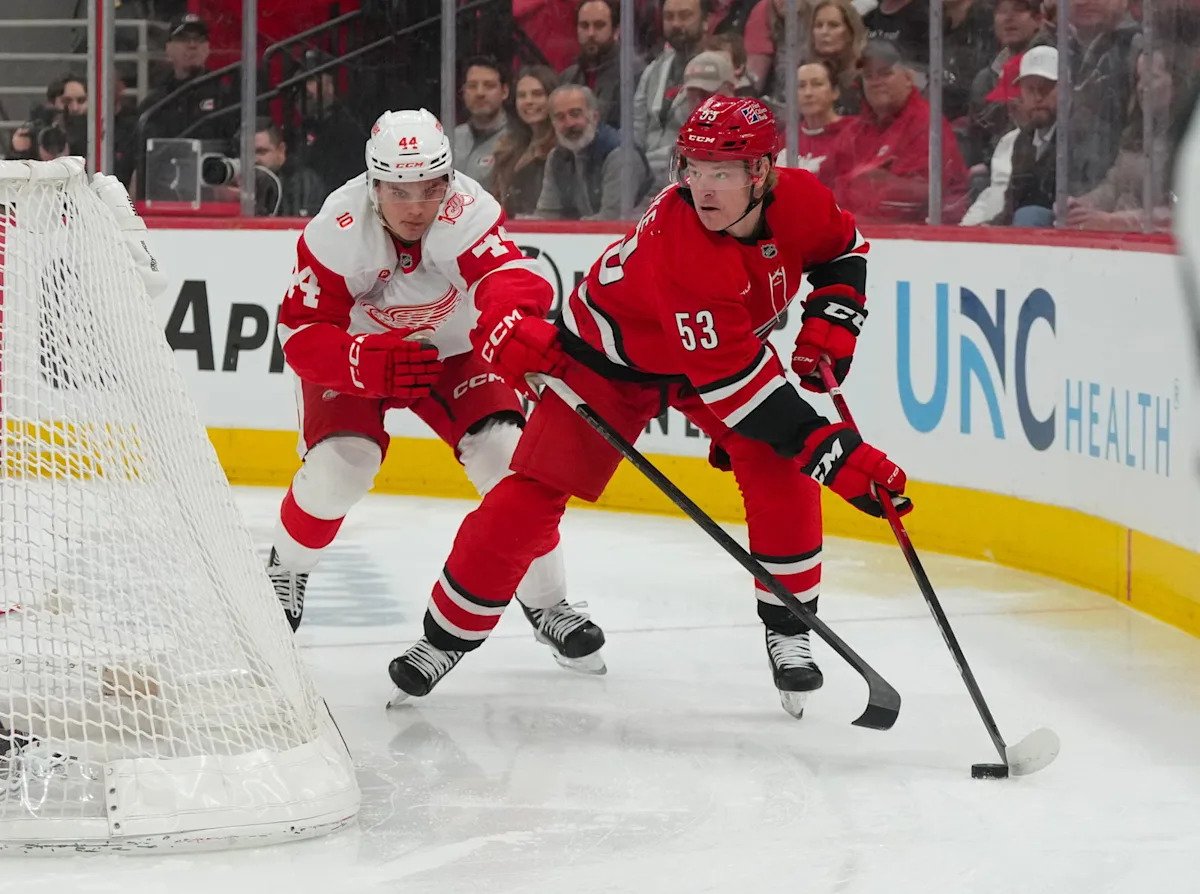
Another NHL season has come and gone without the Detroit Red Wings anywhere near a Stanley Cup celebration, and as the confetti falls for another organization, it presents yet another opportunity for the Red Wings to study what separates contenders from pretenders.
This past season, the lessons come courtesy of the Western Conference champion Vegas Golden Knights and, more importantly, the Stanley Cup champion Carolina Hurricanes.
Advertisement
The Golden Knights offer perhaps the most instructive case study in modern NHL roster construction as General manager Kelly McCrimmon has built a culture of aggressive, calculated risk-taking, consistently flipping draft assets and prospects for proven impact players at exactly the right moments.
Almost no players on the Vegas roster is homegrown, yet the Golden Knights have remained perennial contenders by making their organization appear as an irresistible destination, the kind of place where players know the front office is serious about winning at all costs. That reputation attracts talent, and that talent helps the team continue to win games.
That culture of urgency is precisely what Detroit has severely lacked in recent years as the situation has reached a boiling point when franchise captain Dylan Larkin requested a trade, citing in the past that their is a lack of organizational vision when it comes to genuinely contending for a Stanley Cup.
The Red Wings possess more than enough assets to make the kind of aggressive moves Vegas has made repeatedly. However, the difference is that general manager Steve Yzerman has not viewed those swings as the right fit for where the franchise stands.
Rather than pursuing players like Robert Thomas or Quinn Hughes, players who are home run talents and could genuinely elevate the roster, Yzerman has tended toward singles and doubles. This past season, Justin Faulk and David Perron are useful additions, and Faulk in particular looks like he could be a meaningful contributor going forward, but on a true contender he would be the third or fourth addition when making a run towards a Stanley Cup.
Advertisement
Vegas built its identity by going all in, with Jack Eichel, Tomas Hertl, Mark Stone and most recently Mitch Marner being acquired not by playing it safe. They were acquired by selling assets aggressively and timing those moves with precision. It is worth noting that the financial model matters just as much as the boldness of the moves.
Bookmark The Hockey News Detroit Red Wings team site to stay connected to the latest news, game-day coverage, and player features.
The only players to win the Stanley Cup while carrying eight-figure cap hits are Eichel with Vegas and Sergei Bobrovsky and Aleksander Barkov with Florida. Keeping individual salaries at or around the $10 million range allows organizations to build the kind of roster depth that survives a two-month playoff grind and the Hurricanes are the clearest proof of that principle.
Carolina won the Stanley Cup without a single player earning eight figures, with Sebastian Aho serving as the highest-paid player on the roster at $9.75 million. They also enter the off-season with close to $12 million in available cap space, a testament to how methodically the organization has been constructed. They didn’t build their roster overnight as they developed some homegrown talent but also made aggressive moves for impact players when the moment called for it.
They went out and added Nikolaj Ehlers in free agency, traded for superstar winger Mikko Rantanen and later landed Logan Stankoven from Dallas in a follow-up deal, brought in experienced contributors like Taylor Hall at the right price, and filled their bottom six with reliable, cheap depth pieces in William Carrier, Jordan Martinook, Eric Robinson, Mark Jankowski and Jordan Staal, who has never been easy to overlook regardless of where he plays. They also added K’Andre Miller via trade and signed Sean Walker to shore up the back end.
Advertisement
Every one of those moves was calculated and added a different touch to a roster that would go on to slowly develop into a Stanley Cup champion.
The concern in Detroit is that Yzerman’s approach, while patient and methodical, does not appear to be trending in that direction with enough urgency. Additions like John Gibson and Justin Faulk make sense as finishing pieces for a team already on the cusp of contending.
But they cannot be the headline moves for a team still trying to establish itself as a legitimate threat. Taking swings at players like Robert Thomas or Quinn Hughes, players who push a roster forward rather than merely maintaining the status quo, is what separates the organizations hoisting trophies from the ones watching them do it. Until Detroit starts making those kinds of moves, the gap between the Red Wings and the league’s elite will likely remain exactly where it is.
Never miss a story by adding us to your Google News favorites!
Image
For action-packed issues, access to the entire magazine archive and a free issue, subscribe to The Hockey News at THN.com/free. Get the latest news and trending stories by subscribing to our newsletter here. And share your thoughts by commenting below the article on THN.com or creating your own post in our community forum.

