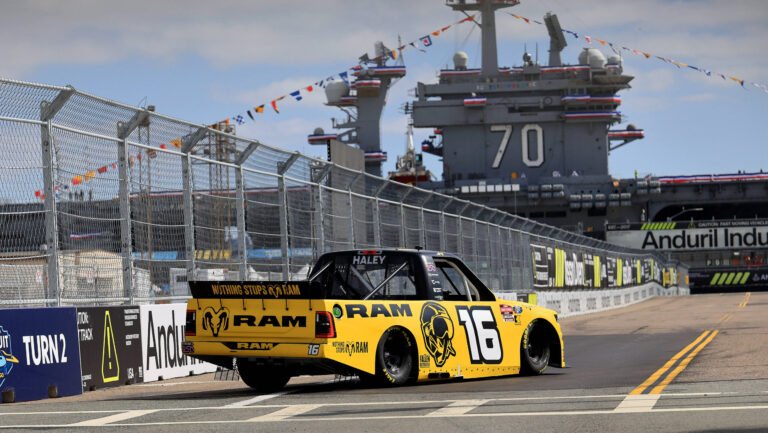
For most NASCAR race weekends, fans arrive and see the finished product.
The grandstands are full. The catchfence is in place. The track is ready.
What they rarely see is everything that happened beforehand.
Advertisement
This weekend’s historic debut at Naval Base Coronado is different.
Before NASCAR’s top series ever takes the green flag in San Diego, officials will have spent more than two years planning, negotiating, designing and building what may be the most complicated temporary venue in the sport’s modern history.
The 3.4-mile course isn’t located inside a stadium. It’s not a traditional street circuit, either.
Instead, NASCAR has transformed portions of an active U.S. military base into a race track, creating a first-of-its-kind venue that winds through base roadways, past hangars and across sections of an operational airfield.
Advertisement
And according to NASCAR officials, getting to this point was every bit as challenging as it sounds.
NASCAR wasn’t just building a race track
One of the most surprising parts of the project had nothing to do with asphalt.
It was communication.
According to NASCAR Senior Director Jeremy Casperson, much of the past two years was spent learning how to operate inside a military environment where the priorities are understandably different from those of a racing series.
“We’ve been working with them for over two years, just understanding exactly what we can and can’t do,” Casperson told NASCAR.com.
The challenge went deeper than construction plans and site maps.
Advertisement
“One of the difficult things is we speak a language, NASCAR does, and the Navy — rightly so — speaks their own language,” Casperson said. “And trying to learn their language and exactly how it translates to our language and vice versa, it’s been a learning process, and I think we’ve made really good strides, and we feel like we’re in a great spot.”
Those conversations helped shape every phase of the project.
Because unlike a traditional race facility, Naval Base Coronado could not simply shut down while NASCAR moved in.
The race track had to fit around the Navy, not the other way around
That’s what makes this event so unique.
Advertisement
NASCAR wasn’t handed an empty property and told to build whatever it wanted.
The base remained active.
Aircraft still flew.
Military operations continued.
Personnel still had jobs to do.
As a result, NASCAR’s planning process often revolved around accommodating the Navy’s mission while simultaneously constructing a race venue.
“We had to put together a timeline of where we were going to be, where on base, and get that blessed by the Navy,” NASCAR operations director Brian Geye told NASCAR.com.
Part of the course even runs through areas adjacent to ongoing airfield activity.
“Part of the course runs on base roadways, which you would think would be harder to manage,” Geye said. “They’re actually easier to manage because the other flip side is we’re on the airfield and they’re still flying.”
Advertisement
That reality created a balancing act unlike anything NASCAR has faced before.
The sport wasn’t just preparing for a race weekend.
It was preparing for a race weekend inside a facility whose primary responsibility remains national defense.
The numbers behind NASCAR’s most ambitious temporary venue
The scale of the project helps explain why it took more than two years to reach this point.
According to NASCAR officials, workers installed approximately 6.8 miles of wall and fencing around the course. More than 3,100 barriers were in place by the final week before race weekend.
The work extended far beyond simply outlining the track.
Advertisement
Officials said more than 150 locations required welding or surface improvements. Areas containing manhole covers, utility access points, electrical infrastructure and other permanent military-base features had to be adapted for competition.
“We didn’t really remove anything, but we added some pavement for the chicane, and we added some pavement in the Turn 4 area,” Casperson said. “We had some real big undulation down by the crane rails. We smoothed it out really the best we could. It’s not smooth, but it’s a heck of a lot better than it was.”
Even with months of preparation, crews continued working deep into June to finish construction.
NASCAR is entering completely uncharted territory
The sport has experimented with bold ideas before.
Advertisement
The Clash at the Los Angeles Memorial Coliseum was considered ambitious. The Chicago Street Race was viewed as a major leap.
Naval Base Coronado feels different.
Those events pushed NASCAR into new environments. This one pushes NASCAR into an environment few major sports have ever attempted to use in the first place.
That’s why the most impressive part of this weekend may not be the racing itself.
It’s the fact that NASCAR and the U.S. Navy found a way to make it happen at all.
After more than two years of planning, thousands of barriers, countless meetings and one enormous logistical puzzle, NASCAR’s newest race track is finally ready.
Now comes the easy part.

