The WNBA has all of our attention, but now I just want to look away. The league of powerful women — Caitlin Clark exploring the boundaries of the game like an abstract painter, Olivia Miles personifying the rebirth of slick, Breanna Stewart pulling out new tricks from her offensive arsenal, A’ja Wilson shapeshifting nightly into a GOAT — feels less like a sport and more like a societal powder keg.
It has spiraled into a rinse-and-repeat drama.
Advertisement
A Black player clotheslines a White player, and it’s time to flinch. An ejection ensues, and the banished player, unfortunately, finds her phone and straightaway posts on Threads, and we cringe. Then the predictable rants trend on social media apps and morning shows.
The WNBA has proved it can hold our eyeballs ever since “the Caitlin Clark effect” introduced a new audience to the game and generated blockbuster ratings. However, with more and more moments like Saturday’s meltdown between the Indiana Fever and Chicago Sky, it’s becoming exasperating.
And what is “it”?
It’s every politician shilling for votes off the jet stream of Clark’s fame, every troll who couldn’t tell the difference between Chelsea Gray and Allisha Gray but suddenly has hot takes about the league. It’s the conversation, a trap, really, that hasn’t grown past Black versus White, conservative versus liberal, straight versus gay.
Advertisement
More than any other sports fanbase, the new and broader audience that consumes the WNBA craves the simple and salacious. That nature to wallow in mud might never change as long as people rule this planet. But while there are enough factions clashing against the country’s most popular and prosperous women’s professional sports league, the players of the W — the ones who should be safeguarding their commodity — are falling into the trap. Sometimes, willingly.
It’s Fever guard Sophie Cunningham choosing to weigh in on a divisive topic of transgender athletes in women’s sports, a grossly exaggerated “issue,” and opening the door for a flood of agitators to defile the discussion.
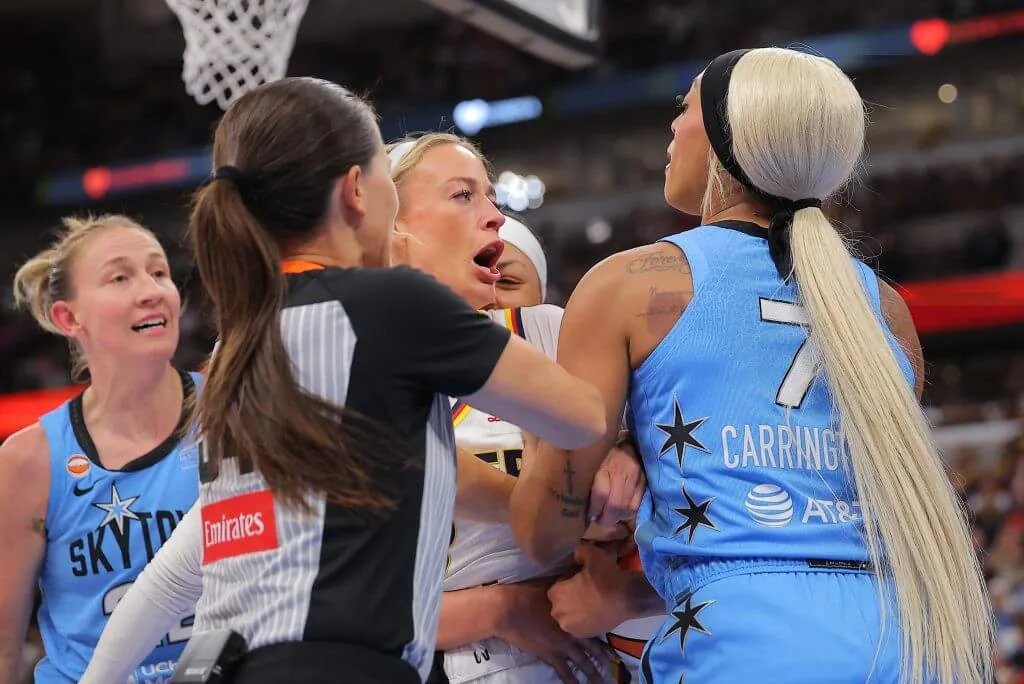
It’s also Sky guard DiJonai Carrington, packing matches and carelessly tossing them onto the already incendiary discourse of race by posting “WHITE PRIVILEGE” after being ejected for her flagrant foul on Cunningham.
It’s Phoenix Mercury forward Alyssa Thomas’s fist to Clark’s neck, Seattle Storm co-owner Celeste Keaton’s F-bomb directed at two teenage fans. It’s the piling on whenever anything like these events happen.
Advertisement
Sports truly are supposed to be a diversion, something we consider fun, a reprieve from real life, but it feels like psychological warfare just to engage with the WNBA. It’s getting to the point where you have to brace for impact every time “WNBA” pops up in the algorithm.
Though now the league enjoys big-time audiences, like the 2.52 million viewers ABC averaged for the Fever-Minnesota Lynx game on Aug. 2, the mayhem that swallows up the sport is at risk of alienating the die-hards and turning off the interlopers, too.
Remember during their rookie seasons when Angel Reese gleefully clapped after Clark absorbed a flagrant foul from Chennedy Carter, and that became a whole thing? That was child’s play compared to the cesspool that has become the daily WNBA conversation.
Advertisement
Let’s start with this truth: Cunningham has every right to stand by her belief that transgender women shouldn’t be allowed to compete with biological women. She’s 10 toes down, and to be sure, so are 79 percent of Americans who share her opinion, according to a New York Times/Ipsos survey. And Indiana, the state Cunningham plays in, was one of the first to pass a bill banning transgender girls from participating in sports at public schools — which means this issue barely impacts the young girls who come to Fever games to support her in their No. 8 jerseys. Nor does it rise to the level of a national crisis since institutions like the NCAA, the United States Tennis Association and the Olympics all have eligibility rules in place. There’s also the fact that no transgender women are even competing in the WNBA, making this an argument largely based on a hypothetical scenario.
Yet, because Cunningham plays in a league boosted by the LGBTQIA+ community, her opinion against the involvement of transgender athletes in women’s sports has sparked irony and amusement among those seeking to ignite this cultural war. Now we have ex-NBA players Enes Kanter Freedom and Royce White mockingly declaring their eligibility for the WNBA Draft. These far-right flamethrowers, these retirees thirsty for attention, these unserious stunt artists are here only to condemn the theory of inclusivity and taunt the women of this league. Please, let me off this ride.
Then there’s Carrington, who took out Cunningham in the air. Though Carrington previously has had mix-ups with Clark, Cunningham’s teammate, when tough defense and accidental swipes across the face made Carrington a target, no one can really know her intentions Saturday. In keeping the focus just on that moment, her foul against Cunningham was unnecessary and could’ve been dangerous. But Carrington’s social media post after the foul was even more unnecessary, and much more dangerous.
Makayla Timpson, the Indiana Fever center affectionately known as “KK,” started against the Sky and played decently enough to join her superstar teammate and head coach Stephanie White in the postgame media session. The opening line of questions to the trio centered on Carrington’s flagrant foul. When a reporter began his question about Carrington’s social media post, Timpson heard the words “White privilege” and reacted by widening her eyes and glancing to her left. She then covered her face and rubbed her temple, likely hoping to avoid having to comment.
Advertisement
KK, girl. Your expression said it best.
We all could’ve gone without hearing Carrington’s instant thoughts following her ejection. But she allowed herself to be accused of playing the race “card,” as Cunningham called it. Also, she made it more untenable for her African-American peers who will face legitimate bias.
Carrington, a Black woman who has been in same-sex relationships in the WNBA, is exactly the kind of punching bag for the most unhinged faction of new fans. After those run-ins with Clark years ago, Carrington was called everything but a child of God across social media. She has indeed experienced racism and homophobia. But on Saturday, she undercut the phrase “White privilege” — reducing it from a legitimate societal concern for people who look like her to a sneering chant for the far right.
These moments aren’t just problematic, but they’re overshadowing the positives, like Kayla McBride torching the net for a record-breaking 10 3s, the young Washington Mystics shushing their doubters with seven straight wins and Jessica Shepard emerging as a triple-double revelation in Dallas. In certain doses, train wrecks and dumpster fires can be juicy. Fun to watch, even. However, a constant cycle of quarrels can wear down an audience. Eventually, tension takes a toll, and the WNBA will have to pay that price.
Advertisement
This article originally appeared in The Athletic.
Chicago Sky, Indiana Fever, WNBA, Opinion, Culture, Google Women’s Sports Expansion, The Athletic Women’s Basketball Show
2026 The Athletic Media Company

