Sam Falls Just Short: 3:40-Barrier Continues to Evade Contenders, Even With World Record Gone
Sometimes, the longest-lasting world records fall at the least-expected moment. Nineteen years ago, when Janet Evans still held the world records in the 800 and 1500 freestyle, Kate Ziegler claimed the mark in the 30-lap race at a low-stakes, otherwise-nondescript meet in Texas. The pursuit of the men’s 50 freestyle record took 17 years before Cam McEvoy finally downed it, not at a selection meet or championship meet but the China Open.
Likewise, the men’s 400 freestyle record survived until a stunning performance from Germany’s Lukas Martens at the Stockholm Swim Open last April. Martens was already the Olympic gold medalist in the event and a strong contender for the mark, but the breakthrough came when least expected. Still, that time of 3:39.96 finally knocked the 3:40.07 set by Paul Biedermann during the supersuit era from the record books.
Once that mark was gone, once a swimmer finally broke through the 3:40-barrier, more would surely follow. Not quite — after more than 14 months, no one has come close to Martens’ new record, including the 24-year-old German himself. Martens clocked 3:40.61 at the German Championships in May 2025, then won the world title in an incredible duel with Australia’s Sam Short, coming out on top by just two hundredths with a relatively slow time of 3:42.35.
Lukas Martens, the world-record holder in the men’s 400 freestyle –Photo Courtesy: Emily Cameron
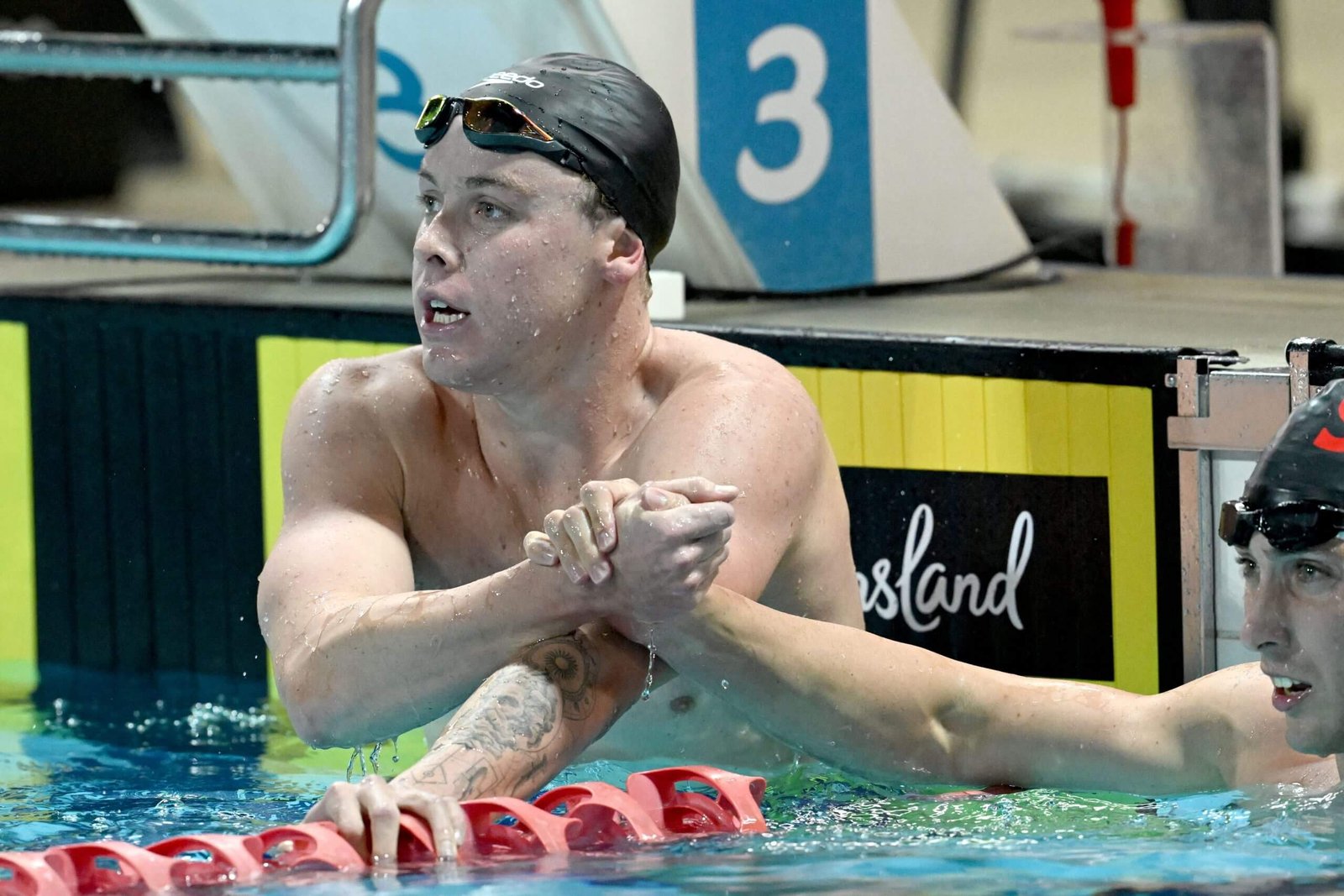
Since then, Martens’ quickest time is the 3:41.76 he swam in April. For 2026, the world-leading time belongs to Short, thanks to a record-scaring swim Monday at the Australian Swimming Trials. The 22-year-old was under world-record pace for most of the race, flipping a hundredth quicker than Martens at the 350-meter mark, before falling off the pace down the stretch. He finished in 3:40.67, seven tenths behind the world record but a personal best by one hundredth.
Short belongs to a group of five swimmers with best times in the 3:40-range. He swam that fast for the first time at the 2023 World Championships, another final that came down to the wire as he edged Tunisia’s Ahmed Hafnaoui by two hundredths, 3:40.68 to 3:40.70. Biedermann (3:40.07) remains the quickest of the 3:40 swimmers, with Ian Thorpe just behind with the 3:40.08 that stood as the world record from 2002 to 2009. Sun Yang rounds out the group with the 3:40.14 he swam on the way to Olympic gold in London.
Behind them are six swimmers in the 3:41s: Tunisia’s Ous Mellouli, Australia’s Elijah Winnington, China’s Zhang Lin, Korea’s Park Tae Hwan, Australia’s Mack Horton and China’s Zhang Zhanshuo. Zhang swam his best time this year, going 3:41.55 in a breakout effort at the China Open, while Winnington is the only other member of the group still competing, having gone 3:44.17 for second place behind Short at Australian Trials. After that, the list drops off to Korea’s Kim Woomin at 3:42.42.
Where is the deluge of 3:39s? Still nowhere to be found. The expected jump in this event has never happened, and swimmers still struggle to maintain the sizzling pace required down the stretch.
Short believes he will be the next swimmer to get there, admitting after his race, “I’m obsessed with that 3:39 barrier.” He added, “I think it’s only a matter of time.” Short needs that self-confidence going into his championship meets this year, the Commonwealth Games and Pan Pacific Championships, and he does appear on track for a drop in the coming months. But remember, two years ago, he and Hafnaoui both sat on the precipice of that world record, only for both men to struggle mightily in the Olympic year. Short fell to fourth in the Paris final while Hafnaoui did not attend the Games at all.
We will see in the coming months if Short or anyone else can join the 3:39 club. He and Martens will not match up this year in their regional competitions, with Martens focusing on the European Championships. Zhang and Kim try to post big performances at the Asian Games (and possibly Pan Pacs) while Hafnaoui could have a resurgent summer after his impressive NCAA Championships. The Americans are further off, but Rex Maurer made a big jump last year while Luka Mijatovic and Ryan Erisman are improving quickly.
So many close calls in the men’s 400 free, only one breakthrough. Seemingly a forgone conclusion to happen in 2024, the first 3:39 waited until eight months later. Since then, nothing. Who is next?

