My road bike and my track bike. My mountain bike and my son’s mountain bike. Both of our BMX bikes and two bikes—a strider and a pedal bike—for my daughter. Six helmets in three styles (aero, mountain bike and full-faced BMX), several different types of riding kit (bibs and a road jersey, a mountain-bike jersey and shorts, BMX pants, jerseys, and pads) clipless shoes, BMX sneakers and mountain-biking shoes. And, of course, a pound or two of Gummy Bears and plenty of snacks, courtesy of my wife.
This is what my family packed in both of our cars for a weekend in Rock Hill, South Carolina (US), where, thanks to the town’s world-class biking facility, the Rock Hill Outdoor Center, you can enjoy just about every type of bike riding and racing in the span of just one weekend.
The main parts of the facility are three-fold: an Olympic-standard 250-meter velodrome, a BMX Supercross track, and a 1.1-mile dedicated criterium course. All of it is built within the bounds of a growing housing development called Riverwalk. At just 20 or so minutes south of Charlotte, Rock Hill is easily accessible and, over the last few decades, has been growing in renown as one of the East Coast’s premier biking destinations.

We arrived Friday night just in time to enjoy an evening at one of Rock Hill’s bicycling crown jewels: their BMX Supercross track, which is the first Olympic-standard BMX training facility on the East Coast. With a five-meter starting hill for standard BMX racing and an eight-meter hill for BMX Supercross (a far more insane version of the discipline, wherein riders have to sail over massive gaps and even the tall asphalt turns of the BMX track), the complex intertwines both BMX and Supercross into a single, multimodal track.
Beside it, a beautifully crafted asphalt pump track where my eight-year-old son spent every single second between his heats furiously making laps (despite his old man’s suggestion that maybe he should rest his legs a bit) alongside his four-year-old sister who spent the early part of her evening racing her strider bike—the adorable preamble to just about every local BMX race on Earth—on the track’s final two straightaways.
After nearly 30 years away from the sport, I returned to BMX a year-and-a-half ago at my son’s urging. Since then, I’ve raced (well, calling what I do on a BMX bike “racing” is a stretch) with him all over North and South Carolina on any variety of tracks. We’ve ventured down to Rock Hill for a few occasions, local Friday night races, a 2024 National race (where my little guy missed advancing to the main event by half-a-wheel), and as spectators for the UCI BMX World Championships, which Rock Hill hosted over the course of a week in May 2024.
To make a comparison CW readers might best understand: if racing on a local BMX track is like riding an off-the-rack Trek, racing at Rock Hill is like riding a custom-built Colnago V5Rs. It’s smooth, fast, clean, snappy, and very intuitive.

Michael Ventolo-Mantovani
Once a sinewy fixed-gear obsessive with jeans cuffed at the ankle and a pack of cigarettes rolled up in his sleeve, Michael is now more focused on performance and developing a love of riding in his kids. And he still races BMX bikes.
The following morning, I stretched out my tired legs and, while my wife and kids lounged in our hotel beds watching movies, headed back to the biking complex to spend a few hours at the town’s 1.1-mile, fully dedicated crit course, which is just a few feet away from the BMX track.
With 81-feet of elevation per lap, the Rock Hill criterium course is a rare gem. Whereas most crit courses are pan flat and filled with hard rights and lefts (see also: business park parking lots), the Rock Hill crit course is a winding, seven-turn loop that stretches over a large hill, giving it the unique distinction of being something of a climber’s crit course.
“Why build a crit course on a hill?” I asked Rock Hill’s cycling and Outdoor Center supervisor Molly Koester-Bruce. Because, she said, long before the crit course and the BMX track, the velodrome and the massive housing development, this area was a landfill surrounded by fields. Even if they wanted to make a flat crit course, the town couldn’t have levelled the area.
So, rather than try to fix a problem that didn’t really exist, the town decided to build the course onto the slopes of the former landfill. But don’t worry. As someone who rides in Rock Hill all the time, I assure you, there is no evidence of the area’s former role. In fact, it wasn’t until this weekend when I sat to interview Koester-Bruce that I learned of the complex’s trash-filled past.
And while the town’s schedule boasts a regular slate of racing opportunities—weeknight races hosted by cycling coach Chad Andrews, the long-running Hincapie Spring Series, youth-only NICA races, and, this season, a USA Crits race—it is open to the public most days for training and recreational riding. In fact, the morning I rode, the only other people on the track were an older couple making laps on their upright Schwinns, no doubt trying to get some exercise away from any sort of interference from motor vehicles.

(Image credit: Carrisa Rogers)
As the sun climbed higher in the sky, my wife and kids returned to the BMX track, where the town was hosting their regular Saturday practice. Of course, my kids were more interested in darting back and forth between the pump track and the facility’s robust playground, which is a godsend for little BMXers and/or siblings who are still too young to race.
For the third time over the course of the weekend, I swapped bikes—this time, road bike for track bike—and headed down the hill toward Rock Hill’s other cycling crown jewels.
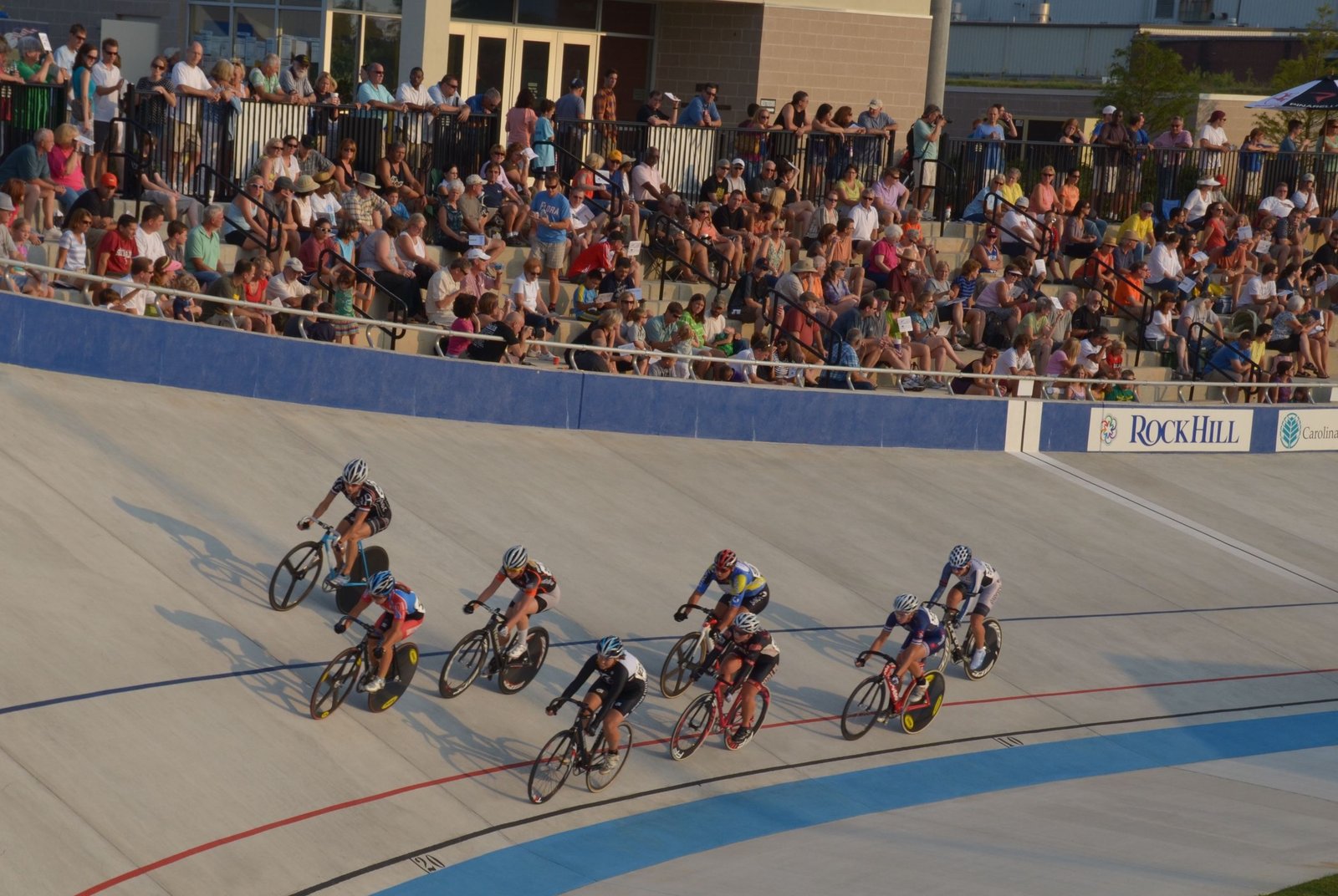
The Rock Hill Velodrome was the first thing to be built in this entire facility, when, in 2008, the town dug a massive hole a flat field and started construction on an Olympic-standard 250-meter track whose turns boast 42.5 degree of banking. According to Koester-Bruce, digging down—rather than building up—was intentional, as the town wanted curious passersby to be able to peek over the track’s railings and see what track racing was all about.
This idea of taking down walls and building exposure into the experience permeates just about every element of bike riding and racing in Rock Hill. The town hosts a monthly track certification course (you cannot ride a velodrome if you haven’t been certified) and weekly grassroots racing; they have regular new rider orientations at the BMX track and a monthly ladies-only BMX clinic coached by local and regional expert women racers; and, unless there is a race on the calendar, the crit course is open to anyone who can ride a bike. Meanwhile, all of their facilities are full of loaner bikes and helmets, and the town has a trailer full of bikes that they regularly bring to area schools, all with an eye of getting as many people on bicycles as possible.

(Image credit: Getty Images)
The Rock Hill Velodrome is one of just 25 tracks in the United States and, at 250 meters, just one of five that are of modern Olympic and World-Championship standard. Since its construction and opening in 2012, the track has added seating for several hundred spectators and a two-story tower for announcers and officials. And speaking of World Championship standards, the track is home to Emily Hayes, a young sprinter who started out as a BMX racer before matriculating to the velodrome, where she currently races at an elite level for Team USA.
During the season, which typically spans from April through October, the velodrome has regular USA Cycling-sanctioned races, a kid’s race series, weekly motorpacing sessions, and has recently hosted the U.S. Master’s Nationals (sidenote: the track remains open for training in the off months).
But this weekend, it hosted just a few racers, training for the coming season. Two of whom were me and my son, who, after many months spent convincing his parents that he was fully capable of riding a bike with no brakes on a track whose turns are damn near walls, became one of the youngest certified riders Rock Hill has ever had.
He and I traded efforts on our standing-start 500s and worked on our flying 200s. Given the previous day-and-a-half spent beating our legs to pulps, neither of us clocked times we would ever write home about. Still, we both agreed that a bad day on a bike was better than a pretty good day off of one. Even better, we agreed that any crash-free day spent in a velodrome couldn’t possibly be bad.
Still, our legs were jellied and we were hungry. And so, after a hearty meal at Rock Hill’s beloved beer-and-burger joint Hobo’s, we turned in to our hotel and konked out as soon as our heads hit our pillows.
Before we loaded EVERYTHING back up to head home on Sunday morning, I drove a few miles up the road to the Anne Springs Close Greenway, to spend my final morning in Rock Hill getting my tires muddy. His tiny legs exhausted from the previous two days, my son decided to forego our planned mountain-biking morning in favour of a few episodes of SpongeBob and a hotel continental breakfast with his mom and sister. I guess there is something to be said for staying in PJs rather than getting muddy.
While Rock Hill has dozens of miles of single track, some of it directly behind the crit course, I’d been encouraged to check out the newly built trails and terrain park at the Anne Springs Close Greenway, a 2,100-acre, protected natural preserve that boasts four long and flowy mountain-bike trails, along with horse and hiking trails, all totalling more than 40 miles, a disc golf course, fishing areas, and even a local nature-focused preschool on site.
As primarily a road and track cyclist, my tires like to stay on the ground. Still, my guide, Nate Chaison, who recently started as a mountain bike guide for the city of Rock Hill, took me for a slow loop through the newly built skills park, which features four jump lines, rock gardens, and a handful of ridiculously fun wooden rollers. I’m sure if I was more capable on a mountain bike, it would have been rad. Chaison certainly looked like he was having fun as he launched over the tabletops, whipping his rear wheel damn near 90 degrees away from his bike.
After an hour or so exploring the Anne Springs Close Greenway trails with Chaison, I headed to a local do-it-yourself carwash, where I cleared all of the peanut butter mud off my mountain bike (don’t worry, I used a low pressure) and most of the mud off my legs before heading back to the hotel to meet up with my wife and kids, hoping they’d at least least saved me some Gummy Bears.
There, we loaded both of our cars with just about every bike, every helmet, and every piece of kit we own and headed back home to rest our very weary but very happy legs.

