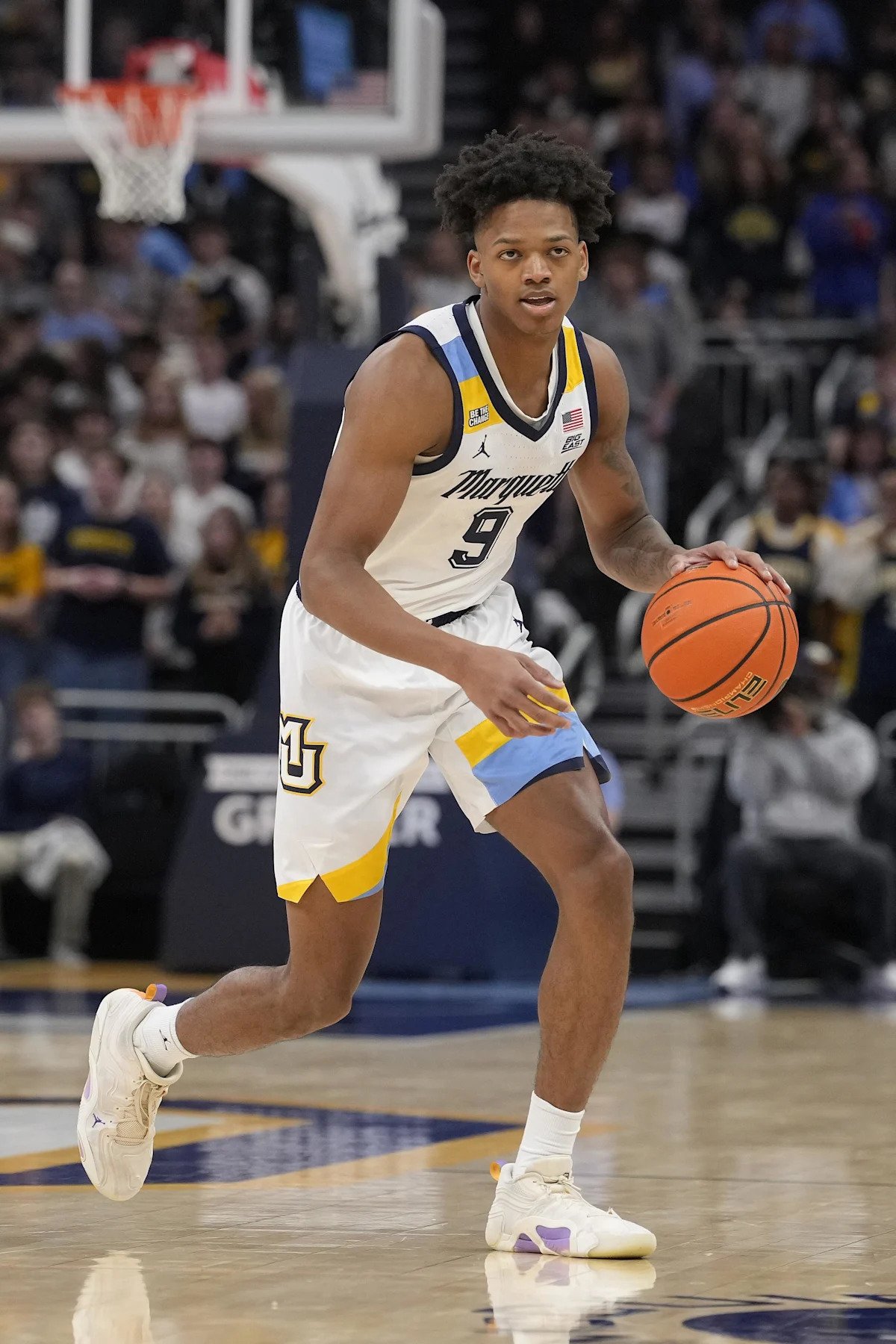
With the 2025-26 season long since in the books, let’s take a few moments to look back at the performance of each member of YOUR Marquette Golden Eagles this year. While we’re at it, we’ll also take a look back at our player previews and see how our preseason prognostications stack up with how things actually played out. We’ll run through the roster in order of total minutes played going from lowest to highest, and today we shift to a sophomore who had a much better run of things after Christmas…..
Damarius Owens
Sophomore — #9 — Forward — 6’7” — 205 lbs. — Rochester, New York
|
Games |
Min |
FGM |
FGA |
FG% |
3PTM |
3PA |
3P% |
FTM |
FTA |
FT% |
OReb |
DReb |
Reb |
Ast |
Stl |
Blk |
Fouls |
Pts |
|---|---|---|---|---|---|---|---|---|---|---|---|---|---|---|---|---|---|---|
|
30 |
15.7 |
1.6 |
3.9 |
40.5% |
0.5 |
2.0 |
27.1% |
1.1 |
1.5 |
71.7% |
0.8 |
1.8 |
2.6 |
0.7 |
0.6 |
0.2 |
1.0 |
4.8 |
|
ORtg |
%Poss |
%Shots |
eFG% |
TS% |
OR% |
DR% |
ARate |
TORate |
Blk% |
Stl% |
FC/40 |
FD/40 |
FTRate |
|---|---|---|---|---|---|---|---|---|---|---|---|---|---|
|
103.9 |
16.6% |
16.4% |
47.4% |
51.9% |
5.5% |
12.9% |
8.3% |
15.4% |
1.4% |
2.1% |
2.6 |
3.2 |
39.7% |
WHAT WE SAID:
Reasonable Expectations
Starting from the perspective of “well, if he’s healthy, he has to be better/do more, right,” we can put last year out on Front Street and say that’s the starting point: 2.6 points, 1.2 rebounds, 9.5 minutes per game. Yeah, that should be easy enough to surpass and that’s probably why the BartTorvik.com algorithm projects him waaaaay past that. 21 minutes a night, 7.1 points, 3.3 rebounds, 1.4 assists per game. In my head, I have Owens slotted behind Zaide Lowery when it comes to the possibilities of who takes the starting lineup spots not going to Sean Jones, Chase Ross, and Ben Gold, so expecting him to start is a little too far. Part of the rotation of guards and wings that substitute in and out somewhat freely as the game rolls along? That’s definitely in the cards here.
Why You Should Get Excited
I can’t help but think about the very first thing we saw from Damarius Owens last season. Okay, technically it wasn’t immediately upon stepping onto the court for the first time, but the very first thing he did that got recorded in the play by play description was snag a steal for a breakaway and then convert the two free throws after Maryland fouled him to stop the bucket.
I also keep thinking about his performance in the Iowa State game when Chase Ross went out with an ankle twist pretty quickly and MU was going to need minutes from someone on the bench to stay in contention with the Cyclones. 11 points, two rebounds, an assist, and a block, including 3-for-4 long range shooting in a raucous Hilton Coliseum is a heck of a “we’re gonna need something from you tonight” performance.
There’s a version of this season both for Marquette and for Owens where his top line talent emerges pretty quickly and maximizing his minutes becomes critical to the Golden Eagles’ success. If he’s got it, then Marquette should run with it. There’s too many questions about this season to just ignore a star-making turn if that happens.
Potential Pitfalls
It is possible that the combination of the groin injury and the toe injury slowed Damarius Owens down a little too much last season, more than normal “he’s a freshman and he’s adjusting to how to get this done at the high major Division 1 level” kind of things. If Owens was just a step or half-step slower than he could have been last year, from a pure physical perspective, then I’m not terribly worried about what I’m about to point out to you.
Hoop Explorer says that Marquette was giving up 108.8 points per 100 possessions with Owens on the court last season against top 200 opponents.
Is that bad, you ask? Well, starting at the perspective of 100 per 100 trips — a point per possession — is average, then yeah, it’s not good. When I point out that Marquette was giving up just 94.2 points per 100 possessions with Owens on the bench, yeah, it’s really bad.
Again: If this is because nagging injuries slowed him down a tad while he was learning how to defend at the Division 1 level, it is what it is and you just hope that getting healthy buys Owens that step back and he’s fine in 2025-26. If it’s “he can’t defend” or something similar, then it could be a very long season for him, especially if Marquette has to plow their way through games without a devastating offense to make things a little bit easier on the defensive side.
Let’s start with this, because it’s a thing that we didn’t know about when the preview was written back in October. Not the surgery that Shaka Smart is going to mention, that we knew about because I linked to Ben Steele getting a quote from Smart about that in the preview. It’s the other thing.
Advertisement
This is from an episode of the Inside Marquette Basketball television show that I believe aired on the FanDuel Sports Wisconsin channel and is posted to YouTube every week, and this episode was posted online on January 21st. I’ve cued it up to the start of the Damarius Owens section of the discussion between Sophia Minnaert and head coach Shaka Smart, and then we’ll transcribe the important parts from Smart. If that doesn’t go straight there, you want to skip to the 15:00 mark.
Emphasis mine here.
Damarius especially, he went through a really challenging start of this season, the first 8 to 10 games or so. A lot of people don’t know this, he didn’t have much of an offseason. He had surgery and so he missed most of the off season. I think in a lot of ways that set him back more so mentally than physically because he came into the season a little bit tentative and a little bit unsure. He really needed some reps and with the time that he was able to play early, he took his lumps, he had some tough moments, but he hung in there and he stayed with it.
There was a couple crucial moments, off the court, where he had to make really, really self-defining decisions about what he was going to be about, who he was going to align himself with, and what he wanted his future to be. He made the right choice because he’s very high character, as high character as there is on our team and he cares about winning and he cares about his teammates. And so that’s why it’s emotional really for me to see him getting some positive results because this has not come easily. We’ve all seen the potential that he has. I think our crowd recognizes it. He played well against Georgetown in our first conference game and you see the fans react to him like, “Yes, this is what we want from this guy!”
Everyone in our program knows he has potential. He’s gotten to the point or got to the point earlier this season where he was just tired of hearing that word because he wants to do it now. He wants to contribute to winning now and now he is. Every game this season that he’s played more than 20 minutes, he’s had a very productive game from a scoring standpoint and normally from a rebounding standpoint. So that is show me and I’ll play you, and it’s exciting.
I’m sorry, WHAT?
I didn’t blog this at the time because, well, let’s be honest about: There’s nothing there to talk about. “I’m sorry, WHAT?” would pretty much be the end of the discussion of it, and since there’s never going to be any further discussion from Smart or Owens as to exactly what that was all about, there’s no point in guessing at what it was.
Advertisement
It is, however, instructive as part of the context to what we saw from Damarius Owens this season.
Guys. You’re never going to believe this, but AMAZINGLY, Damarius Owens started getting a decent amount of playing time for this team riiiiiiight about the time that the relationship between Zaide Lowery and the program in general fractured beyond repair. The 10th game of the season — the spot right about where Shaka Smart said that Owens stopped having a challenging start to the season — was Marquette’s 96-76 loss at Wisconsin, where Owens was ill and did not even travel with the team. That was also the first game where Lowery came off the bench. Game #11 was the road trip to Purdue, Owens played 10 minutes in the 20 point loss, Lowery played 12. Game #12 was the home loss to Georgetown, the first game of the year where Zaide Lowery did not play at all, and that’s the game that Smart himself noted how well Owens performed. TOTALLY A COINCIDENCE, I’M SURE. Anyway, yep, pretty good stuff there: In a 27 minute outing, the longest of Owens career to that point, he had a career high 15 points on 5-for-11 shooting, seven rebounds, and a steal.
With all of this in mind, I think it’s instructive to look at the separation of Damarius Owens’ season. There’s his rough start to the season where he had to overcome some mental hurdles in the words of the head coach, and then there’s everything after Zaide Lowery left and really opened up the rotation for Owens to grab some playing time.
Rough Start: 9 games played — 1 DNP and 1 missed for illness — 2.6 points and 1.2 rebounds per game, just 8.7 minutes per game, and a very not good 32% shooting from the field and 27% from behind the three-point line
Advertisement
The Rest Of The Way: 21 games played — including his first career start out of nowhere as Royce Parham developed back spasms on the road against Georgetown — 5.7 points, 3.1 rebounds, 42% shooting from the field, and a still not good 27% from behind the three-point line, all in 18.7 minutes a night.
I do want to give Owens credit for something here. 49 of his 57 two-point attempts on the season came in Big East regular season play, and he shot 57% inside the arc in those games. He had the 12th best shooting percentage on two-pointers in the entire conference! It’s just that his three-point shooting rate was such where he was firing off just as many twos as threes — I suspect Marquette’s offensive structure bears a lot of the blame here under the “if you’re open, shoot it” mantra — and because the three-point shooting was so bad, it really hurt his overall shooting percentage.
Safe to say that once Owens got his confidence together/was given playing time that wasn’t going to Zaide Lowery, he was contributing more on the stat sheet than he was before that. It’s reasonable to ask if Marquette was actually better with him on the floor, annnnnd, no, that’s not really a thing that we can get behind. Hoop Explorer has Marquette just barely under +11 points per 100 possessions comparing offense to defense when Owens was playing once Big East play started, and literally 0.1 points per 100 possessions worse when Owens was on the bench. The good news is that the defense was better with him out there, 100.1 vs 104.5. If the differential is essentially the same, you’ll take “is better on defense” with him on the floor. It does mean “is worse on offense,” but if you don’t have to score a bunch of points because you’re getting more stops, isn’t that the better way to go about things?
Did anything from mid-December onwards ever really turn into “oh hell yeah, this is a star-making turn from Owens” or anything like that? No, not really, nothing like game after game of that Iowa State game from freshman year or even his performance in the home game against Georgetown as mentioned above. What we did get from Owens was pretty much double digit minutes every single night, in the rotation, contributing, pushing the squad towards that much improved second half of the season, making it clear that he can be a piece that the coaching staff can make use of in the future. That’s not something that we saw from him last year or as this season got started, so it’s a big jump forward for him, even if maaaaaaaybe it had more to do with opportunities being created for him as opposed to actively winning his minutes in the practice gym.
Advertisement
BEST GAME
I think the default setting would be that breakout game that Shaka Smart highlighted at home against Georgetown. The catch is that Marquette lost that game and Owens was on the floor for the final six minutes of the first half as MU went from up 24-16 to down 37-33 at intermission. He also played the final 11 minutes of that game, which involved Marquette giving up a game killing 11-1 run. Not ideal! However, if we look at the other Georgetown game, Owens finished with 11 points, two rebounds, an assist, and a steal in 33 minutes in his first career start which came a something of a last minute surprise AND he shot 2-for-6 on threes (which is fine) AND Marquette won, 76-60.
SEASON GRADE
It’s clear that Damarius Owens had a better sophomore season in comparison to his freshman season. It wasn’t a blowaway season on any level, and it took a massive rupture in the team and a resetting of the rotation in the wake of an atrocious start to the year to get Owens to the point where he was clearly having a better second season in Milwaukee. If we wanted to be particularly biased, we could say that Marquette didn’t actually start showing signs of improvement until after Owens got more playing time regularly, but I don’t quite think that’s the change that started shifting things for MU. He had a few more flickers of achievement like that freshman year Iowa State game, but that was more uncommon than a regularly occurring thing. The biggest thing for me is that once Owens started earning regular minutes this season, it’s clear that he was a positive impact on the defensive end of the court. Maybe not all the way over into being a needle mover or something like that, but the Golden Eagles were better with him out there and that’s going to help him earn more trust from Shaka Smart.
Advertisement
When attempting to set a grade for his season, it comes down to how much do we want to weight the first third of the season? The part of the year where Owens was blocked in the rotation either by Lowery or by his lack of confidence in Smart’s explanation of things is still part of his sophomore season and that has to be a part of the grade here. Because it wasn’t an obvious leap forward, merely a “yep, he’s a useful player” season, and because he didn’t quite get going until the season was a lost cause anyway, I think I can’t go better than a 6.
Follow Anonymous Eagle on social media
Facebook: AnonymousEagle
Instagram: AnonymousEagleSBN
Bluesky: AnonymousEagle

