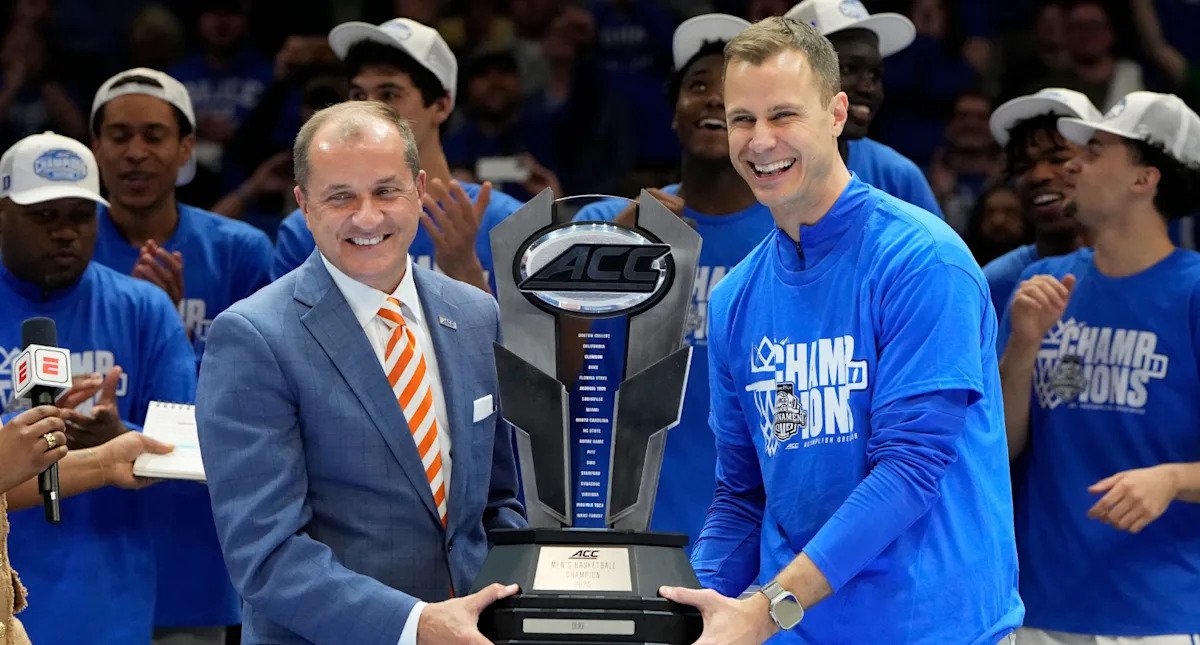
More details are emerging about how Duke pulled off its landmark deal with Amazon, with ACC commissioner Jim Phillips shedding new light on the arrangement Wednesday.
“ESPN was in every one of the conversations,” Phillips said. “To Duke’s credit, they came up with something creative and brought it to ESPN and us. Where it finished and where it started wasn’t exactly in the same spot, but they had to commit to things with ESPN.”
When Duke’s three-game Prime Video package was announced, the obvious question was how a program as thoroughly tied to ESPN as Duke managed to cut a deal with a competing streaming service in the first place. Phillips’ answer is that Duke did not do it around ESPN — it did it with ESPN at the table — and getting there required Duke to make commitments to its primary rights partner, which includes participating in additional ESPN-owned neutral-site events during the 2027-28 and 2028-29 seasons, that were not part of the original proposal.
Advertisement
The Michigan situation, meanwhile, remains unresolved. Per Brett McMurphy, Duke has received ESPN’s permission to schedule nonconference games on Amazon. Michigan, however, did not secure approval from the Big Ten, per a source cited by On3, which means the Wolverines could be replaced as Duke’s opponent in the package entirely. The Big Ten had already publicly disputed the matchup, claiming Fox Sports holds broadcast rights to a Duke-Michigan game based on a previously agreed-upon alternating pattern with ESPN. An IP lawyer who examined the Big Ten’s claim was skeptical, pointing out that Fox’s contractual relationship runs through ESPN and the ACC, not Duke or Amazon.
As Ben Portnoy reported in the Sports Business Journal last week, industry sources view Duke’s three-game package as essentially a replacement for a multi-team event. College basketball fans know these well — the early-season Thanksgiving tournaments where programs travel to Maui or the Bahamas or – to play two or three games over a long weekend. Teams are permitted one MTE per season. Instead of participating in one, Duke has seemingly created its own, had third-party promoters arrange the games, and those promoters sold the package to Amazon. Duke did not sell directly to the streamer.
Whether Michigan ends up in the package or not, the precedent Duke is setting is the more consequential sports media story. If college basketball’s most marketable program can package its own nonconference schedule and sell it to a streaming platform — with ESPN’s sign-off and whatever commitments that required — other programs will be watching carefully to see if they can do the same. The question is how many have the leverage to pull it off, and what ESPN will ask for in return.
The post Jim Phillips: ESPN was involved in Duke-Amazon deal from the start appeared first on Awful Announcing.

