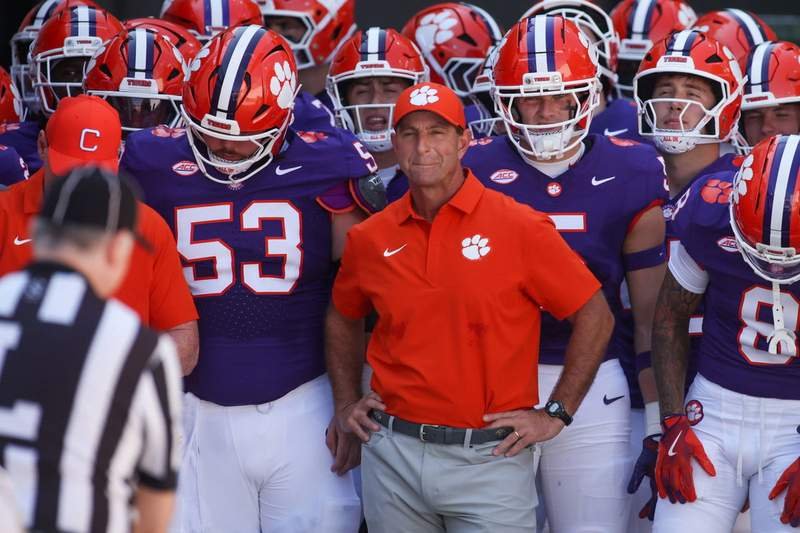
Enter Clemson head coach Dabo Swinney’s office, and you will know why players still choose the program. His two national championship trophies sit proudly on the table. Mementos and pictures from the Tigers’ history dot the walls. A video screen plays Swinney’s photos with friends and coaches like Nick Saban. There won’t be an ounce of effect on Swinney’s legacy if he decides to quit coaching today, and yet somewhere, all of it also feels like vestiges of a bygone era.
There was a reason Nick Saban called quits abruptly on coaching in 2023, after the NIL and the portal era started banging on his door every year. But Saban was 72 when he retired. It was around Swinney’s age (58) that Saban won his first national title with Alabama. Clearly, there’s a long road ahead to tread, and there’s a lot still left to achieve. That subconscious need to be the ‘apex predator’ probably keeps him going. But Swinney’s stature feels like a dinosaur in an era when humans have made the atomic bomb.
Advertisement
“Built, not bought”: Dabo Swinney’s philosophy
About 66 million years ago, dinosaurs walked the Earth. They ruled the planet and shredded everything to pieces that came their way, and there was no way anyone could have challenged their dominance. But a 9-mile-wide asteroid and 66 million years later, the ‘apex predators’ now fuel our cars. That asteroid moment for Dabo Swinney came on July 1, 2021, when U.S. District Judge Claudia Wilken issued an NIL judgment allowing college players to be paid.
“Nothing’s changed in the last 16 years as far as how we run the program,” Dabo Swinney said about his stance for the new era of college football last year. “We stay true to who we are. I know there are a lot of narratives and things that people create and write. I always say you can have your own narratives and you can have your opinions, but you can’t have your own facts.”
Ever since taking over as Clemson’s head coach in 2009, he has put the program, which last won the national title in 1981, on the map. From 2015 to 2020, his team made the 4-team CFP playoff each year, reached the national title game 4 times, and won it twice when the college football world had no answer for Nick Saban’s ‘process.’ He did it all, banking on recruiting, prioritizing relationships, building lasting bonds, and becoming almost the antithesis of the philosophies of coaches like Nick Saban and Urban Meyer.
Swinney retained much of his backroom staff until 2020 and had only three different OCs and two different DCs in his 11 years. Instead of focusing on on-field results, he emphasized long-term commitment with players. From 2015 to 2018, he posted a whopping 98% graduation rate, eclipsed by only Harvard in the country. Clemson wasn’t just a program; it was a lifestyle for players, and everyone embraced it as Swinney reaped endless results.
Advertisement
“Nick Saban has his process. Dabo built a culture,” Clemson’s former director of recruiting, Thad Turnipseed, said in 2017.
“Alabama people, they love Alabama; it’s their normal to be focused on the process, the result, and it works. But what Clemson is building, I think we enjoy it more. ….”I think we’ll look back in 25 years. And he will have changed college football.”
But changing college football is the last thing Swinney has done ever since the NIL era began.
The program made the playoff just once since, albeit rather controversially through an automatic bid, and finished with a 7-6 record last year, when most analysts predicted it would win the national title. And this was the year when Swinney had an offensive coordinator who had been in the system for several years, had an in-house-developed QB, and had the No. 1 returning production in the country. Going ahead, the probability of Clemson improving is low, even though Swinney is reluctantly making peace with the NIL era.
Advertisement
The cost of standing still
From 2021 to 2025, Dabo Swinney brought in just 6 transfer portal players, but 47 players left the program. This year, though, Clemson has brought in 11 players from the portal. Through the 2026 contingent, the head coach has seemed to reinforce his defensive front and has addressed several key defensive areas. But that attempt to finally tap into the portal and use NIL to build the roster seems to have arrived too little, too late for Clemson.
“You look at 7-6, and your instinct is, ‘Oh, we had a down year, next year will be better,” prominent college football analyst Josh Pate said about Clemson’s 2026 season. “No. No, on paper, next year should be worse for Clemson… I don’t see any reason to think it’d get better… Any sizeable improvement with that program at this point would require significant change, and I don’t think Swinney’s the kind of guy at this point in his career who’s going to significantly change.”
Dabo Swinney has that unrelenting belief in his old-school approach to work in an era where teams haven’t won without the transfer portal and massive NIL infusion. Ohio State won the 2024 national title after investing close to $20 million in its roster and consistently churning in portal talent. In the 2024 cycle, for instance, Ohio State signed 9 players from the portal, including Caleb Downs, Quinshon Judkins, Will Howard, Will Kacmarek, and Seth McLaughlin. They were the primary reason for OSU’s national title win. Similar is the case with Indiana.
Before the 2025 season, IU head coach Curt Cignetti brought in 54 players for his national title-winning roster. Think of players like Heisman winner Fernando Mendoza, the whole James Madison core, like Mikhail Kamara, and defensive contributors like Dominique Ratcliff, all of whom were the result of Indiana’s transfer portal strategy. And it gave the college football world an underdog story that reached the mountaintop.
Advertisement
For Dabo Swinney, though, a man who has built his career on relationships and long-term commitment, bringing in one-year ‘rental’ project players seems an ‘abhorrent’ idea, despite the high influx of players he signed from the portal this year.
“No, we’re not going to compromise,” Swinney said last year. “Here’s our purpose, here was our purpose 16 years ago, and that’s still the purpose. And everything we do is about that, period. And as long as we keep that as our north star, we’ll be all right.”
A 7-6 record last year won’t be enough at Clemson, and nothing less than a national title would satisfy the fans. It’s almost like a curse for Swinney, who himself showed the Tigers what to dream but is stuck in conflict between principles he cherished for more than a decade, which still govern his program’s foundations, and the ‘ruthless’ need to win big. At a time when other college football teams were stockpiling talent and building collectives, Dabo Swinney’s Clemson refused the arms race altogether.
The bigger question: Is Clemson a warning or a blueprint?
Last year, the Big 12’s Texas Tech infused $30 million into its roster through its billionaire donor, Cody Campbell, and reached the playoff for the first time. Indiana, similarly, had a prominent and aggressive collective and later got billionaire Mark Cuban’s support, too. Oregon, in a similar fashion, has made it to the playoffs three times in a row, thanks to an endless stream of those ‘Nike’ dollars. Clemson, though, under Dabo Swinney, first refused, then showed reluctance, and finally hesitantly embraced the NIL race.
Advertisement
Clemson, realistically, doesn’t have those high-profile billionaire alumni to support its NIL arms race. After the House vs. NCAA settlement that allowed programs to pay up to $20.5 million to their athletes, Clemson allocated 85 percent of it to football. But churning that revenue consistently and adding $20.5 million every year isn’t as easy as it sounds.
“At Clemson, we always have to have a chip on our shoulder,” Swinney said. “It just is what it is; we don’t have the same alumni base that other schools we have played and had to compete with over the years have. That’s just the way it is. We do not have the same NIL budget as some places have. We do not have some of the same built-in resources from an alumni base and all of that type of stuff.”
In the 2025 fiscal year, Clemson athletics neared $200 million in revenue, butthe reading of the word ‘revenue’ is quite nuanced here. Only $20 million of it came directly from its athletic department’s “revenues,” and the rest came from “direct institutional support.” That institutional support can mean the transfer of state funds, tuition money, or even the program transferring dollars to the athletic department to fund athletes’ scholarships.
Not just that, ‘contributions’ also dropped to $56 million last year from $70 million in 2024. That has happened even as Clemson has repeatedly urged its donors to send money to fund its NIL ambitions, funding the program’s marketing of NIL deals. And that’s when the football program accounts for a whopping $83 million (42%) of Clemson’s athletic department’s budget. Translation: there’s not really enough in its coffers to fund the program’s ambitions.
Advertisement
Clemson’s initial reluctance to embrace the NIL race, something even some small programs like Indiana had done aggressively, has backfired massively. Dabo Swinney’s way might have paid dividends 5-10 years ago, but college football now demands a quick turnaround, a new roster every year or two and leaves no room for stockpiling talent. Because if Clemson won’t offer money, someone else would. And that’s hardly a sustainable way to win the national title, at least for now.
The program that is asking college football to slow down
Estimates place Clemson’s NIL collective spending at around $15.2 million annually, ranking it around 9th nationally. QB Cade Klubnik’s $3.4 million NIL deal has reflected the program’s willingness to spend. But like every aspect, Dabo Swinney hasn’t yet fully embraced that race. One of the biggest names in Clemson’s 2020 recruiting class, D.J. Uiagalelei’s move away from the program signaled just that.
“I get it, you are (sic) against the portal, and you dislike NIL,” D.J.’s father, Dave, said to analyst Josh Pate. “But that’s you and how you feel. Your obligation is to the athletes and what best fits the success of the program.” Like all the things for Dabo Swinney, the embracing of those NIL dollars has come too little too late.
Advertisement
Last year, Clemson announced it would shut down its booster-funded collective, the 110 Society, as the athletic department now aims to lean “heavily into facilitating” NIL deals through its in-house entity, Clemson Ventures. How that would play out after the Collective’s failure remains to be seen. But where did the head coach go wrong, even as Georgia’s Kirby Smart also looks thrifty in his transfer portal and recruiting picks and yet competes at the highest level every year?
Since 2021, Georgia hasn’t spent $20-$30 million each year to fund its roster. Instead, Kirby Smart relied on just being competitive in the NIL market. That way, free agents would be more likely to join a winning program, even if it means getting a little less in terms of NIL and revenue-sharing deals. Dabo Swinney, though, banked all his chips on that ‘winning program’ mindset, without making Clemson competitive in the NIL game. And now, the program doesn’t even look competitive on the field.
“I’m not going to pay a linebacker out of high school more than Sammy Brown. That makes no sense,” Swinney said. “It’s not like we can’t go get a player. If I got to pay the high school kid more than Sammy Brown, well, guess what, that kid’s not coming. A lot of these kids are being overpaid, and then they get there, they’re freshmen, it’s going to be a couple of years, then the coaches cut their money. So now they’re mad, they’re in the portal.”
In a world where Michigan paid Bryce Underwood a whopping $12 million deal, and Miami paid Jackson Cantwell a whopping $2.5 million annually, Clemson could have at least been a tad competitive like Georgia. That was one of the biggest reasons why several college football insiders named the Bulldogs the ‘smartest’ spenders. “Georgia is pretty good with how they spend money,” an ACC NIL collective representative said. “It’s rare that they ever overspend.”
Advertisement
Georgia isn’t asking college football to change; it’s building smartly to survive in this chaotic, unforgiving environment. It’s possible that Dabo Swinney would change to the new era of college football. But he once explored “quitting” if an athlete’s pay-for-play scenario ever panned out. And if his 2026 season were a disaster, it would be about time to do so, even though he remains Clemson’s greatest coach ever. But a casualty of time.
Trending Articles
The post Dabo Swinney’s Clemson Built a Dynasty for a Sport That No Longer Exists. appeared first on EssentiallySports. Add EssentiallySports as a Preferred Source by clicking here.

