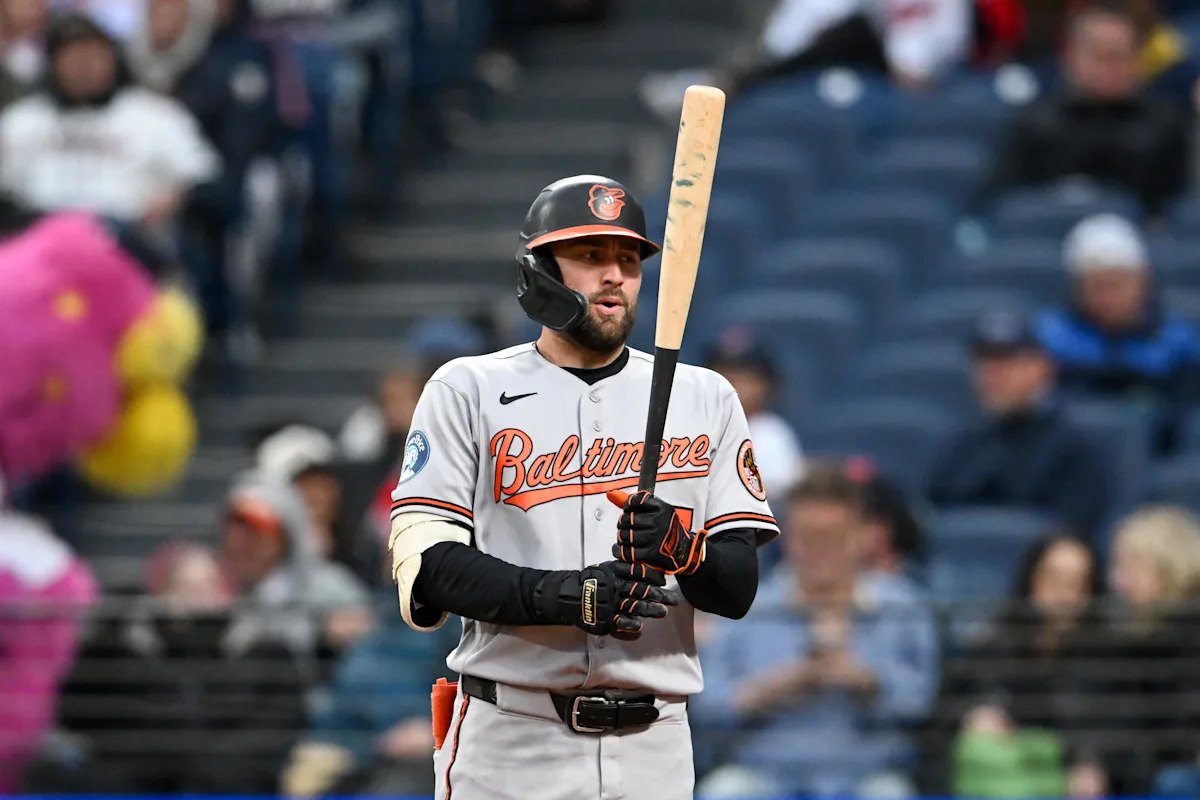
You know your team’s season is going badly when … Oh, here’s a surefire one: in-organization fights start to erupt about why the team is playing badly.
One erupted this week, as beloved MASN broadcaster and former pitcher Ben McDonald unleashed an on-air rant about the O’s overreliance on analytics. Following the O’s 5-3 loss to the Tampa Bay Rays, McDonald vented as follows:
We can talk about analytics and what could happen and what should happen if you hit the ball hard. But … I don’t care if you hit it hard and you hit it to somebody. You’re out. I don’t care how hard you throw ball four. I don’t care what your spin rate was on your breaking ball if you bounce it three feet in front of home plate. I don’t care. What I care about is, do you make plays? Do you make pitches? Do you get hits when it matters? And that’s what the Orioles are struggling to do right now. … So, all this nonsense is eyewash to me about this analytical stuff. You either do or you don’t. And right now, the Orioles don’t.
It would appear Big Ben has a point. The Orioles (21-29) entered today tied for the second-highest average exit velocity in MLB (90 mph), but their offense ranked just 17th, scoring 4.3 runs per game. Adding insult to injury, the first-place Rays (33-15), who swept Baltimore this week in three games, own the sport’s lowest average exit velo, sitting at 87.6 mph.
Advertisement
This is not a totally new story. Last season, the Orioles were a thoroughgoing offensive disappointment, expected to contend but ultimately finishing tied for 24th in MLB in batting average (.235), 21st in OPS (.699), and 24th in runs scored (677). Injuries played a real role: Jordan Westburg, Adley Rutschman, Colton Cowser, Ryan Mountcastle, Heston Kjerstad and Tyler O’Neill each missed fifty games or more, the latter earning himself the nickname “General Soreness.”
The organization didn’t just sit and take these body blows: instead, they took action (a pun!)—namely by firing the entire hitting staff. Coaches Sherman Johnson and Tommy Joseph were shown the door, and with new manager Craig Albernaz came Dustin Lind as lead hitting coach, who brought experience building the Giants’ and Phillies’ hitting programs.
Have these showy moves made much difference? The truth is: not really, at least not yet. Last season, the Birds hit .235 with a 42.2% hard-hit rate and a 24.2% strikeout rate. This season, they’re hitting .233 with a 42.5% hard-hit rate and a 24.7% strikeout rate. (Cue the Spiderman meme here.) If anything, they’re swinging for the fences a bit more and the contact is slightly worse.
Broken down by pitch type, the pattern becomes easy to see. Against fastballs, the Orioles own a .266 average, .379 wOBA, and a hard-hit rate of nearly 50% of balls in play. All are above average. They’re better, too, than in 2025, when the Birds hit heaters to the tune of a .244 average, .334 wOBA, and 49% hard-hit rate.
Advertisement
The trouble, like the old saying goes, is with the curve. As of early May, pointed out a Baltimore Sports and Life piece (appropriately titled “At some point, someone’s gotta hit a curveball”), the O’s were hitting just .182 with a .250 wOBA and a 35.4% strikeout rate (league average is 29%)—among the worst numbers in baseball. (Last season, those numbers were .206, .272 and 32.1%, so the team is now appreciably worse.) That shouldn’t be surprising given some garish individual performances you already know about: Colton Cowser has two hits off a breaking ball all year; Coby Mayo boasts a 41% strikeout rate against curveballs.
Is it the exit velocities? I’m not sure. What I can say is that exit velocity does not correlate with offensive excellence—otherwise, the Mets and the Red Sox would be contenders this year. For that matter, these five teams are the best at hitting curveballs: LAD, SEA, CLE, PHI, MIL. In exit velocity, Philadelphia ranks fourth, LAD fifth, Seattle eighth, Milwaukee 28th and Cleveland 29th. I’m no statistician, but I think it seems like average exit velocity and hitting curveballs should have nothing to do with each other. I don’t know. But I do think the Orioles should start to give press conferences explaining why they’re so bad at hitting curveballs.
One more trend that sticks out: the terrible splits against lefties. Last year the team batting average splits against lefty/righty starters were .230/.236. This year, it’s .210/.240. That’s pretty bad. The main offenders: Leody Taveras (.156 BA against LHP), Colton Cowser (.200), Gunnar Henderson (.211) and Jeremiah Jackson (.231).
Which brings us back to Ben McDonald. He’s right that hard-hit rates and spin rates don’t matter if you’re not producing. He’s right, too, to question whether there’s too much of an emphasis on hitting the ball hard, which seemingly has little to do with offensive excellence in general.
Advertisement
But it seems like the curveball problems are a different thing, and so are the roster construction problems that explain why this team is so outmatched by lefties, and why the young draft classes aren’t popping like other youngsters like Bobby Witt Jr., Corbin Carroll, and Konnor Griffin.
Can all the Orioles’ struggles be laid at the feet of GM Mike Elias, wondered Steve Melewski the other day. No, he said, given the bad injury luck and underperformance. Can they be laid on the coaches? I’m inclined to think that yes, in part.
But regrettably, it feels like the blame has to go around: players, coaches, scouts, management. Losing in myriad ways, in such convincing fashion, is unfortunately a team job.

