Special thanks to Tom Kakert of Hawkeye Report for joining me to discuss Iowa’s roster on this week’s podcast:
On the podcast with Tom, I noted that Iowa and USC were pretty similar programs — which drew a snicker at first — in the sense that both of them at the end of 2023 saw the head coach make a tough decision to fire a coordinator to whom he had a personal connection, but had been arguably the most underperforming coach in the sport. For USC, it was on the defense, Coach Riley’s longtime DC and close friend Alex Grinch; for Iowa it was the offense, Coach Ferentz’s son Brian.
Advertisement
I’d remarked at the time that the new coordinators, DC Lynn for USC and OC Lester for Iowa, would not only get a honeymoon but a parade from fans simply for not being their predecessors; that is, Grinch and Ferentz fils had so badly suppressed the performance below its baseline talent that the new coordinators would enjoy a massive bounceback in 2024 just by getting out of the way and not being historically inept.
But I also noted at that time, and in follow-up writing in looking to the following season for the Trojans and for the Hawkeyes, that the bloom would be off the rose in 2025 and fans would start expecting some actual value-added instead of just not being the last guy … and that the underlying fundamental statistical performance in 2024 and those coaches’ prior careers didn’t make me sanguine that Lynn or Lester were anything other than replacement-value coordinators.
There’s a maximalist case to be made — and to play devil’s advocate, I did so on the podcast to hear Tom’s good responses — that Lester squandered what could have been the the best Iowa offense in 15 years. In 2025 Iowa had a Joe Moore-award offensive line, the winningest quarterback in NCAA history, and an available skill talent configuration (three WRs, two RBs, and a TE) all with excellent production … if they were used properly and separated from the rest of their units who didn’t.
Tom pointed out two things: first, that it’s been Iowa’s gameplan under Ferentz for decades to deliberately keep the game tight and low scoring, then win with a late 4th quarter push, so a more aggressive offense would have worked against that strategy (we also discussed the flipside of it, how the defense masterfully lays out bait for the opponent to march downfield then miss in the redzone). Second, that FCS transfer quarterback Mark Gronowski had missed all of Spring with a shoulder injury, took longer than expected to get up to speed and out of his own head in the passing game, was hurt again in week 5, and didn’t put together complete games at the potential he’d flashed until the last few weeks of the season (similar stories also applied to a couple guys in the WR and TE units).
Advertisement
I think that’s fair enough for letting Lester off the hook, though I also think it means Hawkeye fans probably shouldn’t expect any dramatic rises in their offensive output anytime soon. The same strategic imperative will probably be around as long as Ferentz is, and 2026 features another round of FCS transfers in prominent roles, many of whom missed Spring because they took hard knocks Tom told me they weren’t ready for from Big Ten hitters.
Quarterbacks
Gronowski signed a UDFA with the Dolphins at the end of the season. The race to replace him looks like it’ll go through Fall camp, and Tom said he expects both to wind up playing at least some in the first couple of weeks (I think they’re looking forward to a little revenge in the CyHawk game in week 2; Iowa State has squeaked by with tiny-margin wins in three of the last four but the entire roster has decamped to Happy Valley this year). The contenders are both former transfers, high 3-star #10 QB Hecklinski from the 2024 cycle who came in from Wake Forest last year and mid 3-star #9 QB H. Brown from the 2023 cycle who came in from Auburn the year before.
Brown is the only one who’s gotten meaningful play, at Auburn he went the entire game against New Mexico and started the game against Arkansas … until he threw three consecutive interceptions and was benched for Payton Thorne. Even with those, in that time as a redshirt freshman he got in 43 passes at a very impressive 173.6 NCAA passer rating, about two standard deviations above median. At Iowa, he came in as relief for Gronowski (Tom told a wince-inducing story of Lester showing him the coaches’ tape of a missed screen pass that might have cost them a season-altering win) and finished 2025 at a 101.4 rating, five standard deviations worth of falloff and quite a welcome to the Big Ten.
Advertisement
Hecklinski has never seen the field in meaningful play and barely even in garbage time, Tom had to tell me what he even looks like. While Brown is 6’4” with a big arm, prototypical size and explosive passing potential, Hecklinski is much shorter at 5’11”. The interesting thing is that the consistent term used to describe Hecklinski in the media and scouting service reports, which Tom endorsed, is “gunslinger” – not something I usually associate with shorter QBs who tend to the game-manager sort.
I had expected this race to look like the usual “big arm / low accuracy” vs “low ceiling / high floor” contest with the scrappy little game manager winning out because it’s Iowa. Tom told me that stereotype was busted, instead it’s the other way around: Hecklinski is the dreamboat who was ahead for most of last season because of his gunslinging, and it’s just a matter of him being excessively cavalier and making mistakes that cost the team too much in practice. So Tom said it’d default to Brown right now because he’s making fewer mistakes — which really startled me — but the fanbase’s hearts are with Hecklinski to win it.
Running Backs

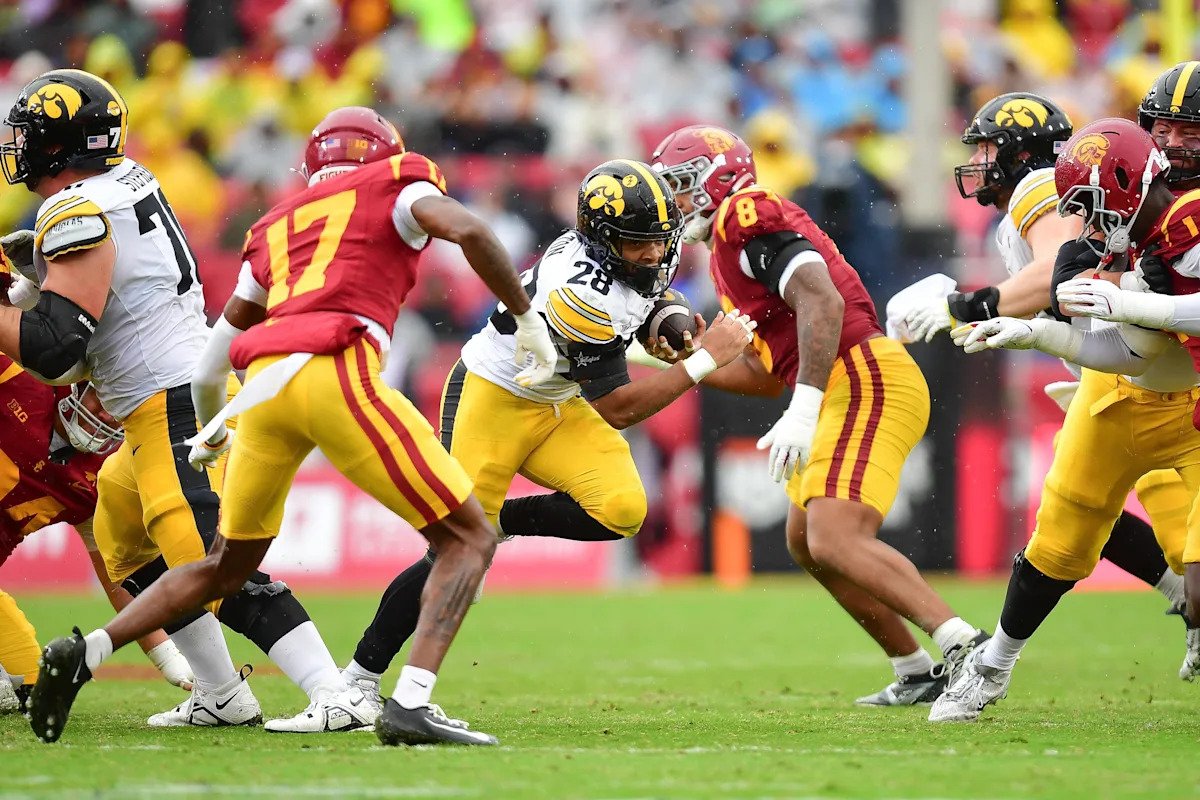
In 2024, the final year Iowa had future NFL back Kaleb Johnson, backups #28 RB Moulton and Jaziun Patterson were splitting reps in relief, and their per-carry numbers were very promising, actually a little better than the starter on a per-play basis (probably simply from being fresher, they were probably overworking Johnson a bit that year).
Advertisement
While Moulton wound up outperforming Patterson in that respect for 2025, I was a bit surprised by how lopsideded the distribution was, about 3:1 for Moulton. The gap in their per-carry numbers wasn’t that big, about 60.5% success rate vs 56.1%, and 4.97 adjusted YPC vs 4.34, while both of them had the Big Ten standard ~10% explosive rush rate which was five points below the FBS median but Johnson did better at.
Considering the line they had blocking for them, I thought both were getting just about what was expected and not much more, though I’m not sure where they could have found an alternative since Patterson was underworked with lower numbers. The other three backs all came in with absolutely putrid per-carry success rates: #5 RB McNeil and #26 RB X. Williams at 31.3% each, while Terrell Washington was at 22.2%, prior to garbage time.
Tom intimated that McNeil, who’s a year younger than Williams, has jumped him in the pecking order and is going to be battling the incoming FCS transfer #21 RB L.J. Phillips for the main backup or perhaps 1B role to Moulton’s 1A. Phillips’ raw stats from South Dakota’s run to the FCS quarterfinals last year are bonkers, nearly 300 carries and 2,000 yards, 6.5 yards per carry and 19 touchdowns. Tom said he recalled Hayden Fry’s description of a previous Iowa running back, “a rolling ball of butcher knives” at 5’9” and 225 lbs.
With Phillips’ prior production and the amount of other backs in the room as a backstop against the chance it doesn’t translate to the Big Ten level, Iowa’s in good shape to have two productive primary backs. The depth situation behind them looks shaky to me, however – it’s two third-years who’ve gotten passed up, a redshirt freshman with no experience, and they didn’t take a prep recruit.
Advertisement
Tight Ends

The plan in 2025 was some combination of Hayden Large, #48 TE Ortwerth, and #87 TE Ostrenga, though I’m not sure in what mix and roles because once again — we discussed how since Sam LaPorta was drafted at the end of 2022, Iowa’s TEs have been cursed by injury and had less of an NFL payday than they should have — injuries and inexperience got in the way. Ostrenga tore his Achilles in the second week, and former walk-on (and, Tom informed me, former QB) #81 TE Vonnahme was still getting used to the job and learning the blocking assignments.
Still, I think it took the staff much longer than it should have to realize they needed to do whatever was required to put Vonnahme on the field because he massively outperformed everyone else on the offense. In fact once garbage time and push-pass sweep runs are properly controlled for Vonnahme outproduced the entire passing offense combined with one receiver excepted (and they didn’t throw to that receiver enough, either!); Vonnahme had a per-target success rate of 58.1% and an astonishing 11.53 adjusted YPT on 31 meaningful targets, he should have had double that.
Advertisement
Large and Ortwerth’s production was anemic, under 50% success rates and under 6 YPT for both (I think the Bears signed Large out of a reflex to sign all Iowa TEs). Tom tells me that Ostrenga is fully healthy and he’ll have a role, but I have to wonder if Iowa has the constitution to sit Ortwerth down in favor of the more promising bluechip #85 TE Meyer or some creativity with #19 TE Woods (fun story on the podcast about him).
Wide Receivers

In my in-season preview last Fall I wrote that the opportunities and inefficiencies for Iowa’s offense were most clear in who they were targeting among the wideouts – some long-term investments who weren’t paying off vs newer options who should have been getting the ball a lot more. The end of the season got some closure on that, as top performers Sam Phillips and #2 WR Vander Zee saw their target share tick up in the last month of the season, while Seth Anderson and his alarming 27% success rate with 2.7 YPT was effectively benched.
Advertisement
But other mysteries persisted: Jacob Gill, who in previous seasons was the only receiver above water in his per-target numbers, had a shocking collapse to 45% efficiency and under 7 YPT in 2025, and he continued to be force fed the ball. They tried to find something with elite return man Kaden Wetjen, but his sweep runs became predictable and his true passing numbers (I separate out actual passing from push-pass sweeps as I chart the games) were terrible at 38% success and 6.1 YPT on 21 targets, and his target share in the passing game climbed at the end of the year.
Given the success that Vander Zee had, I might have thought the offense would give Gronowski another tall outside receiver to hit instead of the 6’0” Gill, but the 6’5” #7 WR Howard only got eight meaningful targets for perfectly FBS average numbers. And #1 WR Parker got a lot of buzz out of 2025 Spring training, but then finished the Fall on -1 net receiving yard (I tried to contain my excitement when Tom said camp reports are that he had another great Spring this year).
Vander Zee doubtlessly has one outside spot locked down, and Tom said he’s fully healthy for the first time and without the foot injury that had limited his play previously. They’ve gotten two very exciting FCS transfers #14 WR Diaz and #8 WR James, both highly productive slot receivers, though each missed some of Spring after getting knocked around by Iowa’s defense (Tom described them both as “170 lbs, soaking wet with a bunch of quarters in their pockets”). Parker is also a slot guy, so they should be set for production and depth there.
The question is just who rounds out the group on the outside and at backup. The most likely is Howard, who has the most experience, though we still haven’t seen him much. Other options are #0 WR Buie, who missed 2025 with some kind of injury (media reports vaguely mention soft tissue damage) but whose 2024 numbers were very poor, 18 targets at 39% success and 5.2 YPT. Redshirt freshman #13 WR T. Smith was the fourth wideout to miss some Spring practice time with injury, the SMU transfer #88 WR Beeghley was a low 3-star but didn’t play in two years and was passed up by several other Mustangs in Dallas and is now a PWO, and Tom said the next most likely to watch out for is the true freshman #6 WR Stinson.
Advertisement
That’s a lot of bodies but virtually no experience, or where there is experience it’s been the opposite of promising. Unless they get lucky with someone, there are high odds Iowa is going to struggle to generate production beyond Vander Zee and the slot receiver. I don’t relish saying it, but there’s a realistic possibility to be confronted that injuries could seriously derail this unit given the size and history of key producers, and inexperience overall.
Offensive Line

According to my inbox, the fact that Iowa is the only team in the Big Ten pursuing an all-organic homegrown developmental model at offensive line, and the facts that they won the Joe Moore award and the Rimington trophy at center, sent two offensive linemen to the NFL last year, three this year, and looking like the two returning starters for 2026 to next year’s draft, is just a huge coincidence.
Advertisement
According to math, it’s not. Math is undefeated.
For the last several years Iowa has been rotating in a couple of extra linemen during meaningful play, last year those were #71 OT Dotzler and #64 OG Le. Jones (unrelated to the former center). They should plug in at the right tackle and left guard spots which Gennings Dunker and Beau Stephens left when they were drafted. #59 LT Lauck returns and just has his spot back.
The challenge is replacing Logan Jones at center. In garbage time at the ends of games throughout the year, they used the two rotational guys (Dotzler and the other Jones), #53 C Myslinski, #75 RT Leonard, and for the final guard spot they did some weird things including playing starter #58 RG Pieper through to the end.
They didn’t play freshman #60 OL Allgeyer beyond just the one blowout over UMass, so I was pretty surprised when Tom told me he’s Iowa’s likely solution at that spot, with Pieper moving over to play center. Tom also said that Pieper hadn’t played center before, and was having a bit of trouble with the mechanics to begin with, though it seems smoothed out now.
Advertisement
I was even more surprised by the alternative suggestion, which was getting Myslinski back – he was a grad student last year and isn’t currently listed on the roster, but Tom told me he’s missed so much time that Iowa is confident they’ll win a medical waiver for him and have him back for the Fall, to either start at center, be a backup to Pieper, or contend for the guard spot with Allgeyer.
Still, it’s a remarkable testament to how committed Iowa is to their internal offensive line development that they’d go with a center who’s never snapped, a redshirt freshman with no meaningful play, and a backup plan they pulled out of the boneyard all because they’re homegrowns, and according to Tom ahead of the transfer #65 OL Wilson. I’d seen a bit of Wilson at James Madison last year as a backup who got one start at RG – I think any other team would just plug him in at exactly this spot and call it a day, but not Iowa.
At any rate, Leonard has been trained up for rotational tackle and regardless of how they resolve the Allgeyer / Myslinski / Wilson situation they’ll have at least one rotational guard, so assuming whoever is snapping the ball knows how to do that this should be a functional, flexible line once again. Tom and I both agreed it’s due to take something of a step back compared to last year because of the loss of multi-year starters for less experienced guys, but the system is in place so it shouldn’t be a massive fall.

I’ve spilled quite a few barrels of ink (or the digital equivalent) on DC Parker’s master magician’s act of a defense. With the rare exception of teams that see through it, he’s managed to trick every offense into thinking it’s making progress with efficiency rushing so that they forgo the explosive passing — especially in no-risk “money down” 2nd & short situations from midfield — that he really fears, then watches with amusement as they inevitably make mistakes on long drives and his defense compresses to deny them redzone touchdowns. In the 2025 season, Parker crossed the 75-game mark for Iowa wins which fit exactly this pattern, according to the analysis I performed using the play-by-play records going back to the 2012 season when Ferentz promoted him from DB coach to coordinator.
Advertisement
So despite rather significant personnel losses and the influx of far more “play-right-away” transfers (as opposed to purely developmental, of whom they’ve taken a few each year since the portal opened) than I can recall recently, Tom and I both laughed at the thought of any structural or philosophical changes to the conservative, two-high 4-3 / 4-2-5 defense out of accomodation – this coaching staff has hung together for decades with the same approach and it’s incredibly effective at getting offenses to fool themselves into wrestling a pig.
Defensive Tackles

Tom referred to Aaron Graves as an “ironman” for this unit, which wasn’t quite so, but I took his meaning – there was a noticeable gap in how much less he rotated out compared to the other starter, Jonah Pace. There was also a very steep falloff from Graves’ havoc rate on my tally sheet compared to the rest of the rotation, to the point where the fourth man in the rotation, Jeremiah Pittman, effectively had no production at all despite being on the field for more than a quarter of all meaningful snaps.
Advertisement
#96 DT Hawthorne is the only returner from the group, who was a bit more productive than Pittman though not a lot, and they’ve packed the room searching for replacements. All four of the third and fourth line units return, though my guess was that the two FCS transfers, #92 DT Stevenson and #88 DT Olagbaju, would jump to the head of the line, especially because Stevenson is a three-year starter. Tom threw cold water on that, though – he told me that Stevenson’s height listing is deceptive and he has doubts about the transfers’ Big Ten size and readiness.
Instead Tom said that two former walk-ons, #51 DT Gaffney and #57 DT Hubert, who were in the third line last year are likely to be in the rotation ahead of Stevenson, and the fourth line sophomore #91 DT Kennedy is probably ahead of Olagbaju. He thinks the transfers here were brought in more for depth and competition and the standard Iowa developmental pipeline will win out.
I’m inclined to agree, first of all because Tom has never been wrong about a single prediction on the trenches in any of our conversations, and second because it’s been clear to me in film study that Iowa DL coach Bell is looking for a very specific kind of long, flexibile body type to take hits and snap back, and it would make sense from the measurables and from working with them in the past that he’d prefer Gaffney, Hubert, and Kennedy over the shorter, punchier FCS guys.
Considering the magic trick here is to allow a certain amount of rushing but no more (about 3-5 yards) to fool the offense into trying to march the field on a 20-play drive, not being the biggest DTs in the world isn’t really a downside, and indeed is kind of the point. The value that this unit can actually add to the defense is penetrating to create havoc, since havoc is always welcome. I think the reason why Graves massively outperformed his cohort on that count was obvious – he was a bluechip surrounded by 2-stars. I don’t see any bluechips in 2026.
Advertisement
Defensive Ends

The ends look like they’re in a stronger spot than the tackles from a topline production standpoint even though they’re in the same boat with personnel loss. I think both of the new guys coming online look like contenders to displace #44 DE Merrieweather, the returning rotational player who’ll get a promotion to starter – those are #43 DE K. Brown, a two-year starter who’s been getting FCS All-American honors even as a true freshman, and #97 DE Epenesa, younger brother of the 2nd round linebacker and one of the highest rated recruits in Iowa’s history.
If Brown or Epenesa turn out to not quite be starting material they should still get backup level play out of him, and we know Merrieweather can do that already, so one way or another they’ll have two starters and a backup from those three. But I agreed with Tom’s comment that Merrieweather’s more productive partner on the second line, Brian Allen, transferring out was painful since they really could have used him.
Advertisement
I think it gets dicey looking for solid production from the fourth man in the rotation and potential depth options if there’s an unavailability. The three returners have practically no experience — the most is #84 DE Anderson, who got a few games of garbage time run — and #95 DE Ingold missed half his redshirt freshman season at Northern Illinois with an injury.
The risk here is that Brown and Epenesa so outperform the rest of the unit that the staff gets hooked on them, so to speak, and quits rotating altogether. That kind of imbalance can become self-defeating, from a fatigue standpoint. Tom talked about this type of situation happening about a decade ago at Iowa when a lot of productive guys left all at once and the Hawkeyes tried to replace them with an up-and-down group.
Linebackers

This is a real “changing of the guard” moment for Iowa’s backers, as Tom called it, and actually it started several weeks early – starting middle linebacker Jaden Harrell got hurt midseason and #36 LB Montgomery took over for him, and then stayed in the rotation when Harrell got back (that they rotated at all was a testament to how well Montgomery played, normally Iowa doesn’t do that in the back seven).
Advertisement
Montgomery is the only returner with meaningful experience, though he’s a bit smaller at 5’10” (probably why he didn’t start despite, on my tally sheet, superior technical skills) and Tom said they’re
moving him to the weakside spot that Karson Sharar left when he was drafted. #33 LB Buffington, who’s the biggest guy in the unit at 6’3” and 240 lbs, is slated to take over at MIKE, with #23 LB Van Kekerix, last year’s backup SAM moving up there (although they only go to the 4-3 about 20% of reps these days).
Evidently this entire unit has been planned and laid out for quite some time, since Tom was able to tell me starter and backup for each position, down to the two developmental redshirt freshmen and three prep recruits below them, and there hasn’t been a single redundant spot or transfer for years. None of them besides Montgomery have any play outside of garbage time, and with Iowa there’s hardly much of that since it almost always goes to the wire, but LB coach Wallace has the plan and the personnel he wants.
Secondary

Parker coaches the secondary himself and it seemed odd to me to be puzzling over this, but I’m really surprised at how shorthanded they’ve been at cornerback the last several years, and the shortage has been spilling over into the nickel and now safety position in 2026. The corners return #8 CB Lee, who’s not the issue – he’s a fine fit for Iowa’s defense and in my opinion improved substantially from 2024 to 2025. Last year’s backup, #3 CB Watson also returns, though he was banged up in Spring, and Tom told me he should be fine and have the other starting job in the Fall.
Advertisement
The issue is that without rotation, there’s no playing time and guys keep leaving, so there’s no depth at all in the unit – in the last three years Shahid Barros, CJ Bell, O’Lontae Dean, Deavon Hilson, and John Nestor all left the unit (some in peculiar ways) with little to no play, and Tom told me they’re going to do it again by taking the other 2025 backup, #7 DB Godfrey out of the corner room for the nickel (or CASH) position.
So that leaves everyone available to back up Lee and Watson, if something goes wrong, as three true freshmen and a 3rd string junior who’s never seen the field … and Tom and I were only certain about two of the true freshmen, #1 CB D. Jones and #21 CB Vitti.
Parker’s solution in 2025 when they got in a pinch or switched to the 4-3 — not that it inspires much confidence in Watson — was to move the starting nickel, #6 DB Lutmer, over to the outside to play corner. Lutmer returns and is Parker’s solution to another problem, the jam this time being Louisville poaching Koen Etringer out from under them, leaving Iowa without both of their starting safeties from last year as Xavier Nwankpa also left for the NFL.
So according to Tom, Godfrey from the corner room and redshirt freshman #11 DB Wallace, who I think I saw playing a handful of garbage time reps at free safety, are going to the nickel position to duke it out for starter and backup. Neither have played the position extensively.
Advertisement
At safety they’ve got lots of depth, but they’ve picked winners, it would appear – Lutmer for free safety and James Madison transfer #2 DB T. Brown (I checked, none of the Browns on this team are related) at strong safety. Lutmer’s a hitter and a coverage guy, I thought nickel made sense for him and I understood Tom’s reservations about taking their biggest playmaker and putting him at the safety net spot, though it is the most critical element of Parker’s entire philosophy – everything about this defense collapses if that line in the sand is crossed.
When I reviewed the JMU tape last year, Brown was at free instead of strong, and that team played a much, much more aggressive defense than Iowa does (it actually made the secondary look worse than I felt they were since they were constantly exposed without help and the safeties were pushing forward, c.f. Minnesota under DC Collins). Still I thought it was an odd pickup for this defense and for how much they’ve been all-in on Brown since my editing room floor is littered with tape of Sun Belt receivers cooking him.

