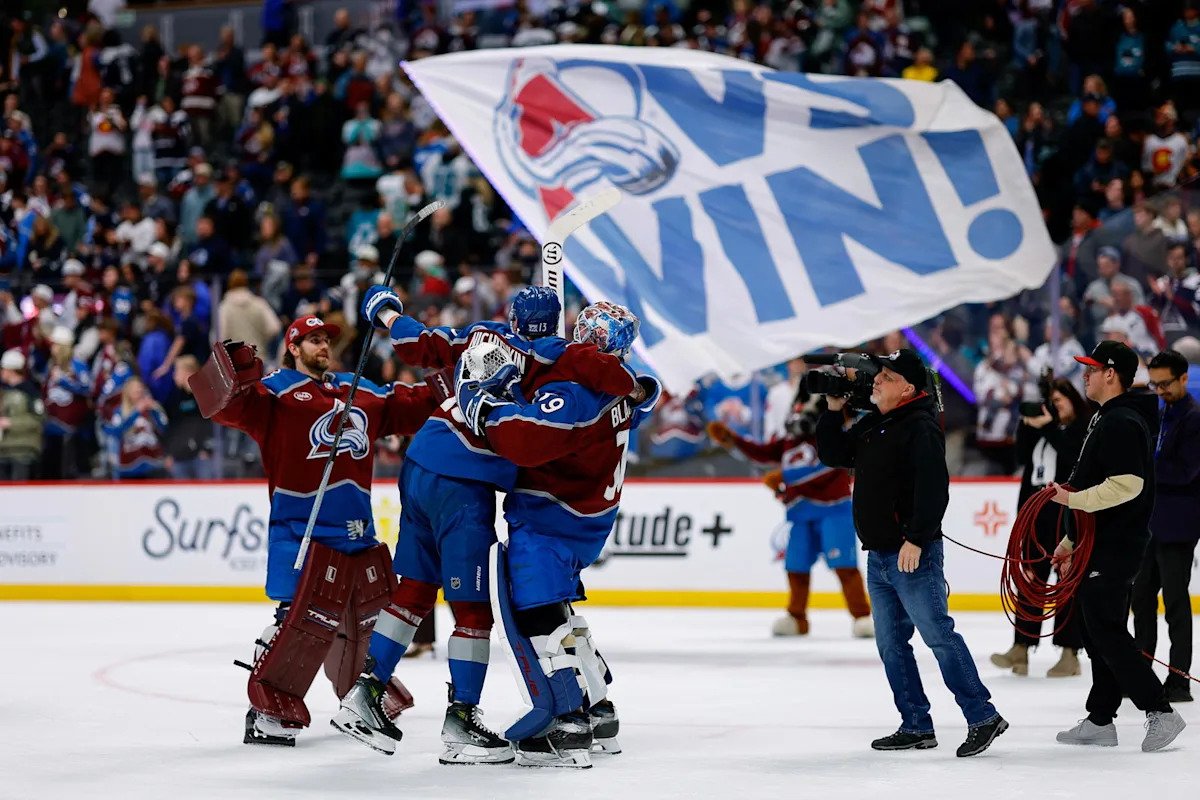
Nobody expected Scott Wedgewood to take over Colorado‘s crease, but training camp could determine whether he ever gives it back.
The most intriguing storyline surrounding the Colorado Avalanche next season won’t be a trade deadline addition or a midseason surge. It’ll begin the first day training camp opens.
Advertisement
Can Mackenzie Blackwood take the starting job back from Scott Wedgewood?
The Avalanche will continue to call it a tandem, and that’s the expected answer. But when the games carried the most weight, the rotation largely disappeared. Wedgewood got the lion’s share of the starts in the Stanley Cup Playoffs, making it clear who Jared Bednar trusted when everything was on the line.
That has become a talking point for a fanbase still trying to process how a team that looked like a legitimate Stanley Cup favorite was swept by the Vegas Golden Knights in the Western Conference Final.
As always, the search for blame began almost immediately.
Advertisement
Brock Nelson‘s production was scrutinized. Martin Necas became an easy target. Nathan MacKinnon‘s injury entered the conversation. But reducing Colorado’s collapse to one player or one moment ignores what actually happened.
The Avalanche were pushed around from the opening faceoff of Game 1. They lost battles along the boards, struggled to manage the puck, and repeatedly surrendered leads. The speed and offensive firepower that masked so many flaws during the regular season suddenly disappeared, leaving behind the defensive lapses and careless turnovers that had quietly followed the team all year.
That’s why the spotlight has now landed on Wedgewood.
He certainly had difficult moments against Vegas, but there were remarkably few instances where you could point to an obvious bad goal and say he cost Colorado the game. More often than not, he was dealing with odd-man rushes, broken coverage, or self-inflicted mistakes in front of him.
Advertisement
Ironically, this entire conversation may have started months before the playoffs.
Blackwood entered the season recovering from a lower-body injury that Bednar later acknowledged to The Hockey News took longer than expected to heal.
The Hockey News attended several voluntary offseason skates, and Blackwood participated in one late in the summer alongside several AHL players. From this writer’s vantage point, he looked noticeably slow—enough that it raised concerns. During another session a few days later, Blackwood audibly groaned in pain during a drill before leaving the ice and disappearing from workouts for an extended stretch.
It became increasingly obvious he wasn’t fully healthy.
Advertisement
While Blackwood worked his way back, Wedgewood quietly took advantage of the opportunity. He handled the majority of the reps, looked comfortable from the start, and carried that confidence into the regular season.
That’s really where this story began.
Wedgewood came out flying and stayed that way for long stretches, while Blackwood never quite found a consistent rhythm. He started slowly, caught fire, cooled off again, and spent much of the season alternating between brilliant and ordinary performances. Even so, he closed the year with a tremendous effort in Game 4 despite the loss.
It’s also worth remembering that Blackwood and Wedgewood are built differently as goaltenders.
Advertisement
Bednar has explained that Blackwood is at his best when he has consistent preparation, regular reps, and the chance to settle into a rhythm over multiple starts. Wedgewood, meanwhile, is almost a throwback. He can sit for a week, step into the crease without warning, and immediately give his team a chance to win.
That’s been the story of his career.
He’s bounced around the league enough to earn the journeyman label, but somewhere along the way he quietly became one of the NHL’s most dependable—and underrated—goaltenders.
There’s a reason Avalanche fans embraced the nickname “The Lumberyard.”
Advertisement
Wedgewood didn’t simply keep the net warm while Blackwood recovered. He grabbed the opportunity and turned it into the best season of his career.
He finished 31-6-6 in 45 appearances with a 2.02 goals-against average and a career-high—and league-leading—.921 save percentage. Those numbers went a long way toward explaining why he and Blackwood shared the William M. Jennings Trophy as the NHL’s top goaltending tandem.
Blackwood’s season deserves a little more context than the raw numbers provide.
Despite never fully settling into a rhythm, he still posted a 23-10-2 record with a 2.51 goals-against average and a .904 save percentage. Considering his save percentage dipped below .900 at multiple points before climbing back over the mark by season’s end, the finish was more encouraging than it might appear at first glance.
Advertisement
It’s difficult to find timing and confidence when you miss training camp, skip the preseason, and spend the opening weeks trying to catch up while the goaltender sharing your crease is putting together one of the best statistical seasons in hockey.
And that’s exactly what makes this training camp so compelling.
If Blackwood arrives healthy and finally gets the preparation Bednar believes he needs, the Avalanche could once again have the luxury of two starting-caliber goaltenders pushing each other every night. Wedgewood has already proven he can carry a contender for extended stretches, while Blackwood still possesses the ceiling that convinced Colorado he could be its long-term answer.
Maybe the Avalanche truly do have a tandem.
Advertisement
Or maybe Wedgewood has earned the right to keep the crease until someone takes it away.
Either way, “The Lumberyard” enters next season as one of Colorado’s biggest strengths—and perhaps the most fascinating position battle on a roster built to win the Stanley Cup.
Image

