Following a magical 2025-26 season in which the Pittsburgh Penguins made an improbable run to the playoffs, it has clearly been stated by general manager and president of hockey operations Kyle Dubas that the plan is to keep improving next season.
Of course, a lot has to happen for the Penguins to continue taking steps toward becoming a legitimate contender again. The path forward is still not an easy one, even if 2025-26 was a springboard.
Advertisement
And one of the things they will certainly need to address in 2026-27 is how they are going to balance the drive to contend and the necessity to integrate youth onto the NHL roster for good.
Goaltending seems to be the most obvious shoe-in for a youth movement, as veteran Stuart Skinner is a UFA, leaving pending-RFA Arturs Silovs and the up-and-coming Sergei Murashov to be the likely NHL tandem next season. And, on the forward front, there are plenty of names (Ben Kindel aside) who saw smidgens of NHL action last season – including Rutger McGroarty, Ville Koivunen, Avery Hayes, and Tristan Broz – and will likely take on a bigger role in 2026-27.
Then, there is the blue line. Yes, it’s already been discussed how the left side is a big question mark heading into next season, as the Penguins have some names on the NHL roster in Parker Wotherspoon and Sam Girard to fill in two of three spots but are in need of more youth talent at the position. Whether that help comes via the NHL Draft, the trade market, or both remains to be seen.
But, the right side? Well, there is a bit more assurance there, but this is exactly where the conundrum of “rookie or replacement” takes hold. We know that Erik Karlsson and Kris Letang are highly likely to occupy two spots, leaving one spot wide-open.
Loss Of Pieniniemi Further Exposes Glaring Positional Need For Penguins
Advertisement
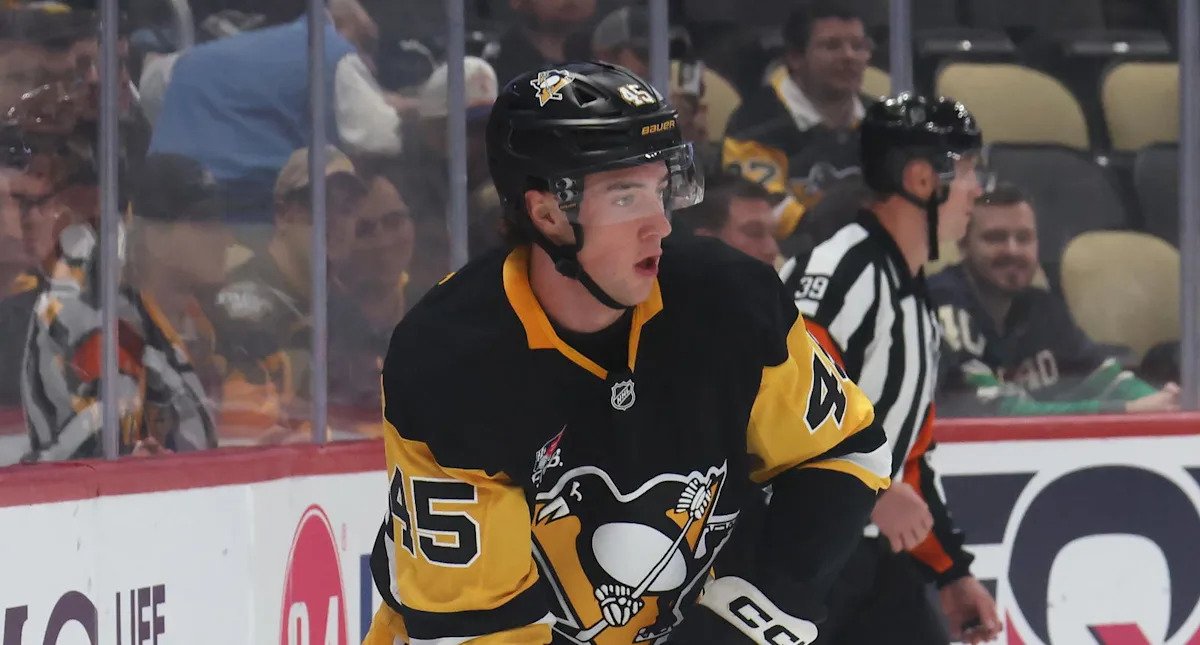
Will the Penguins look to add on the right side this offseason, or will it be rookie and top defensive prospect Harrison Brunicke‘s spot to lose?
As it’s been well-documented at this point, the now-20-year-old defenseman’s 2025-26 season was a bit of a whirlwind, as he made the big club out of training camp but only played in nine games at the NHL level before an AHL conditioning stint, a trip to the World Junior Championship, and a sentence back to the Kamloops Blazers of the WHL for the back half of the season.
After the conclusion of his WHL season, he rejoined Wilkes-Barre/Scranton (WBS) for the last portion of the AHL regular season and its playoff run, which stretched to six games in the Eastern Conference Final. And Brunicke was a huge part of that run, as he played top-pairing minutes and was deployed in key situations throughout the postseason.

WBS’s Season May Be Over — But There Is Much More To Come
Advertisement
Yes, the sheer offensive numbers are nice to look at: He paced point-per-game (two goals and 24 points in 24 games) with Kamloops to close out their regular season, had a goal and eight points in 11 AHL regular season games, and contributed two goals and seven points in 15 Calder Cup Playoff games.
Numbers aside, the version of Brunicke on display during the AHL playoffs was not necessarily a different version from the onset of the 2025-26 season, but it was a vastly improved and much more mature version — one that was more physically imposing, stronger in his own zone, better at breakouts, and sturdier at the net-front. And this was all while he managed to build even more on his elite skating ability, strength in transition, and offensive instincts.
Some think that Brunicke showed enough in that final AHL run to prove that he is NHL-ready. However, while that might be the case, him being “NHL-ready” also needs to come with the expectation that there are still going to be growing pains in his adjustment to the NHL. Given the type of player he is, he is going to make mistakes, and some of those mistakes are going to be loud ones.
Advertisement
So, given the Penguins’ need to see what they have in some of their young talent like Brunicke but also their desire to build on the playoff push that began this spring, is it worth risking to, essentially, leave that final right-side defensive slot open for Brunicke without much of a failsafe for him? Or should the Penguins look for outside help to give Brunicke someone to compete against for an NHL roster spot and for someone to fill as a nice stopgap between Letang or Karlsson’s eventual departure and Brunicke’s top-four readiness?
Honestly, there’s no easy answer.
Sure, many advise that the Penguins say goodbye to Letang, who is 39 and underperformed last season, in order to make way for both Brunicke and someone else to populate the right side behind a still-capable No. 1 defenseman in Karlsson. But, the reality is that it’s not that simple. Letang has a full no-movement clause, and even if he was willing to waive that to go somewhere else, a mutual team would have to want to take on him and his $6.1 million for two more years.

5 Intriguing Penguins’ Draft Targets To Keep An Eye On After NHL Scouting Combine
Advertisement
Realistically, Letang will be wearing a Penguins’ sweater next season, but that doesn’t mean his role shouldn’t be subject to change. The problem is that, if Letang is destined for a reduced role on a bottom pairing, it’s a tall ask to rely on a high-ceiling but still-stabilizing rookie in Brunicke to take on a top-four role out of the gate.
If the Penguins truly want to compete and take a big step next season, it likely doesn’t involve Letang in a top-four role anymore, but it realistically probably doesn’t involve Brunicke in one quite yet, either. Which puts them in quite the pickle.
All that said, seeking outside help may not be the worst idea — especially if that outside help is a mid-20 something with upside and the potential to act as that bridge – or, potentially, as more – between where Brunicke is now and him eventually accepting the baton from Letang or Karlsson.
This has been written about, but Buffalo Sabres defenseman Michael Kesselring seems to make a lot of sense here, as he is more proven at the NHL level than Brunicke but, at 26, could use a change of scenery after injuries and inconsistency pushed him out of a potential top-four role in Buffalo. He is also a pending-RFA, and the Sabres will be cap-crunched if they look to add substantially this summer, rendering a deal between the two clubs actually making sense.

This Sabres Defender Could Be One Of The NHL’s Hottest Trade Targets
Advertisement
If someone like Kesselring can be had for a fair price, it could, potentially, be the best situation for the Penguins and for Brunicke. They would be getting a player who should be able to help them in the now and, potentially, be a mainstay for future contention, and they would also be getting a player to tow the line of challenging Brunicke while also shielding him from taking on too much too soon.
And, yes, there is a fine line between blocking young talent and handing them the keys, and Dubas and the Penguins must tread carefully and hold that line when it comes to their most promising defensive prospect and, arguably, their most promising prospect in general. Because of their lack of true prospect depth on the blueline, they cannot afford to miss on Brunicke, and they have to do everything in their power to set him up for success.
For everyone’s benefit, introducing, at least, a stopgap “replacement” might not be the worst thing for the “rookie” who has a hefty load of the team’s future weighing on his shoulders.

OFFICIAL: Penguins, Newest Trade Acquisition Finalize Contract For 2026-27 Season
Bookmark THN – Pittsburgh Penguins on your Google News tab to follow the latest Penguins news, roster moves, player features, and more!

