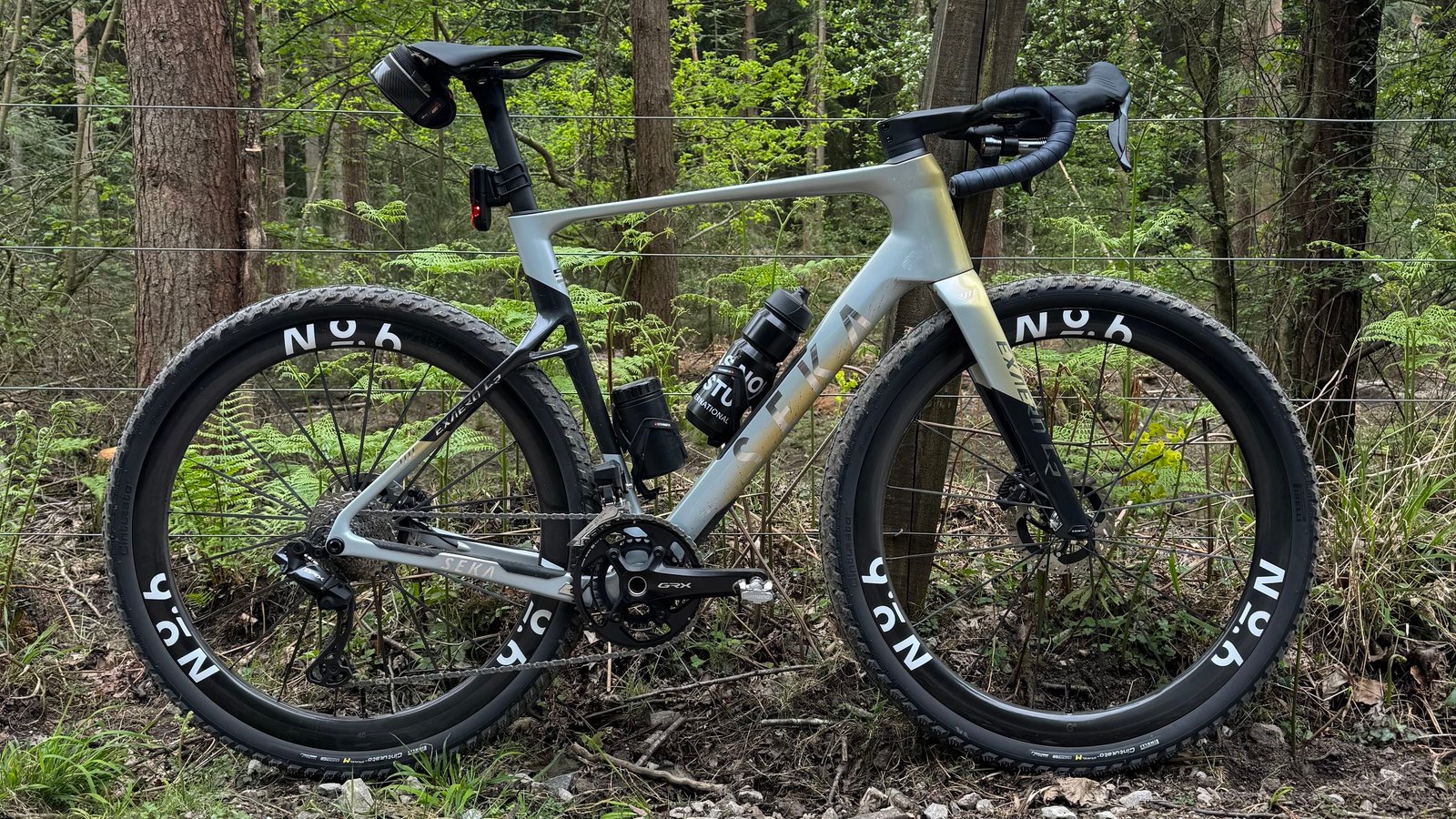
Pirelli has been updating its fast-paced tyres of late, and the Cinturato Gravel range has been getting the same treatment; the M HPs come from the same High Performance factory in Italy as the road models the Lidl Trek team race on.
Image 1 of 2

Construction
The Cinturato Gravel M HP sits within the Cinturato Gravel range. This consists of the H for hardpack, S for soft conditions such as heavy mud, and the M which sits in the middle. The RH and RM are the race models with a lighter construction and faster rolling resistance.
The Cinturato Gravel M features a semi-slick central tread with small grooves between for optimised rolling resistance on hardpack gravel and tarmac. On the sides the tread features taller protrusions with larger spacings between them for holding traction on loose gravel and in muddy conditions.

There are currently two options for this tyre, Speedgrip, and SmartEvo GR. These are the new SmartEvo GR while the Speedgrip is the previous generation. SmartEvo GR takes cues from the brands SmartEvo road racing tyre compound. Designed to be lighter rolling, while higher grip both on and off road, in rain or shine. This tread sits atop the new ProWALL Gravel casing, 120 TPI up from 60 TPI in the previous TechWALL casing. This should result in a more supple ride and greater deformation of the casing for faster rolling. It features additional side wall support to protect against impacts there, along with a puncture protection belt under the tread section of the casing.
For the tyres on test, I went for a 50/45mm combo front and rear. Measured width for the 50mm on the No6 G45R wheels with 28mm internal width was 53.92mm at, while the 45mm rear on 26mm internal width was 42.7mm at 22psi.
Sizes range from 35-50mm in 5mm increments in 700C, with 45 and 50mm for 650B wheels. Classic gum, Retro tan wall, or Standard black colourways are available.

The difference in colour was due to availability of the 45mm rear tyres just being the natural side wall, versus the black sidewall for the 50mm front
(Image credit: Future – Andy Turner)
The Ride
Normally, I find tubeless tyres easy to fit with just some elbow grease, or maybe my trusty rubber grip gloves, and only for the second bead. These tyres required levers to get the first and second bead on, and a great deal of elbow grease and gritting of teeth. Given I was fitting these on relatively narrow gravel rims at 26 and 28mm internal width, that does put these firmly in the category of ‘harder to fit’ tyres. However, this does mean that they seat easily with a track pump and do not leak pressure in the slightest. It’s also worth remembering that these are directionally fitted tyres, with rotation direction printed on the sidewall. You won’t want to be removing these and re-fitting again in a hurry. But two tyre levers will make life a lot easier.
I originally fitted two 50mm tyres to the Seka ExAero GR frameset. The claimed 57 and 52mm clearance front and rear should have easily accommodating the tyres. However, once seated the 50mm Cinturato M measured in at over 53mm, so clearance at the rear was incredibly tight and not suitable for muddy conditions. Pirelli sent me a 45mm tyre, which came in at just over 47mm. I have seen this on the road going Cinturato tyres as well where the measured width is a good deal wider than advertised; it’s a factor worth considering when looking at frame clearances.
Image 1 of 2


It might also explain the weight, as these are rather weighty tyres. They are not part of the RH or RM race-line that Pirelli have for the fastest and lightest tyres. But looking at the new Continental Dubnital 50mm tyres, those are around 580g for 50mm, while the 45mm Pirelli Cinturato M comes in at 625g actual. The 50mm of course adds to that weight.
Riding on these tyres though, I quickly grew to love them. On the tarmac, riding over to the Forest of Dean trails, the tyres don’t ‘feel’ as fast, in part due to the 22 PSI pressure, recommended by Pirelli, dampening the vibrations and feel considerably. But my average speed on the road was only 1.5-2kph slower than with 30mm road tyres and wheels. Once I hoped on the trails, they really came alive.
The central tread is very close, so it acts almost like a slicker road or hardpack gravel tyre. Along fire roads, compact gravel, and tarmac, the tyres roll impressively well. But when you venture on to loose surfaces that’s where the magic happens.
I ended up using these tyres for the Gralloch UCI gravel race. In Scotland, I was expecting rain and mud, so wanted a tread pattern that would add some grip. But also, the course is renowned for being a puncture trap with large sharp stones. For the most part, the course is hardpack gravel, but on the muddy section, and across loose and chunky gravel, I felt very happy in my choice of using these M tyres.
Bombing down the descents at over 40mph or being forced onto the rough line while fighting for position, the Cinturato M filled me with confidence. I had no issues with locking up under heavy breaking into tight corners either. There were a few occasions where leaning the tyre over the tread caught me before a slide occurred. The tread blocks are the same size on both the 45 and 50mm tyre, but the spacing is wider on the 50mm. Given the front wheel is the one you want to wash out the least, this was very welcome and gave me tangibly better traction. The only downside was the finale downhill tarmac descent, where the large gaps between tread blocks was a little sketchy on tarmac hairpins leaning the bike over. But that is not what these tyres are designed for.
Image 1 of 3


Puncture protection is of course another key area, especially when racing. I was fortunate to avoid punctures, despite taking less-than-ideal lines on various occasions and hitting some massive holes out on the course. Wide tyres with low pressure but high air volume do help with this a lot, as well as being extremely comfortable. Inspecting the bike after the race though I could see, mainly on the rear, a good deal of cuts and nicks in the tyre. However, none had penetrated the puncture belt, so no sealant had been needed to repair the damage . Given how notorious the Gralloch course is, this is compelling evidence for the Cinturato Gravel M capacity to avoid punctures. Perhaps the H (Hardpack) version would be ‘faster’, but to finish first, first you must finish.
Were I at the fitness level where I could be making attacks on climbs though, I have to say the weight of the tyre is a potential limiter for those looking for the absolute peak of gravel race tyres. They roll exceptionally well, but steeper inclines and accelerations on those do highlight that added weight. But then the durability is often compromised when reducing the weight of tyres.
Value
As much as I really like these tyres, they are on the more expensive side, given that they are not the most race focussed gravel tyres available. At £74.99 / $94.99 they are more expensive, in GBP, than the Continental Dubnital (£66.99 / $86.95 ) and similar to the very race focussed Schwalbe G-One RX Pro (£75 / $91), and Panaracer GravelKing ZX R-line (£64.99 / $84.99). Only the Vittoria Terrano PRO tyres, at £85 / $112, are more expensive. Weirdly the Vittoria is heavier in 45mm even with the race focus and similar tread pattern though.
But value is a very subjective matter, especially for gravel tyres. On the road, a more fragile road tyre generally lives its lifespan save for an abnormal puncture, otherwise it seals and carries on rolling. On gravel, puncture protection is far more than a small nick or cut, as sharp stones and branches can create large cuts that can take a few minutes to sort out with sealant, plugs, or inner tubes. In this scenario, for me, a tyre that will avoid those issues becomes of great value. Additionally, the grip and comfort afforded by the Cinturato Gravel M was extremely valuable to me in the race. Compared to other gravel tyres I’ve tested, they also deal with loose surfaces far better giving reliable traction and feedback.
Having tackled the most abrasive gravel race the UK has to offer, along with plenty of varied off-road and on-road testing, the Pirelli Cinturato Gravel M certainly deal with anything you can throw at them. Of course, you can get unlucky and suffer a blowout puncture on any tyre if you have a high impact sharp stone impact at the wrong angle.
For me personally, the balance of smooth rolling on and especially off-road, combined with the comfort and excellent traction, plus a tyre that is clearly very rugged, makes for a superb option for sharp gravel, longer duration off-road adventures, or wet weather gravel. They are not cheap, and not the best value overall, but I massively enjoy them and would be cautious of moving to a more fragile tyre even for racing.

A mix of a near solid centre line of tread balanced with widely spaced outer knobs delivers a great balance of traction and fast rolling on and off-road
(Image credit: Future – Andy Turner)
Conclusion
The Pirelli Cinturato Gravel M tyres may not be race day specialists like the RM model, but this updated version offers a superb balance of fast rolling on and off-road, supple and comfortable ride feel, and awe-inspiring confidence on loose or muddy surfaces. They’re fast enough to qualify me for the Gravel World Championships, and although other tyres might have more ‘speed’, but the resilience of these means less time lost fixing punctures. They are not cheap, and for some will not represent the best value, nor are they a hardpack specialist. But as a tyre than can perform well pretty much everywhere in every condition, they are a superb choice.

