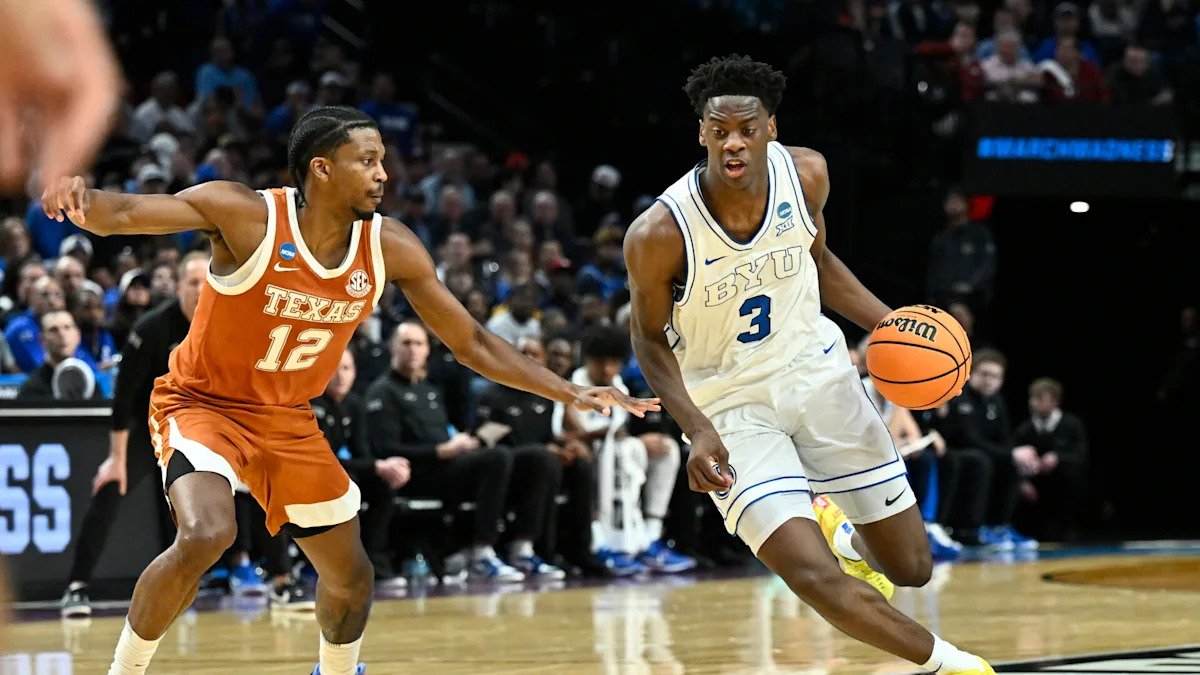
With the 2025-26 season in the rear-view mirror, the first order of business for the NBA in 2026-27 is the 2026 NBA Draft, which begins on Tuesday, June 23, in Brooklyn. Given the firepower at the top of the draft, many consider this to be one of the deepest draft classes in recent memory. There may be a clear separation between the top four and the rest of the class, but teams picking later in the first round should struggle to find value.
Here is our big board ranking the top 75 prospects in the 2026 draft class, with BYU’s AJ Dybantsa leading the way. And for those who may be new to the big board experience, this is not a projection of where each player will be drafted.
Advertisement
1. G/F AJ Dybantsa, BYU
2. G Darryn Peterson, Kansas
3. F Cameron Boozer, Duke
4. F Caleb Wilson, North Carolina
5. G Darius Acuff Jr., Arkansas
As noted above, many perceive Dybantsa, Peterson, Boozer and Wilson as a class of their own in this draft. Washington holds the first overall pick, and there has been a push from Peterson’s camp to get him into the conversation. Will the availability issues at Kansas continue in the NBA? Regardless of where he’s selected, that’s a question the franchise in question will have to address. Dybantsa sits atop the board because of the combination of size, athleticism and skill set. And with the Wizards adding Trae Young in January, Dybantsa may be an easier player to fit into the team’s rotation.
Advertisement
Boozer offers a high floor, while Wilson’s ceiling makes him a highly intriguing prospect despite his freshman season ending prematurely due to injury. After the top four, there’s likely to be a rush on guards. Acuff was sensational during his lone season at Arkansas; does Jalen Brunson‘s rise in New York affect how team executives view the reigning SEC Player of the Year?
6. G Kingston Flemings, Houston
7. G Mikel Brown Jr., Louisville
8. G Keaton Wagler, Illinois
9. G Brayden Burries, Arizona
10. F Nate Ament, Tennessee
11. F Yaxel Lendeborg, Michigan
12. C Aday Mara, Michigan
13. F Dailyn Swain, Texas
14. F Morez Johnson Jr., Michigan
15. C Hannes Steinbach, Washington
Among the guards in this portion of the rankings, Brown may offer the highest upside. His lone season at Louisville ended in late February due to injury, but that doesn’t take away from what he brings to the table as a shooter and playmaker. However, Brown does need to get stronger, and the same can be said for Illinois’ Wagler. After coming off the bench to begin his freshman campaign, the Fighting Illini’s loss of Kylan Boswell to a broken hand opened the door for the 6-foot-5 guard to truly flourish offensively.
Advertisement
After that quartet of guards, frontcourt players become the focus. Ament’s upside makes him one of the more intriguing prospects at his position, but the Michigan trio of Lendeborg, Mara and Johnson may be better equipped to help teams win now. Steinbach is a high-level rebounder and finisher around the basket with good size and coordination.
16. G Cameron Carr, Baylor
17. G Labaron Philon Jr., Alabama
18. G Christian Anderson, Texas Tech
19. G Ebuka Okorie, Stanford
20. C Jayden Quaintance, Kentucky
21. F Koa Peat, Arizona
22. G Bennett Stirtz, Iowa
23. F/C Chris Cenac Jr., Houston
24. F Joshua Jefferson, Iowa State
25. F Karim Lopez, New Zealand Breakers
Could someone in this portion of the rankings become one of the best players in this draft class? Absolutely. Carr shone at the NBA Draft Combine, while freshmen like Peat and Cenac were part of winning programs, which could be beneficial at the next level. The “mystery man” of this group is Quaintance, a highly athletic post player who played just three games at Kentucky this season. He suffered a torn ACL while at Arizona State, and a return to the court in Lexington did not last long before Quaintance needed to be shut down. Okorie’s draft “stock,” for lack of a better term, has improved throughout the spring, while Stirtz and Jefferson are experienced players with high basketball IQs who can impact winning.
Advertisement
26. C Zuby Ejiofor, St. John’s
27. C Henri Veesaar, North Carolina
28. G/F Richie Saunders, BYU
29. C Tarris Reed Jr., UConn
30. G Meleek Thomas, Arkansas
31. F Allen Graves, Santa Clara
32. G/F Sergio de Larrea, Valencia (Spain)
33. F Alex Karaban, UConn
34. G/F Isaiah Evans, Duke
35. F Maliq Brown, Duke
Ejiofor may not have the height of a “true” center, but the wingspan and athleticism work in his favor. The decision to transfer from Kansas to St. John’s paid dividends for the center, who racked up numerous individual awards in his two seasons in Queens while also leading the Red Storm to two Big East regular season/postseason titles. Fellow Big East alums Reed and Karaban should also drum up interest in the late-first/early-second portion of the draft.
Advertisement
However, Graves offers up the most intrigue among the players in this area of the board. During his lone season at Santa Clara, his advanced numbers were outstanding, and the feeling among many is that he’ll be a first-round pick. A torn ACL derailed Saunders’ season; he could be a “redshirt” for whichever team selects him, but the former BYU standout has first-round ability.
36. G Emanuel Sharp, Houston
37. F Baba Miller, Cincinnati
38. F/C Felix Okpara, Tennessee
39. G Bruce Thornton, Ohio State
40. G Jack Kayil, Alba Berlin (Germany)
41. G Braden Smith, Purdue
42. F Izaiyah Nelson, South Florida
43. G Ryan Conwell, Louisville
44. F Trevon Brazile, Arkansas
45. G Jaden Bradley, Arizona
Smith left Purdue as the NCAA’s all-time assist leader; if not for his listed height of 5 feet 10.25 inches, he would be more popular among draft analysts. Sharp and Thornton are two other college basketball veterans who should not be overlooked come draft night. One player who likely improved his draft standing during the postseason was Brazile, who was part of Acuff’s supporting cast on an Arkansas team that won the SEC Tournament and reached the Sweet 16.
Advertisement
46. G Ja’Kobi Gillespie, Tennessee
47. C Nate Bittle, Oregon
48. F Nick Martinelli, Northwestern
49. C Ugonna Onyenso, Virginia
50. G Noam Yaacov, Oostende (Belgium)
51. F Dillon Mitchell, St. John’s
52. G Nick Boyd, Wisconsin
53. F Tyler Bilodeau, UCLA
54. F Tyler Nickel, Vanderbilt
55. F Tobias Jensen, Ratiopharm Ulm (Germany)
Yaacov has committed to play at the University of Utah next season, so a team may draft him with the idea of stashing the exciting point guard for a season. Beyond him, some intriguing college basketball veterans could be of value at the next level.
Mitchell is an athletic defender who can also facilitate offensively, but he has to improve his shot considerably. Boyd isn’t the biggest point guard, but the ability to attack defenses off the dribble makes him a potential second-round pick. Further up in the rankings are some productive frontcourt players in Bittle, Martinelli and Onyenso, with the latter being one of the best rim protectors in this draft class.
Advertisement
56. G Tamin Lipsey, Iowa State
57. G Quadir Copeland, NC State
58. G/F Jaden Henley, Grand Canyon
59. G/F Aaron Nkrumah, Tennessee State
60. G Duke Miles, Vanderbilt
61. C Oscar Cluff, Purdue
62. F Trey Kaufman-Renn, Purdue
63. G Lamar Wilkerson, Indiana
64. G Otega Oweh, Kentucky
65. G Milos Uzan, Houston
Lipsey is one of the best on-ball defenders in this draft class and also showed the ability to run a team while at Iowa State, while Copeland brings more size to the playmaker role than most of the others in this class. Oweh can be a power guard at the next level, but he’ll need to polish his skill set somewhat to account for the stronger defenders he’ll encounter. Nkrumah’s athleticism and defensive ability make him an intriguing two-way option, especially for teams willing to give him some time to improve his perimeter shooting.
Advertisement
66. F Tobi Lawal, Virginia Tech
67. G/F Michael Ajayi, Butler
68. C Graham Ike, Gonzaga
69. G Seth Trimble, North Carolina
70. G/F Zach Cleveland, Liberty
71. F Bryce Hopkins, St. John’s
72. F Mark Mitchell Jr., Missouri
73. F/C Tobe Awaka, Arizona
74. G Peter Suder, Miami-Ohio
75. C Rafael Castro, George Washington
Ike was one of the most productive post players in college basketball while at Gonzaga, but he’ll need to become more comfortable in the mid-range to account for his lack of height as a center. Lawal tested well athletically at the combine, while Hopkins and Mitchell are two wings who need to improve their shooting consistency to stick at the NBA level.

