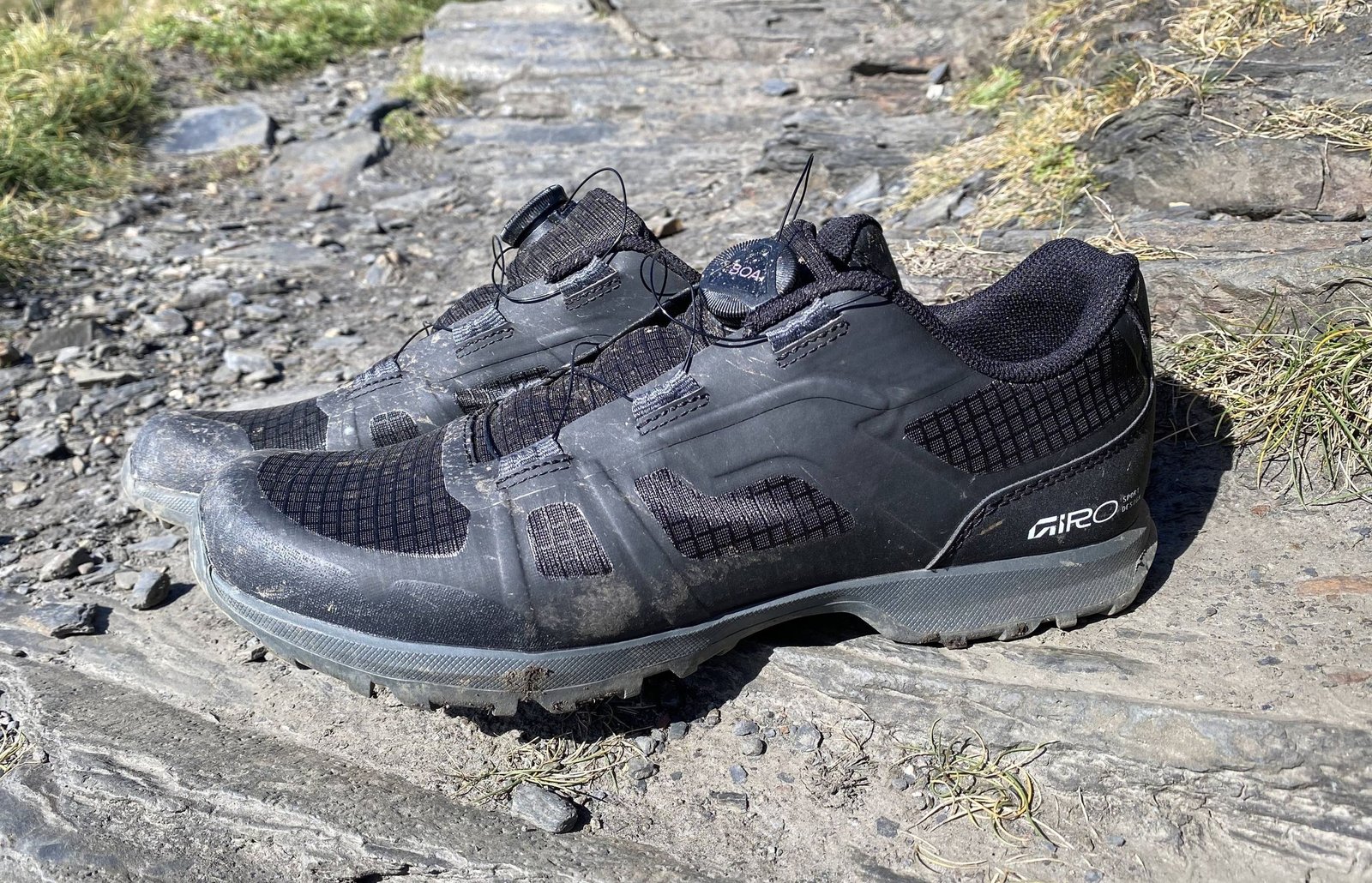
Launched over six years ago, the Giro Gauge was designed to merge Giro’s Rumbler VR’s versatility with their own Terraduro’s off-road shoe credentials.
I was keen to see if they delivered where versatility is concerned. Could they be a do-it-all shoe for a multi-day bike trip? They needed to perform on the bike, on a multitude of walking terrains, and still be comfortable and discreet enough for functional wear in the evenings. It’s fair to say they didn’t let themselves down, providing it didn’t rain…
Construction
The aggressively lugged rubber sole is designed for durability off the bike, while still offering sufficient stiffness for power on the pedals; indeed, they are compatible with the best gravel bike pedals. An EVA midsole is intended ‘to disperse pressure and absorb shock, enhancing comfort and stability over rough terrain’.


(Image credit: Emma Silversides)
A supple synthetic mesh upper, combined with a Boa dial, provides a snug, breathable fit.

(Image credit: Emma Silversides)
Reinforced heel and toe boxes – protected with Giro’s Rockprint material – shield against impacts, scratches and abrasions.

(Image credit: Emma Silversides)
Inside, the insole is simple, offering no extra arch support. The Gauge comes in three colours – Black, Sky Blue and Dark Sage Green – and in sizes 39 to 50, though half sizes aren’t offered. A traditional laced version is also available.
Performance
For years, Giro’s Rumbler VR were my go-to shoes for everything from long tours to casual rides. They logged countless miles across multiple countries and coped admirably with some brutally gnarly hikes. So when they were discontinued, I was devastated. I tried a few other brands in search of a replacement but never found that sweet spot: on-and-off-bike performance in a shoe that was actually comfortable. After weeks of testing the Gauge shoes in a variety of scenarios, I can confidently say they hit all the marks the Rumbler VRs did, and exceeded them on some levels. They’re not perfect – indeed, a hardened mountain biker may scorn them – but for anyone after a versatile, discreet, well-made shoe, there’s much to like.
It’s worth noting that the Gauge doesn’t come in a women’s-specific version. That said, I’ve often found female-specific shoes to be too narrow anyway. I tested a size 42 – my go-to across most brands – and the fit was spot on. Fit is always subjective, but for me there was plenty of width and a generous toe box. There was no pinching or rubbing at the heel cup either, something I’ve experienced with a few other ‘touring-focused’ shoes, particularly when walking.
I swapped out the fairly basic insoles that come with the shoes for my custom orthotics and a more supportive insert. The supplied insole feels like a cost-saving choice from Giro and, unless you have very flat feet, it’s something you’ll probably want to upgrade.

(Image credit: Emma Silversides)
Dialling-in the right position for the SPD cleats was straightforward. There’s plenty of adjustment range and, unlike a pair of Shimano shoes I recently tested, it was possible to run the cleats relatively far forward.
Compared to traditional laces, the Boa dial makes getting out on the road quick and easy; this a win over my old Rumbler VRs. With only a single dial on the Gauge and no additional fastener lower down, I found myself giving the dial occasional extra turns at the start of rides as the tension settled. That might irritate some riders, but given I was using these mainly for touring, functional rides and off-road forays, it never really bothered me – I’m not chasing high-end performance here.
The sole strikes a great balance: stiff enough to feel reasonably efficient on the bike, especially when putting the power down on drags or climbs, but not so rigid that walking feels clunky and awkward. The lugs are impressively durable too. On one of the test tours, I spent time walking sections of the South West Coastal Path. The rubber sole proved reliably grippy – even on smooth, sloping rock faces and seaweed-covered surfaces. I felt confident scrambling around off the bike, then clipping back in and having a sole that still transferred power effectively on steep climbs out of the Cornish bays and coves I’d just explored on foot.
The toe cap and heel cup stood up well to brushes and scrapes with rocks while I was hiking. When I got home I gave them a quick clean and they look remarkably like new – Giro’s own ‘Rockprint’ is robust stuff.

(Image credit: Emma Silversides)
The synthetic mesh upper is surprisingly breathable. Admittedly, my rides haven’t been in scorching temperatures – low twenties celsius was the best I got – but at no point did I sense that my feet were overheating as can often be the case in black shoes. While the mesh works brilliantly where ventilation is concerned, it’s a complete fail when it comes to protecting your feet from even the lightest of road spray. Indeed, the Gauge’s will offer zero protection when it starts to rain, and Giro don’t claim otherwise. This is certainly worth bearing in mind if you are considering investing. On a rather more positive note, they dry out much quicker than the Rumbler VR’s ever did.
Assuming it has not rained, the Gauges transition well to casual use after a day’s touring. They are discreet and neutral, making them perfect for off-the-bike use… I’d be as happy strolling into a pub wearing them, as I would be tackling a gravel climb or rocky hike.
VALUE
Similarly specced shoes include Fizik’s £159.99/$179.99 Terra Atlas Shoes and Ride Concept’s £159.95/$176 Acomplice. I haven’t tested either of these, so can’t draw comparisons when it comes to fit or performance, but they are both priced significantly higher than Giro’s £119.99/$129.95 Gauges. If you’re happy with laces you can get the Gauges for £104.99/$99.95.
If you prioritise comfort, grip and clipless compatibility over a super stiff, performance sole, the Gauges are definitely worth considering. They are an ideal shoe for tourers, bike packers, gravel riders and commuters alike. The only serious negative I can speak of is the lack of water repellency – at this price point you can’t have everything.

