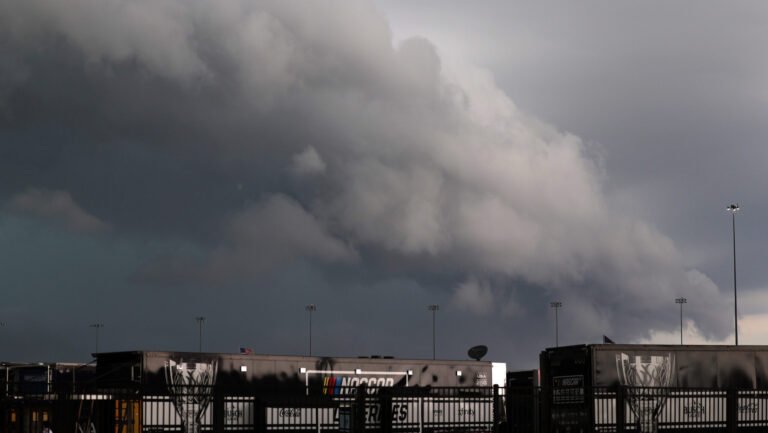
Dark clouds rolled over Chicagoland Speedway on Saturday, but the biggest storm facing NASCAR teams isn’t in the forecast.
It’s the strategic gamble that could decide Sunday’s Cup Series race.
Although Chicagoland hosted Cup Series races for nearly two decades before falling off the schedule after 2019, Sunday’s event marks the first time NASCAR’s Next Gen car will compete on the 1.5-mile oval. Seven years of aging pavement have transformed the racing surface, leaving crew chiefs with limited data and plenty of uncertainty heading into the 267-lap race.
Advertisement
That uncertainty has elevated one strategic question above all others: When should teams use their eight sets of Goodyear tires?
With an abrasive surface, unpredictable cautions and unknown tire wear over a long green-flag run, the answer could ultimately determine who leaves Chicagoland with the trophy.
Nobody knows exactly how the Next Gen car will race here
Unlike Kansas Speedway, Las Vegas Motor Speedway or Charlotte Motor Speedway, Chicagoland has essentially become an unknown.
Drivers and crew chiefs completed just one 50-minute practice session Friday before qualifying, leaving little time to understand how the aging pavement will affect handling over an entire fuel run.
Advertisement
A handful of organizations had a slight advantage after participating in a Goodyear tire test earlier this year, including Joe Gibbs Racing’s No. 11 team led by crew chief Chris Gayle. But even Gayle acknowledged that testing can only reveal so much once 38 cars begin laying rubber on the track.
“It’s not huge, but it is an advantage, right?” Gayle told NASCAR.com. “You get a leg up on where the place is.”
He explained that the information gathered during the test provides a useful baseline, but the racing surface evolves dramatically once an actual race weekend begins.
That means every team will continue adjusting long after the green flag waves.
Advertisement
Chicagoland’s aging surface creates another challenge
The track itself may be the biggest variable.
Years of Illinois weather have left Chicagoland with multiple types of bumps and seams that today’s Next Gen car has never encountered in competition.
Gayle described aggressive bumps in different sections of the speedway, while Hendrick Motorsports crew chief Rudy Fugle told NASCAR.com one section entering Turn 1 has become so pronounced that it almost launches the car.
“The bump into Turn 1, which has been there forever, it’s a patch. But now it’s a launch point,” Fugle said. “You almost take off.”
Advertisement
Those changing track characteristics force teams into a difficult compromise. They need enough compliance to absorb the bumps without upsetting the car, but they also need enough speed to remain competitive over a full fuel run.
Finding that balance may prove just as important as outright pace.
Tire strategy could decide the winner
Ultimately, however, the biggest unknown may not be setup at all.
It may be knowing when to pit.
Each Cup Series team has eight fresh sets of Goodyear tires available for Sunday’s race, and both Gayle and Fugle believe managing that inventory will become increasingly complicated if cautions begin stacking up.
Advertisement
“I think you’re going to want tires and you’re probably going to want four at that point,” Gayle told NASCAR.com while discussing late-race caution scenarios.
The difficulty comes when yellows arrive at unpredictable intervals. Crew chiefs must decide whether to sacrifice track position for fresh rubber or stay on older tires and hope another caution arrives before their competitors gain too much of an advantage.
Fugle admitted those situations can quickly become stressful.
“Whenever the cautions come out every 10 laps, you’re scared to death,” he told NASCAR.com. “The five-lap cautions are kind of fun because you have the opportunity to trade and get ahead of something… But when you get to 10, 12, 15 laps on tires and you stack those, you get really scared.”
Advertisement
By the time Sunday’s race reaches its closing laps, the fastest car may not necessarily be leading.
Instead, the winner could be the team that simply makes the right tire call at exactly the right moment.

