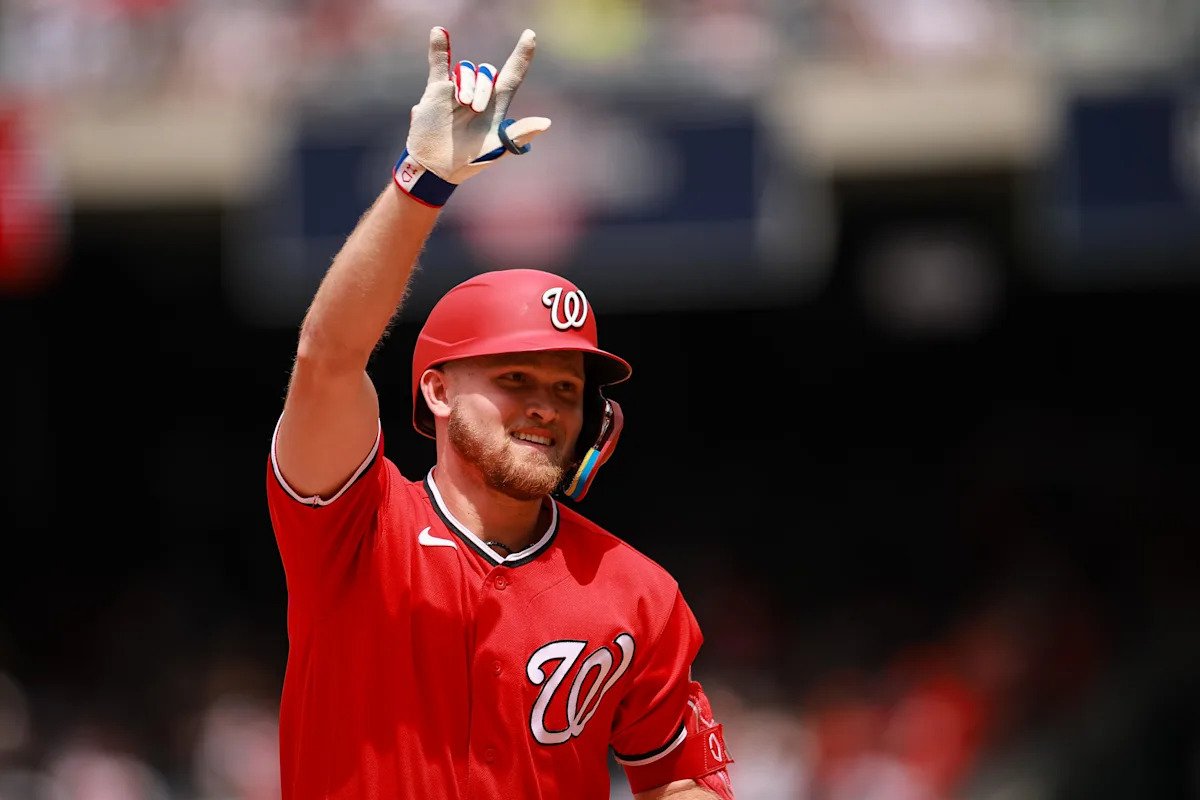
In a season full of great stories on the offensive side of the ball, the emergence of Curtis Mead has been one of the best ones. The Nats traded a 6th round senior sign for Mead, who had just been DFA’d by the White Sox. It has proven to be a great deal, as Mead has 17 homers and has been arguably the most clutch hitter on the team.
The Curtis Mead story is a good example of how a second chance and a change of scenery can benefit a player’s career. A few years ago Mead was a top 50 prospect and one of the best hitters in the minor leagues. At the time, people thought the Rays had won the one for one swap that sent Mead to Tampa and Cristopher Sanchez to Philly.
Advertisement
Obviously that did not turn out to be the case, with Sanchez starting the All-Star game and his home park while Mead is having success, just not in Tampa. Mead just hit and hit in the minor leagues, but the transition to the majors was tough. The Rays had a tough time finding a consistent role for him with Junior Caminero on the rise, Yandy Diaz and Jonathan Aranda at DH and first base, as well as Brandon Lowe playing second at the time.
Mead got looks here and there, but with no true home, the Aussie struggled. Eventually the Rays decided to trade him to the White Sox. Mead got a solid run of playing time there but did not make the most of his chance. With Miguel Vargas at third base and the addition of Munetaka Murakami at first, the writing was on the wall again for Mead.
When Mead reunited with his old minor league manager Blake Butera, he had to know this could be his last shot. To begin the season, Mead was on the short side of a first base platoon with Luis Garcia Jr., but played so well that the Nats had to find more playing time for him. He would get some reps at third base, DH or second base as well.
However, he found a permanent home at third after Brady House got sent down. Since then, Mead plays almost every day, though he will occasionally get an off day against a tough right handed pitcher. For the year, the 25 year old has 17 homers and an .843 OPS. He is on pace to hit over 30 home runs, which is not bad for a guy with 5 career bombs entering the season.
Mead is a very well rounded bat who does a great job combining contact ability, power and swing decisions. His chase rate, barrel rate and whiff rate are all in the 75th percentile or better. He does not hit the ball incredibly hard, but he hits the ball at good angles and pulls the ball in the air a lot. That allows him to have 30 home run power despite average raw power.
Advertisement
Based on his pedigree and minor league track record, it was clear that there was a good hitter in Curtis Mead that just needed to be unlocked. Guys do not hit .298 with an .878 OPS in the minors while almost always being younger than the competition by accident. That is what Mead did, and now after finally getting some stability, he is producing at the big league level.
Sure, Mead has some warts in his profile, most notably his lack of a true defensive home. Mead is sure handed at third base, but his arm is light for the position. He has played some first, but does not look super comfortable over there. I am interested to see what he would look like at second base, but I wonder about the range. It could be fun to experiment with him in the corner outfield spots and make him into a true super utility guy.
Mead came into the season as a post-hype flier who could hopefully be a solid platoon bat. However, he has become so much more than that. Mead is one of the big four pieces of the best offense in baseball. He is one of four players with at least 15 homers on the Nats. Mead, Abrams, Garcia and Wood have provided such immense value at the plate this season.
For Curtis Mead, this is no fluke either. His wOBA and xwOBA are identical at .365, meaning there is no luck right now. This is just who he is as a hitter. His BABIP of .251 is also unusually low. With his fly ball heavy profile, a low BABIP is not unexpected, but I would expect that to go up at least a little bit, which would raise his .247 average.
Advertisement
That .247 average is mediocre, but he makes up for that with his ability to draw walks. One of Mead’s defining attributes is that he consistently grinds out at bats. He does not whiff or chase very much. That makes it no surprise that Mead is walking over 11% of the time this year while striking out at a sub-20% clip.
Based on how teams drafted the other day, it is clear that Mead’s offensive profile is very desirable. Teams love high contact hitters with power and plate discipline. Curtis Mead has become the very good, well rounded hitter the Rays expected him to be all those years ago. All it took was a fresh start and some time in Matt Borgschulte’s hitting lab.

