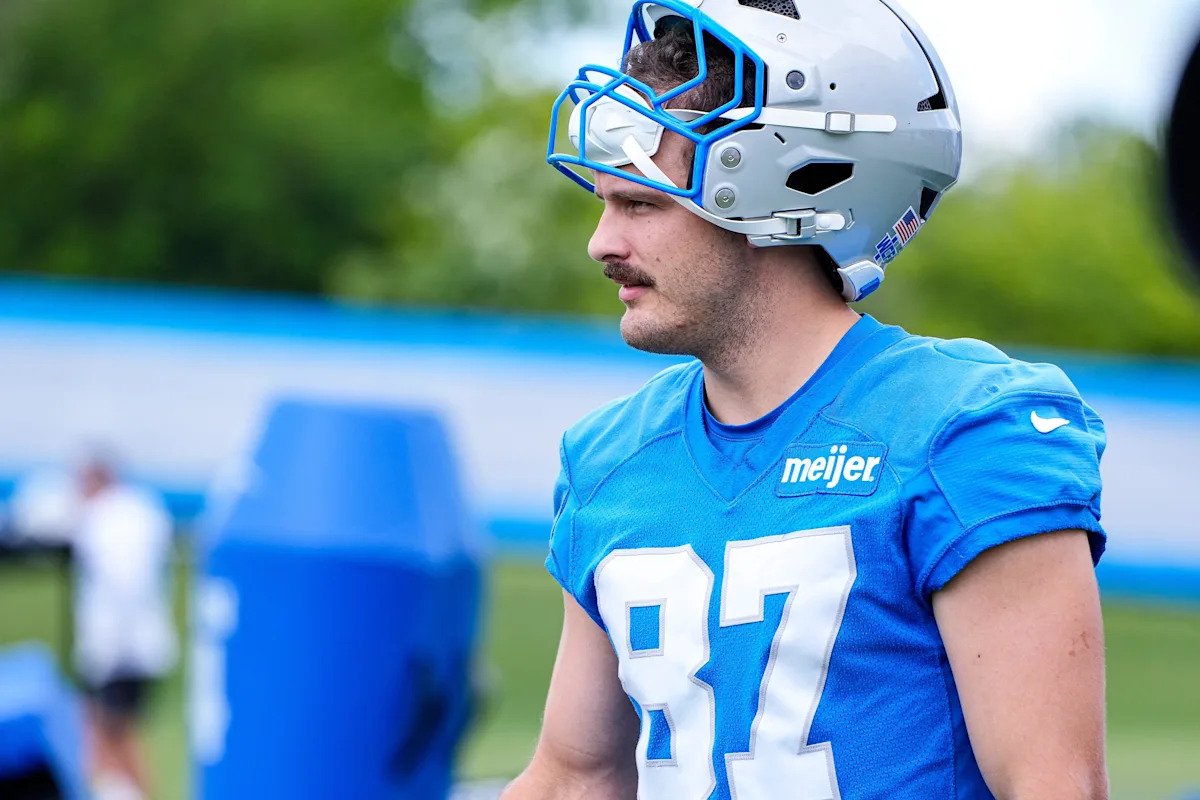
In this installment of our Detroit Lions 2026 training camp preview series, we examine the Lions’ tight end room, speculate on current and future roles, and discuss how many players from this group could make the 53-man roster.
Previous training camp previews:
Advertisement
Roster construction
Under the Brad Holmes and Dan Campbell regime, the Lions have been inconsistent with the number of tight ends on the active roster, initially using a fullback early in their tenures but opting for TE/H-backs in recent seasons.
Let’s take a look at what they’ve done in the previous five seasons:
-
2021: Mainly deployed just two tight ends and a fullback (Jason Cabinda) on the active roster, along with another two on the practice squad.
-
2022: Opened with four tight ends on the roster before reducing to three and re-adding a fullback (Cabinda returned from IR) mid-season.
-
2023: Opened the season with three tight ends and a fullback, but when Cabinda landed on IR, the Lions only replaced him with a fourth tight end for a few games before returning to just three for the majority of the season—leaning on a variety of players to play an H-back role.
-
2024: Opted for three tight ends, and eliminated the fullback role.
-
2025: Consistently kept three tight ends on the roster throughout the season, despite dealing with a plethora of injuries, including losing their top three tight ends.
Prepping for 13 personnel
While Rams’ coach Sean McVay gets most of the love surrounding the NFL’s increased usage of 13 personnel (1 running back, three tight ends, and 1 receiver), it was actually Lions new offensive coordinator, Drew Petzing, who started the trend a few years back when he was in Arizona. By using this “heavier” skill-set-based look, offenses can give defenses confusing looks and create mismatches to their advantage.
Advertisement
Here’s an excerpt from Pride of Detroit’s interview with Petzing, discussing 13 personnel:
“If you have three tight ends that don’t have a multiple skill set, you’re not going to do it. Because the key is the matchups. When you have guys that can do a lot of different things, you can start to dictate things based on what the defense wants to do.
“I think as the game has evolved defensively over the last 5-7 years, you’re starting to see more and more different defensive personnels. It’s not just, ‘Hey, we’ve got base. Hey, we’ve got nickel. Here we go, this is it.’ You’re seeing different variations of base, different variations of nickel…
“Now, in 13 personnel, you have to be able to deal with everybody in the box and multiple gaps that you weren’t ready to account for. And then if you get big, I can spread things out and create people that you don’t want to have in space. So it allows you to dictate to the defense a little bit more some of the things that they have been trying to dictate to us based on who they’re putting on the field. It gives you the freedom to jump back and forth without being predictable.”
With the Lions returning their top two tight ends from last season in Sam LaPorta and Brock Wright, Detroit entered the offseason looking for a third tight end with a “multiple skill set” that could give them the option of running 13 personnel. To fill this need, the Lions signed Michigan native Tyler Conklin, a veteran who has spent the majority of his career as a TE1 or TE2, and was with the Vikings at the same time as Petzing in 2018 and 2019.
Additionally, to round out the tight ends room, the Lions signed undrafted rookie free agent Miles Kitselman, returned practice squader/H-back Zach Horton, and added Thomas Gordon in free agency.
The battleground
Will Sam LaPorta return to form?
LaPorta’s 2025 season was cut short due to a back injury, but the Lions are optimistic that he will be able to put that injury behind him by this year’s training camp, after limited participation in OTAs and minicamp.
Advertisement
“We like where he is going; he is trending the right way,” coach Dan Campbell said in the spring.
If LaPorta can return to form as anticipated, many are predicting that he could be in for a career year based on his talent and Petzing’s ability to elevate tight ends; Trey McBride had back-to-back 1,000-yard receiving seasons and was a two-time Pro Bowler and an All-Pro under Petzing the last two years.
Can Brock Wright hold on to his TE2 role?
Like LaPorta, Wright also finished 2025 on injured reserve (neck and trachea injuries) but is also expected to be fully available for training camp, especially considering he did not appear limited in the spring. Wright is another player who could see greater benefit from the addition of Petzing, as the 27-year-old has a balanced skill set and can line up in a variety of positions, including inline, split-out, and in the backfield as an H-back.
Advertisement
Wright will certainly face competition for his TE2 role—Conklin will arguably represent the toughest challenger he’s faced for the role—but early expectations are that TE2 is Wright’s job to lose.
Can Tyler Conklin hold off the young TEs for the TE3 role?
Conklin was limited in spring practices, but that was not overly surprising as this coaching staff is slow to acclimate veterans over 30 years old who are coming off injuries. He is also expected to be ready to go by training camp.
While Conklin is loaded with skills and experience (127 games played, 69 starts, and 270 career receptions), he is coming off the worst season of his career (save his rookie season) during his one-year stint with the Chargers. Expectations are that Conklin will be able to return to form in a reduced TE3 role in Detroit, but if his struggles in Los Angeles linger, he’ll have to fight to keep his role.
Advertisement
With injuries to multiple tight ends during OTAs/Minicamp, it was UDFA rookie Miles Kitselman (6-foot-5, 251 pounds) who was quickly elevated to the first-team offense. Kitselman spent the last four seasons in the SEC (two at Alabama and two at Tennessee) and brings a balanced skill set to Detroit. He has the physicality to line up inline (attached to the line of scrimmage), the range to line up in the backfield as an H-back, and excels as a run blocker. His talent and upside should allow him to challenge for a TE3 role and could force the Lions to consider keeping a fourth tight end.
Will the Lions keep a TE4?
There is precedent suggesting that the Lions would consider keeping four tight ends given Petzing’s history of using 13 personnel, but with the top-level talent at wide receiver, the Lions may be inclined to keep just three tight ends and continue to expand their roles.
The play from Conklin and Kitselman will certainly factor into whether the Lions elect to keep four tight ends, but there is also a wild card to this conversation: Jackson Meeks.
Advertisement
As we discussed in our wide receiver preview article, Meeks has been cross-training at WR-X and tight end, and he brings a unique skill set to the offense. While the second-year player has been working at both positions for nearly a year, it’s still not entirely clear how far along he has progressed in his development at either spot. Training camp will give Meeks a platform to showcase his crossover skills and could be a key factor in roster construction at the end of August.

