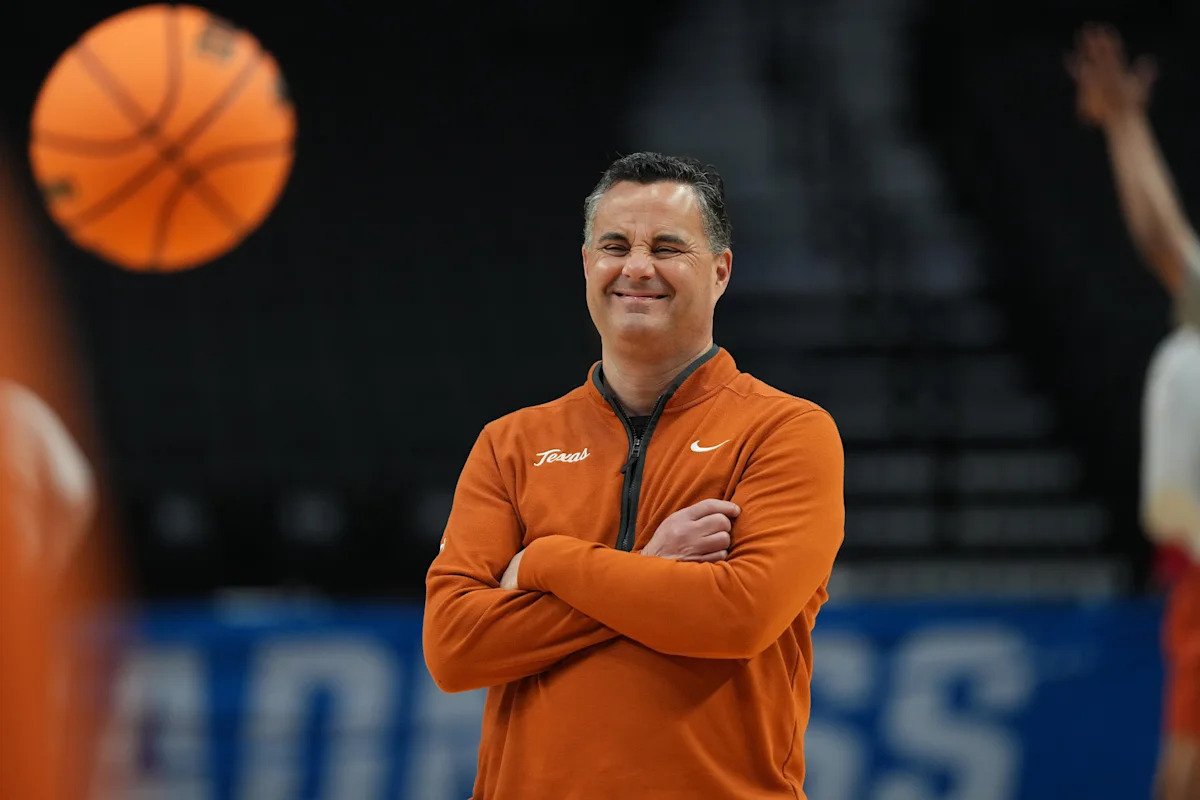
“What a difference a year makes.”
After the first season under Texas Longhorns head coach Sean Miller ended with a surprising run from the First Four to the Sweet 16, where a last-second tip in vaulted the Purdue Boilermakers into the Elite Eight, Miller and his staff are now entrenched on the Forty Acres, where they executed one of the most successful portal strategies in the country, landing a five-man class that ranks No. 4 nationally in the 247Sports Composite rankings to complement the No. 5-ranked high school signing class, recently supplemented by the surprise reclassification of forward Marcus Spear Jr., previously the top-ranked recruit in the 2027 cycle.
Advertisement
Put together, the Horns have the top overall class in the country, leading to early projections of Texas as a top-10 team nationally in stark contrast to last season’s group, slapped together hastily by the new staff with no ability to plan a portal strategy in advance. Picked to finish ninth in the preseason SEC media poll after landing the No. 25 portal class nationally, the Longhorns ended the regular season in 10th place before slipping into the NCAA Tournament and playing the team’s best basketball of the season during March Madness.
Now the expectations are higher as a projected preseason top-10 team — and Miller isn”t spending time trying to actively lower those expectations — as the team goes through summer workouts with Spears and the sterling portal class on campus.
During a Tuesday media availability, Miller detailed the experienced additions, highlighted by the signings of Colorado transfer guard Isaiah Johnson and TCU transfer forward David Punch to build around the high-profile retention of junior center Matas Vokietaitis.
Guard Isaiah Johnson
After signing with Colorado as a prospect ranked just inside the top 300 players nationally, Johnson had a breakout freshman season with the Buffs, ranking third in the Big 12 in scoring at 16.9 points per game, leading CU in that category as well as steals (33), three-point field goals made (56), free throws made (160), and free throws attempted (195), and ranking second in assists (96), three-point field goal percentage (.378), and minutes (30.6 mpg).
Advertisement
The standout season made Johnson a highly-coveted commodity in the portal, committing to Texas as the No. 13 player overall and the No. 2 point guard.
Currently returning from a minor thumb injury, the 6’1, 170-pounder now faces high expectations on the Forty Acres.
“Isaiah Johnson, 18 years old a year ago at Colorado in the Big 12, averaged 16 points a game, and I think that if I just stop right there, if you’re in the Big 12 Conference and you shoot the percentages that he shot, and you average 16 points a game as an 18-year-old, I think it shows that he has a huge high ceiling, and we’re we’re really excited about helping him get to that ceiling,” Miller said.
The Texas head coach believes that ceiling includes the ability to make his teammates better, and with an assist rate of 18.6 percent that was lower than Dailyn Swain last season, Johnson should improve in that area with a better supporting cast.
Advertisement
The physical dimension is important, too, especially to hold up defensively in the rugged SEC, where his frame put him at a disadvantage and sheds some perspective on why his recruiting rankings didn’t quite match a skill set honed under his father, Chris Johnson, a well-regarded NBA trainer who has worked with players like LeBron James, Dwyane Wade, Jimmy Butler, DeMar DeRozan, and Tyrese Maxey.
Forward David Punch
In Miller’s estimation, the best teams in the country last season had a strong four to pair with their five, an area in which Texas was sorely lacking with Nic Codie benched for much of the season, forcing Miller to play 6’7, 215-pound forward Came Heide next to Swain and Vokietaitis.
Advertisement
So it was a high priority for Miller to upgrade the position this offseason, a desire made possible when Punch left TCU after his own breakout season, allowing the Texas head coach to capitalize on the relationship built recruiting the Harker Heights product at Xavier.
“We thought he was a diamond in the rough, tried very hard, but built a relationship with his family and David. I think they recognized that we really believed in him — that was helpful. Once David went in the portal, that it gave us a leg up,” Miller said.
The Longhorns needed all the advantages they could find because Punch went from a top-100 high school prospect in the 2024 recruiting class to the No. 8 overall player in the portal.
“Playing for Jamie Dixon, great coach in the Big 12, like Isaiah, he’s proven rebounding, scoring, shooting percentage. If you looked at what he did, for example, at TCU versus Florida a year ago, very, very few players have played better against Florida a year ago than what David did,” Punch said.
Advertisement
In the early-season win over the Gators, Punch was outstanding, scoring 19 points on 7-of-9 shooting from the field and 5-of-6 shooting from the free-throw line with nine rebounds, two assists, three blocks, and two steals.
“We’re thrilled to add his experience, his physicality, and mostly like when you get guys from the portal, you want them to fit, and I think Matas and David Punch form a very physical one-two punch, no pun intended,” Miller said.
Wing Elyjah Freeman
Among the transfer portal additions, Freeman has the most remarkable trajectory — from an unranked high school recruit in Florida to Division II Lincoln Memorial University to Auburn and then on to Texas.
Advertisement
“When we scouted Auburn, he jumped off the page in terms of his athleticism and the plays that he made,” Miller said.
In a January win over Texas, Freeman scored 10 points in 19 minutes on 4-of-6 shooting, making a three and recording three rebounds and a steal.
“Auburn plays one of America’s toughest schedules a year ago and had a prominent role, had a great ending to his season, and I just think Elijah’s versatility and his upside reminds me a lot of a Daylin Swain — where where he is today is nowhere near where he can be — and so excited about his versatility on the wing,” Miller said.
With the Tigers, Freeman led the team in steals (49) and ranked third in rebounding (5.2 rpg) and fifth in scoring (9.2 ppg) and minutes (26.8 mpg) while shooting 34.3 percent from three.
Advertisement
Texas won’t have to rely on Freeman to be a primarily playmaker like Swain was for Miller’s first Longhorns team, but a junior season efficiency leap from Freeman, who already slightly outpaced Swain in offensive efficiency as a sophomore, would be a major boost to Texas, which won’t have to rely on Freeman as a primary playmaker.
Guard Amari Evans
As with Punch, Miller had a prior relationship with Evans, a Pittsburgh product who spent his freshman season at Tennessee as a role player off the bench, averaging 4.1 points and 3.2 rebounds in 14.4 minutes per game while tying for third on the team in steals (34).
Advertisement
“We recruited Amari very hard out of high school when we were at Xavier, formed I think a trust and a strong relationship with his mom and him. Obviously, me and him drank the same water, right? We’re from the same area, so we finished second to Tennessee. But oftentimes, the way the portal works, that familiarity helps, and once he went into the portal, we knew him. We knew a lot about him.,” Miller said.
A strong defender, Evans has the size and length at 6’5 and 220 pounds with a 6’10 wingspan to make Texas bigger on the perimeter and guard multiple positions, a role that often fell to Chendall Weaver last season, who is shorter than his listed height of 5’3.
“I just think Amari’s defensive presence, his physicality, playing for Coach Barnes, like Elyjah Freeman playing in the SEC a year ago, you’re bringing in an experienced, seasoned player, yet he’s still young in his development. And again, I don’t think he’s anywhere near where his ceiling is,” Miller said.
For Evans to reach his ceiling, the growth will have to come on the offensive end — he shot 57.5 percent from the free-throw line and 22 percent from three, so capitalizing on his opportunities at the line and showing some ability to space the court are important places to start.
Advertisement
Guard Mikey Lewis
There aren’t any questions about the scoring ability that former Saint Mary’s guard Mikey Lewis will provide for Texas after averaging 13.9 points per game as a sophomore with the Gaels.
“If you play for Coach Bennett, you’re one of the most well-coached players in college basketball. First of all, Newcomer of the Year, Sixth Man of the Year, All-Conference player this year, scored over 30 points against Gonzaga, played a prominent role on back-to-back NCAA tournament teams, and again, somebody who can shoot the basketball and score it, who’s played at a very high level and has been from a winning culture,” Miller said.
Advertisement
A 36.8-percent shooter from three and an 88.2-percent shooter from the free-throw line, Lewis is a bucket-getter who had a low turnover rate. Listed at 6’3, he was a poor finisher around the rim at 48.2 percent and only shot 34.1 percent on mid-range shots, both areas for improvement.
Beyond the talent level of the players landed by Texas in the portal, an important part of the team’s strategy also included targeting players with multiple years of eligibility remaining, now extended by the new five-for-five eligibility model.
“That’s the one common theme with the guys we got this spring — they’re not like a one-year player. They’re not in their final season. They’ve been in college for three or four years. You know, most of the guys we got, if you think about it, I’m talking about their upside, their age — they have multiple years — and I think that’s exciting, the possibilities for us and them,” Miller said.
Advertisement
In a best-case scenario, the Horns may not get multiple seasons out of Punch, for instance, but the bulk of the class should provide a core that can provide continuity for Miller over the next several seasons.
“You combine all those players right there, that group of five, I think it gives us firepower, experience, depth, and most importantly, a fun group to work with because I don’t know if any of them are a finished product,” Miller said. “I just think all of them have another level they can get to and it’s up to our environment, our staff, to help them get there.”

