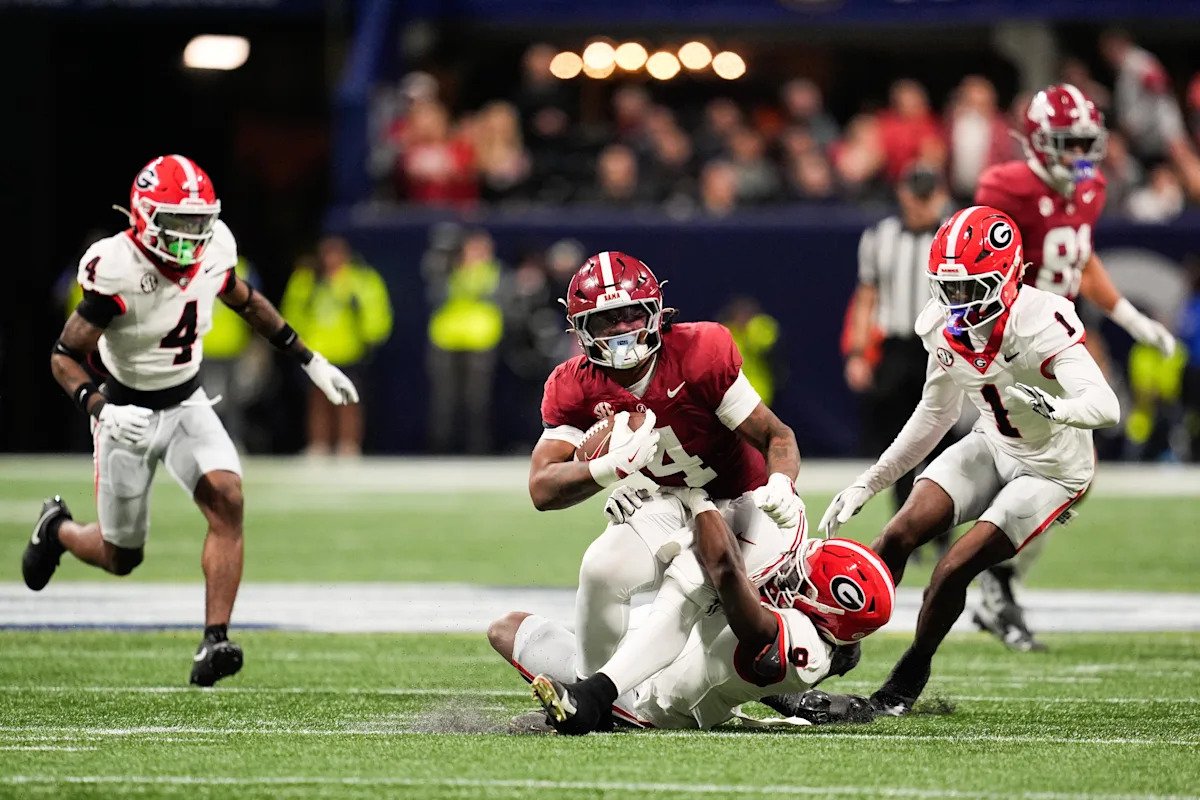
Alabama was bad at running the ball in 2025.
It’s been one of the main talking points for the last 8 months across both local and national sports conversations. The committee kept moving the Tide around in their rankings based on a lack of 100-yard rushing games. And then once the season ended in disappointment, the coaches have fielded questions about the run game in every press conference, and every national preview article or power ranking mention the Tide’s lack of run game in 2025.
Advertisement
The optimistic Alabama fans have looked at the coaching changes, OL changes, and incoming running backs as reasons for hope, while the negative fans have looked no further than retaining offensive coordinator Ryan Grubb as a reason for doubt. But rather than thinking about Alabama specifically, I wanted to take a look back at the last 10 years of college football to see if there have been any other teams to wind up in Alabama’s shoes – and if so, what happened the next year?
Now, for every statistical exercise, you have to make cutoffs. So, for the rules of the road, as well as full transparency, here are the conditions:
-
The team had to finish in the bottom 20 in the country in rushing PPA, excluding garbage time.
-
The team finished the season ranked in the top 25 (using ESPN’s standings tab)
PPA is a metric from CollegeFootballData.com. It essentially measures the predicted points added per play for the team throughout the year. Check out this post if you want a more in-depth explanation.
To put things bluntly, there haven’t been too many examples of teams having good records while rushing the ball as poorly as Alabama did last year. Interestingly, both Alabama AND Oklahoma did just that in 2025, and both made the playoffs. The question I wanted to answer is this: Is there any precedent in the recent era of a good team that couldn’t rush the ball turning around and having a good season the next year?
Advertisement
To start going backwards, there’s only team that’s found themselves in a similar boat in the post-Covid era: The Iowa Hawkeyes. In 2021, Iowa had the 11th worst rushing offense in the country while going 10-4. Now, they also were terrible passing the ball and got away with a bunch of ugly wins with a great defense. The following year, they fell to 8-5. Interestingly, the Hawkeyes then did it again in 2023, having the country’s #1 worst rushing attack while going 10-4. And again, they went 8-5 the following year.
Before that, we have 2020. It was a weird year that has a lot of statistical outliers due to shortened seasons. USC and Indiana were both terrible rushing teams that finished the season ranked, but both then followed that up with losing seasons in 2021.
Then we get a three-year break before we finally get a couple of contenders again in 2016. The Florida Gators had a patchwork offense with QBs Austin Appleby and Luke Del Rio that was the 107th ranked scoring offense in the country, but, like Iowa in the 2020s, wound up with a good overall record due to an exceptional defense. They followed that up with a losing season the following year.
The other team in 2016 to pull this off was, surprisingly enough, the National Championship-stealing winning Clemson Tigers. The Tigers had an amazingly powerful passing game with DeShaun Watson at QB, and while running back Wayne Gallman did have over 1000 yards, it was a generally inefficient rushing attack on a per-play basis that mostly got yards due to sheer volume of plays (an absurd 82 plays per game… That is something I really don’t miss about the 2010s). The Tigers won the Natty (allegedly), then in 2017 they turned around and got right back into the 2017 playoffs, this time with a much more respectable rushing attack.
Advertisement
Finally, in 2015, the Oklahoma State Cowboys had the country’s 10th worst rushing attack, but went 10-3 with Mike Gundy’s high-volume passing offense. They followed that up with another 10-3 season in 2016, but with a more league-average rushing attack as well.
So, there’s a mixed bag here. Throwing out the 2020 year, we basically only have Iowa as a data point in the current era of football – and I don’t think that looking at Iowa is going to be very translatable to Alabama or Oklahoma in terms of the level or type of program.
Before that we have the 2015-2016 teams. The Florida Gators were in dire straights with their QBs for years during this time period, which, for all of Alabama’s woes, QB hasn’t been one of them.
Oklahoma State is more interesting comparison. QB Mason Rudolph (a future NFL QB who some might say shares some similarities with Ty Simpson) had 3700 yards, 21 TDs, and 9 picks, while none of their running backs (including future NFL pro bowler Chris Carson) had over 550 yards. The Cowboys followed up that season with a much better rushing attack, with a freshman sensation Justice Hill coming in and rushing for 1200 yards on 5.5 yards per carry, while Carson dropped to 2nd team role, but wound up with 50 more yards than his prior season, but with an exceptional 6.8 yards per carry. The Cowboys finished 2016 ranked 11th in the country.
Advertisement
The other interesting comp is Clemson’s 2016 team. At first glance, it may seem a bit… Over optimistic… To use them as a comp for Alabama’s 2025 season. However, check out this comparison of each team’s PPA metrics:
|
Team |
Overall offense PPA |
Passing PPA |
Rushing PPA |
Defense overall PPA |
Def passing PPA |
Def rushing PPA |
|---|---|---|---|---|---|---|
|
Alabama 2025 |
0.2 |
0.35 |
0.02 |
0.08 |
0.11 |
0.1 |
|
Clemson 2016 |
0.21 |
0.37 |
0.04 |
0.02 |
0.06 |
-0.01 |
Again, you have to factor in the different eras of rulesets and the fact that Clemson ran 20 more plays per game in 2016 than what Alabama did in 2025. But DeShaun Watson and Ty Simpson are, interestingly, I think a similar player comp in terms of size, athleticism, and arm. Watson was WWAAAAYYY better at improvising, but both wound up drafted in almost the same spot in the NFL Draft: 12th for Watson, 13th for Simpson.
The following season, the Tigers had to break in a new QB (Kelly Bryant), but the RB room saw a freshman Travis Etienne step onto the scene and average 7.2(!) yards per carry, while 2016 reserve running back Tavien Feaster averaged 6.3 ypc. And they made the playoffs before losing a defensive slugfest to Alabama because Bryant couldn’t pass the ball. If you like being optimistic, I think that Keelon Russell (or Austin Mack) can be much, much more effective than Bryant was that season.
So, all hope is not lost, Bama fans. Sure, there’s a chance that the Tide could go the way of 2020s Iowa or 2010s Florida, but both of those programs were in no-man’s-land with their QB situations. On the other hand, I think that both Oklahoma State and Clemson offer us very real hope that a good team with a 1-year ineffective rushing attack has historical precedent of making major strides the next year.
Advertisement
And you know what both of them had in common? A freshman RB bursting onto the scene. No pressure on EJ Crowell or Trae’Shawn Brown, or anything.

