It’s no secret that the offseason of 2026 didn’t go according to plan for general manager Pat Verbeek and the Anaheim Ducks. After a season where they made the playoffs and seemingly turned the corner on their long rebuild, they were in a prime position to add a significant piece or two to their depth chart and take another sizable step toward Stanley Cup contention in the near future.
A historic offer sheet later, and their entire cap structure has been detrimentally altered. They’ll now have to rely on their current young core to take another considerable step in their development into stardom. They’ll also need their young secondary pieces to assume larger roles in their nightly lineups and reach their potential quicker than anticipated.
Advertisement
Young Anaheim Ducks Players Who Could “Graduate” into Impactful NHL Roles in 2026-27
NHL Prospect Pool Overview ’26-27: Anaheim Ducks Have Plenty More On The Way
Once armed with the most projected cap space in the NHL, the Ducks will now likely be forced to move a veteran contract or two to fit star forward Cutter Gauthier‘s eventual new contract under the cap ceiling before the start of the season (or at some point before injured forward Troy Terry is slated to return to the lineup in late autumn).
Heading into the offseason, the two most notable areas in need of improvement on the Ducks’ depth chart were on the right side of the blueline and at the center position, on the second line, behind Leo Carlsson.
Advertisement
The right side of the blueline will now mostly lean heavily on youth, with a combination of Ian Moore, Drew Helleson, Tristan Luneau, and lone veteran Nick Jensen. The center group is projected to remain the same as it was in May, when they lost in the second round to the eventual Western Conference Champion Vegas Golden Knights, and consists of Carlsson, Mikael Granlund, Ryan Poehling, and Tim Washe.
However, the Ducks may have a hidden arrow in their quiver when it comes to addressing their current suboptimal middle-six center situation.
“Well, as you see it now, we have options,” Verbeek said after the Ducks traded Mason McTavish at the 2026 NHL Draft. “Cutter’s played center before. Roger McQueen, we’re going to see what he looks like when he gets to camp. So, we have options. We’re just trying to see where these players are going to shake out when training camp arrives.”
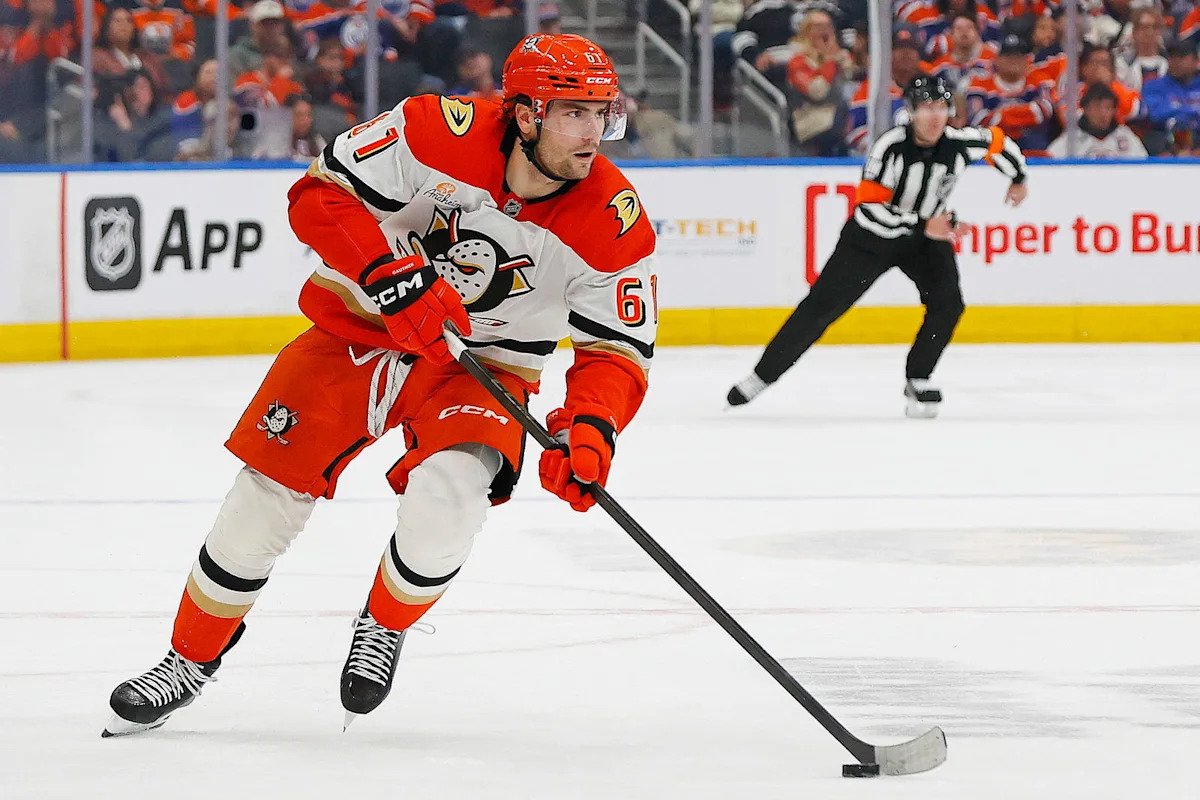
Cutter Gauthier (22) will be entering his third full season in the NHL in 2026-27. After a rookie 2024-25 year that saw him struggle to maintain a role in the top nine under former head coach Greg Cronin, yet still managing to score 44 points (20-24=44) in 82 games, he broke out last season and established himself as a top-20 winger in the NHL and a difference-maker, leading the Ducks in scoring with 69 points (41-28=69) in 76 games. He became the first Ducks player to score 40 goals in a season since Corey Perry in 2013-14 and just the fourth Ducks player in history to do so, joining Perry, Paul Kariya, and Teemu Selanne.
Advertisement
Before his jump to the NHL from the NCAA at Boston College, and during his time with the USNTDP in juniors, Gauthier played down the middle of the ice as a center. He was selected at the top of the first round by the Philadelphia Flyers (5th overall in 2022) as a player who could play either forward position and provide instant offense. He did just that during his collegiate career, scoring 102 points (54-48=102) in 73 games at BC over two seasons.
Gauthier always projected as more of a winger, given his skill set and how he operates on the ice. He provides elite straight-line speed, has a feel for where to be and how to position himself in dangerous areas of the ice, and possesses one of the most deadly releases in the NHL. His shot is undoubtedly one of the best the sport of hockey has ever seen.
Gauthier’s production at a young age and the contract that his common linemate, Carlsson, is now under ($18 million AAV) have given Gauthier a high percentage of leverage in his current extension negotiations with the Ducks. Without knowledge of the range in which the final number will land, it’s entirely conceivable that Gauthier’s AAV comes in around the number Connor Bedard recently signed for with the Chicago Blackhawks, $15 million.
Assuming that hypothetical $15 million AAV, it would render Gauthier the third-highest paid (tied) player in the NHL, and it’s increasingly likely he’ll be, at the very least, within the top ten. Given the roster makeup, can the Ducks ultimately justify paying that salary to a winger?
Advertisement
The Ducks are already projected to ice a top-heavy depth chart on a nightly basis. Carlsson’s contract will eat 17.3% of the cap for the 2026-27 season, and if Gauthier comes in around $13-16 million, roughly 30% of their cap (minimum) will be distributed to just two players. Shifting Gauthier to center and playing him on the second line would, in theory, allow the Ducks to distribute their high-end talent more evenly throughout the lineup, allow Gauthier a greater chance to impact games, and a better opportunity to merit his projected AAV by playing a more premium position.
IMAGN IMAGES via Reuters Connect
Faceoffs and faceoff percentages are not proven to alter the outcome of a game to a high degree, but they’re one of the minor details that coaches emphasize, and one that allows a team to begin a shift with possession of the puck. In 2025-26, when called upon, Gauthier won 102 of 208 draws (49%), good enough for fourth on the Ducks among players who took over 100 draws.
After the draw, Gauthier’s ability to play meaningful minutes down the middle comes more into question. He has the goal-line-to-goal-line speed necessary to play center in head coach Joel Quenneville’s system, one proven demanding of those who play there. In limited opportunities, he’s provided a quality defensive impact and has done fairly well to round out the disruptive aspects of his game on the defensive side of the puck in his young career.
Advertisement
Struggles with a potential shift to the middle may lie in an inability to transport pucks through the middle of neutral ice and drive play with change of pace or manipulative sequences with the puck on his stick. When he’d been called upon in the past to act as the trailer on the power play, he had difficulties gaining clean entry and stickhandling through traffic at high speeds. He’s also not one to quarterback offensive zone cycle sequences or create time and space for himself and teammates.
Without play-driving improvement (something he’s entirely capable of), a shift to the middle for Gauthier may only work if he’s placed on a line with wingers who rely on forechecking and winning pucks back to generate offense or wingers who can assume the playmaking duties for his line.
Sliding Gauthier from the wing to the middle and allowing him to develop those aspects of his game could ultimately provide the Ducks with more options in the present and future when constructing their lineups, allow players like Roger McQueen, Eric Nilson, or Lucas Pettersson to marinate longer in lower levels, and add needed depth as they attempt to remain competitive in the immediate future.
First things first, of course, the Ducks and Gauthier will need to come to an agreement on a new contract before the start of training camp to fully optimize him and the team around him heading into another pivotal season in Anaheim.
Advertisement
Anaheim Ducks Acquire AHL Forward Sean Farrell in Exchange for Sasha Pastujov
Anaheim Ducks Sign First-Round Pick Nikita Klepov to ELC
Outlook for the Anaheim Ducks Blueline, Losing Three Veteran Right Shots
Anaheim Ducks Long Term Salary Cap Outlook, How it was Impacted by Leo Carlsson’s Offer Sheet

