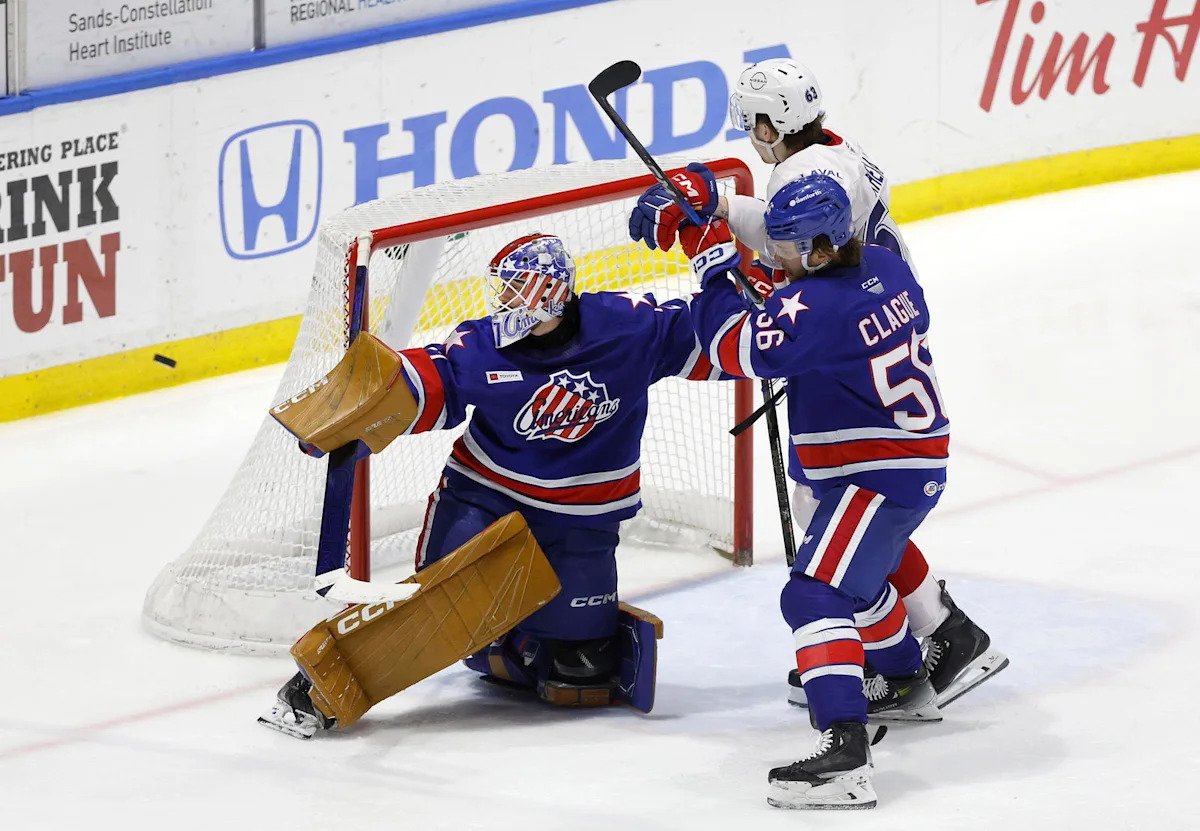
It was the fall of 2025, in Rochester, New York, where Devon Levi was trying to prove something nobody in Buffalo particularly wanted proven.
He was told plenty about where he stood in the only NHL organization he’d ever known when he had been sent down before the season even started. The Sabres already had Ukko-Pekka Luukkonen locked in as their guy. They’d claimed Colten Ellis off waivers from St. Louis, and Ellis went and had a .903 save percentage in a third-string role, which only made things worse for Levi. A goaltender twice named the top goalie in the NCAA, a world juniors silver medalist, a player who’d once looked like Buffalo’s answer in net, spent the entire 2025-26 season in the American Hockey League with no real pathway back.
Advertisement
He stayed there the whole year. He kept playing, and on July 1, 2026, his five-year tenure in Western New York ended with a phone call that sent him and a 2028 7th-round pick to Edmonton in exchange for a 3rd-round pick.
The Oilers had been burned by goaltending before. Talbot, then a carousel of names, then Stuart Skinner and Calvin Pickard carrying the franchise to back-to-back Stanley Cup Finals before the wheels came off. Last year they traded Skinner to Pittsburgh for Tristan Jarry, a swap that was supposed to end the conversation. It didn’t. Jarry struggled in Edmonton the way Skinner had struggled everywhere else, and by July the Oilers were right back where they always seem to end up, staring at a crease with more questions than answers.
So they bought two more. Frederik Andersen arrived hours after the Levi trade, a reigning Stanley Cup champion at 36 years old on a one-year, $1 million deal, a clear stopgap rather than a plan. Jarry stayed put, still signed for two more seasons at $5.375 million, his price locked in regardless of how this year goes. And Levi slid in on a contract that runs out at the exact moment everything else about this roster is supposed to change.
Levi hits restricted free agency in the summer of 2027. Jarry becomes extension-eligible that same summer. And roughly $26 million in cap space opens up for Edmonton at that same moment, the biggest single-year jump the organization has had in years. The Oilers essentially have three separate clocks, all set to strike at once, and all waiting on Levi to decide what the outcome will be.
Oilers’ Cap Ranking Shows a Familiar Pattern
Advertisement
If he plays well, Edmonton walks into 2027 with a cheap, controllable goaltender on an entry-adjacent deal, room to extend him before the market resets, and the rest of that cap space free to spend on the roster around him. Jarry’s extension conversation shifts from who the guy is to how the depth behind him is built. If Levi struggles, or simply doesn’t get the runway to prove anything, Jarry becomes the goaltender Edmonton has to commit real term to, even though they hoped to spend that money elsewhere. Especially considering Andersen’s one-year deal expires and there’s no obvious answer waiting behind it.
Goaltending analyst Kevin Woodley has watched Levi’s tape closely enough to know what separates this version of him from the one Buffalo gave up on. Woodley has said Levi’s is one of the fastest skaters in the NHL, with excellent footwork. It’s more of a matter of reining in his aggression. That adjustment is more mental than physical, and could be the whole competition this fall.
3 Rush Decisions The Oilers Need To Avoid Making This Season
Advertisement
Edmonton might create a narrative where Levi looks like the goaltender who dominated junior and college hockey before Buffalo’s crease got too crowded to let him prove it, and Stan Bowman solved a decade-long problem for the cost of a third-round pick and a one-year, sub-million-dollar contract. Or, he’s simply the seventh or eighth goaltending reset of the past decade, and one more name on a very long list.
Either way, the answer isn’t going to come from Andersen, whose contract runs out regardless, or from Jarry, whose price is already locked in no matter what happens this season. It’s going to come from the 24-year-old who spent last year in Rochester proving very little to an organization that had already stopped watching, now getting one contract year in Edmonton to prove everything at once.

