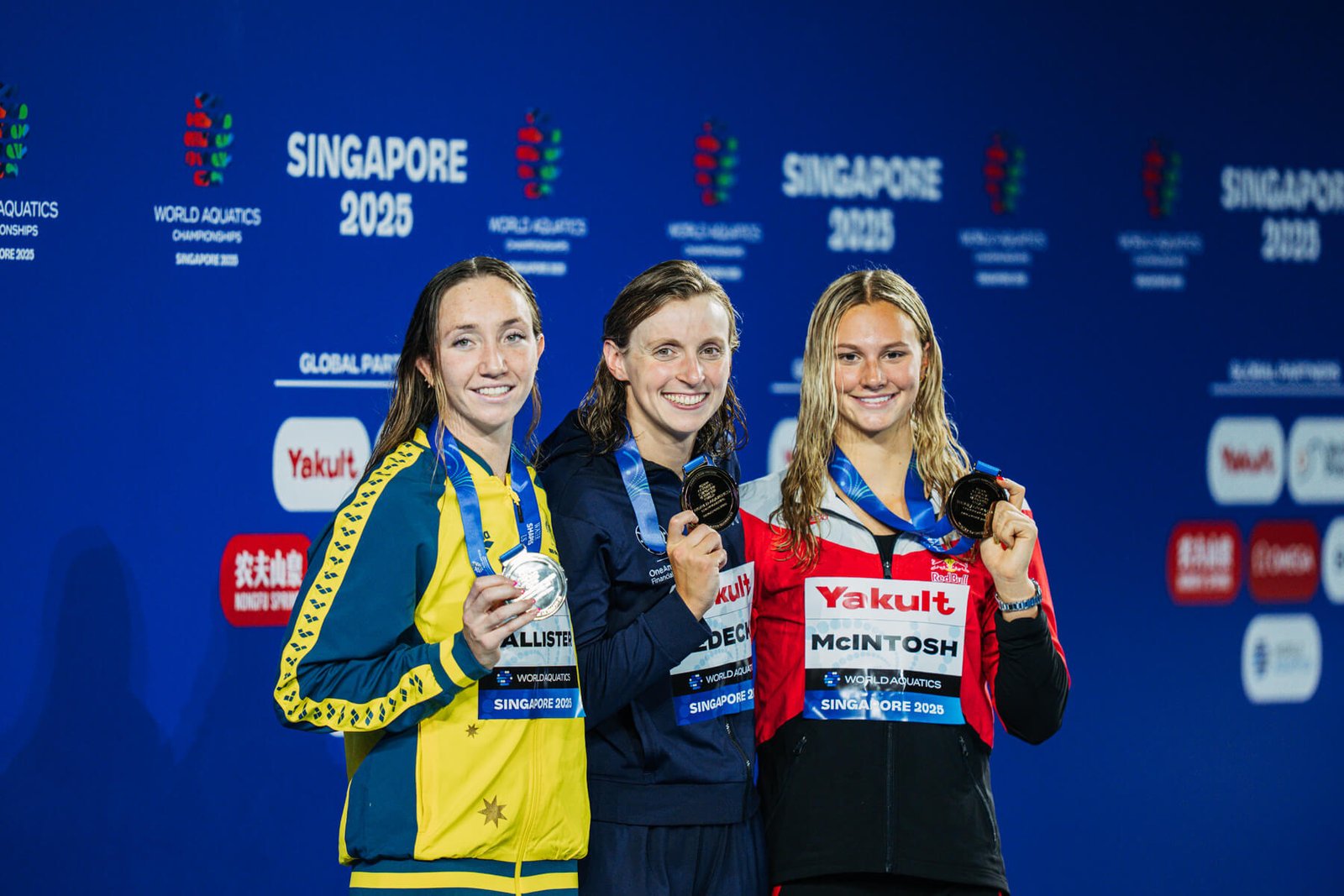
Katie Ledecky Facing Incredible Competition in 800 Freestyle: How We Got Here
Never in swimming’s history has an individual dominated an event the way Katie Ledecky has run roughshod over her competition in the 800 and 1500 freestyle. She has never lost either race at a major international competition, accumulating six Olympic gold medals and 13 world titles between the two events. Those numbers would be greater if the 1500 was part of the Olympic competition prior to Tokyo and if illness had not forced Ledecky to scratch the event at the 2019 World Championships.
Even with Ledecky at 29 years old, her grip on the 30-lap event remains firm; she won the world title last year by five seconds despite runnerup Simona Quadarella swimming an enormous best time and becoming the second-fastest woman ever on the way to silver. In the 800, however, it’s a much different story.
Katie Ledecky — Photo Courtesy: Peter H. Bick
Ledecky broke the world record in the event last May, her first lifetime best in almost nine years. At the World Championships in Singapore, she swam the second-quickest championship time of her career, slower than only her Olympic performance from the 2016 Games, and she still won by only three tenths. In that final, silver medalist Lani Pallister and bronze medalist Summer McIntosh both swam faster than any time Ledecky had posted in her previous six Worlds finals, all dominant victories.
The 2025 season was among the most impressive of Ledecky’s career, and by no fault of her own, her challengers in the 800 free have come within striking distance. After years of monopolizing the top-25 performances in history in the event, McIntosh now owns No. 3, No. 10 and No. 16 while Pallister’s two best swims rank sixth and 19th in history.
McIntosh was the first to make major inroads on Ledecky in the event, first with a win over Ledecky at a local meet in Florida in 2024 and then with a sub-8:10 performance last February, surpassing Ariarne Titmus as the second-fastest swimmer in history. Four months later, on the same night U.S. Nationals concluded in Indianapolis, McIntosh sent shockwaves across the border as she annihilated the world record in the 400 free. Perhaps Ledecky’s freshly-established mark in the 800 would follow.
Not quite, but she came close. Racing in the 800 one day later, McIntosh swam under world-record pace for most of the distance, and she was still within a tenth at the 750-meter mark, only to fall short down the stretch in 8:05.07. Still, she was within a second of Ledecky’s 8:04.12, which seemed suddenly much less insurmountable.
Pallister’s turn came three days later when she clocked 8:10.84 in her victory at Australian Trials, breaking Titmus’ national record. Not quite the speed of her rivals, but Pallister made her intentions of challenging for 800-meter gold clear in the opening days of the World Championships. She just missed a medal in the 400 free despite a 3:58 effort, and she stuck close to Ledecky for the first half of the 1500 final before claiming bronze.
The three-way showdown at Worlds was an instant classic, sure to be remembered among the signature moments of Ledecky’s career. The swimmer widely regarded as the greatest-of-all-time held a narrow lead throughout, but McIntosh and Pallister did not go away. McIntosh took the lead at the 700-meter mark and seemingly had another surge to give, but Ledecky and Pallister kept battling. Ledecky retook the lead entering the final length, and she had to maintain maximum effort to keep Pallister at bay at the finish.
The final results: Ledecky 8:05.62 and a championship record, Pallister 8:05.98 for an Australian and an Oceanic record, McIntosh 8:07.29. Five seconds out was Quadarella in 8:12.81, a European record that made her history’s fifth-fastest performance.
This story is not over. If she can maintain her form for the next two-and-a-half years, Ledecky will try to become the first swimmer to win five Olympic gold medals in one event. Currently, Michael Phelps is the only other swimmer with four straight (men’s 200 IM, 2004 through 2016).
It might be the 23-year-old Pallister rather than the 19-year-old McIntosh posing the biggest threat. McIntosh is the world’s dominant swimmer in the individual medley events, 400 free and 200 butterfly, and she has stated those events will continue to take precedence in her program. If she opts for a fifth individual race at future major competitions, it would not conflict with one of her main races. That would seemingly rule out the 800 from her 2028 Olympic lineup, with its final scheduled on the same day as the 200 fly. Still, McIntosh will have several big-meet opportunities this summer between Canadian Trials, the Commonwealth Games and Pan Pacific Championships.
Pallister, on the other hand, has continued her hot hand since Worlds. At the World Cup stop in Toronto last fall, she obliterated Ledecky’s world record in the short course 800 free by three-and-a-half seconds, clocking 7:54.00. The swim marked a best time by a full eight seconds. We’ll find out soon if that means another long course jump is imminent.
There will be no single global long course meet this year as continental championships take center stage, but not to worry, Ledecky, McIntosh and Pallister are all expected at Pan Pacs in Irvine, Calif., in August. Any 800 free showdown would be hard pressed to live up to last year’s classic, but this race will surely draw huge attention as Ledecky again puts her historic winning streak to the test.

