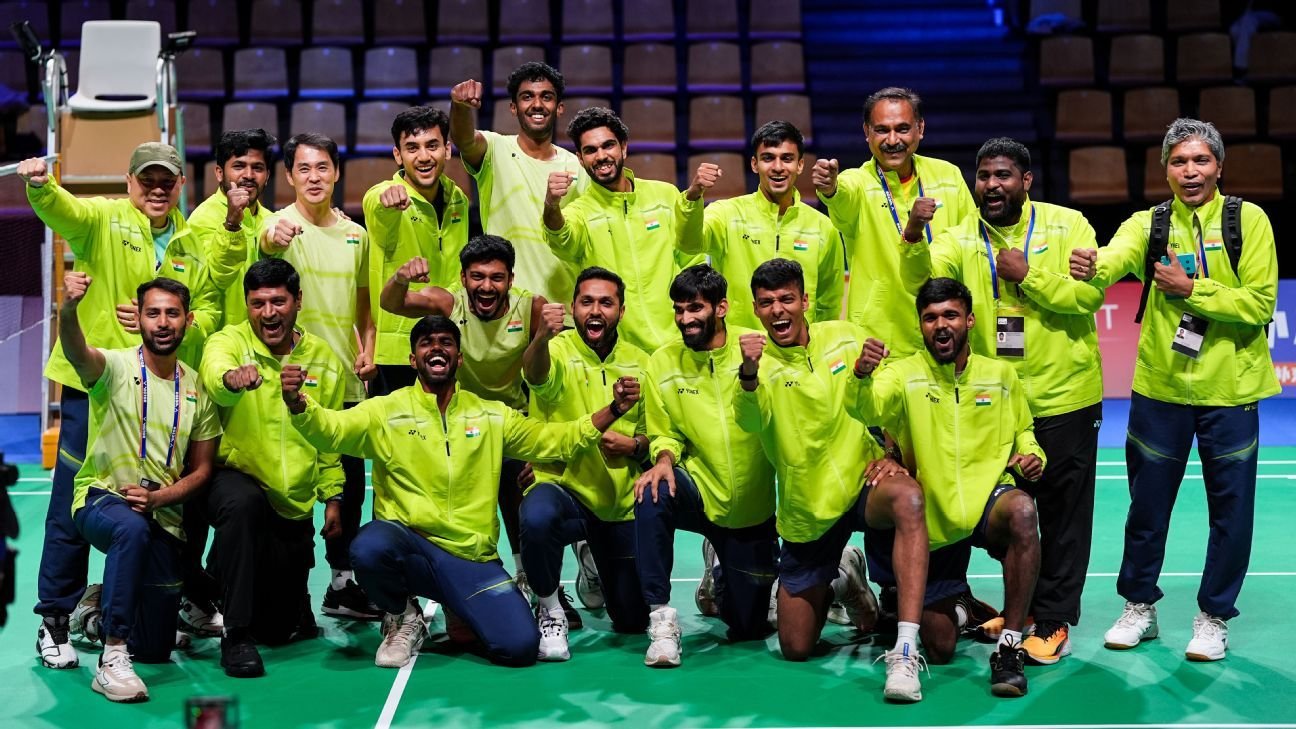
India finished their Thomas Cup 2026 campaign with a bronze medal; only the second ever medal for the Indian men’s team and the first since the historic gold in 2022, also won by the same core of players.
It is an achievement to be celebrated no doubt. Being in the top four in the competitive world of men’s badminton is no small feat. The way the India number ones Lakshya Sen and Satwiksairaj Rankireddy-Chirag Shetty stepped up against Chinese Taipei in the quarterfinals and how Thomas Cup debutant Ayush Shetty showed just why he is so highly-rated as India’s future made it a memorable victory. To do this with the same core from four years ago, after returning empty-handed as defending champions in 2024, is a positive.
Satwik-Chirag look fully fit and are dialled in, Lakshya’s game looks more versatile than ever and Ayush is a fresh burst of hope for Indian men’s singles. India lost to heavyweights (but Shi Yu Qi-less) China 3-2 in the group stage – always a good benchmark to measure a team’s might against. Lakshya and Ayush were clutch against veteran Chou Tien Chen and All England champ Lin Chun-Yi in the quarterfina. Things look good and the medal adds that sheen to it.
But this bronze medal is one to be celebrated with some degree of caution as well. For it is a bronze that shines a light, once again, on the bench strength issue of Indian badminton.
A bronze medal in major badminton tournaments can be an odd one; there are two handed out to both losing semi-finalists. So, while it is to be celebrated because it’s a podium finish, it also means you lost the semifinals.
In India’s case, it was a bit of a brutal loss to France – 3-0 with the French singles players outplaying the Indians. In Lakshya’s absence due to injury, Ayush, Srikanth and Prannoy could not win a single game and the tie was wrapped up in quick time.
France, first-time Thomas Cup finalists and only the second European country to get there, are a great example to highlight where India are lagging behind — the men’s singles dynamic. France’s top three in singles – Christo Popov, Alex Lanier, Toma Junior Popov, – are all ranked higher than the Indians they played, with two of them being top-ten players. Currently, there are no Indians in the Top 10, with Lakshya highest at World no. 11.
Of course, this is just part of the natural circle of life with the heyday of Srikanth and Prannoy, both legends of Indian badminton, now firmly behind them. The worry is how the younger players have not risen to fill the void. Srikanth and Prannoy, ranked and aged in the 30s, are still India’s numbers three and four, with Ayush now second, at just 20 years old. But what after that?
The entire generation aged in their 20s — Tharun Mannepalli, Kiran George, Mithun Manjunath, Priyanshu Rajawat etc — is ranked beyond 40 in the world. A combination of injury setbacks, lack of form and no big runs has set them all back. While Ayush is a new hope – and rightly so given his periodic big runs since fully becoming a senior last year – the other names on this list provide a cautionary tale for him.
Then there is the other, more glaring issue – how the second men’s doubles pair is still a work in progress. After the outliers that are Satwik and Chirag, there is absolutely no one else that come close to that calibre. Even now, more than five years after their breakthrough as a world-class doubles pair.
Four years ago, when India won the Thomas Cup as well, the second MD pairs were Vishnuvardhan Panjala and Krishna Prasad Garaga, and MR Arjun and Dhruv Kapila.
Today, Vishnu and Krishna play with different partners, and both are ranked beyond 150. Dhruv has now shifted his focus to mixed doubles (while still in the Indian squad) and the now-fit Arjun partners Hariharan Amsakarunan, who split with former partner Ruban Kumar Rethinasabapathi at the end of last season. If most of these names sound unfamiliar, then you get the drift of where Indian men’s doubles scene stands right now.
So there’s the picture – a top-heavy pyramid, with a foundation not broad enough. A peak good enough to win the Thomas Cup, a base that may not last five matches under pressure. And in a team competition, you are as strong as your weakest link. The gap between your ceiling and floor cannot be this vast.
None of this is new information, but it bears repeating, especially in a year with the Asian Games, the next team competition. At the last edition in 2023, India won the men’s team silver with a narrow loss to China in a very competitive tie. Since then, India have retained the same core, with Ayush the only new entrant for India. Like this Thomas Cup bronze medal, that was both a positive and a drawback at the same time.
Without being too pessimistic, India’s second-ever Thomas Cup medal must now be celebrated. However, the ball must now be in the Badminton Association of India’s court to have an eye on the future.

