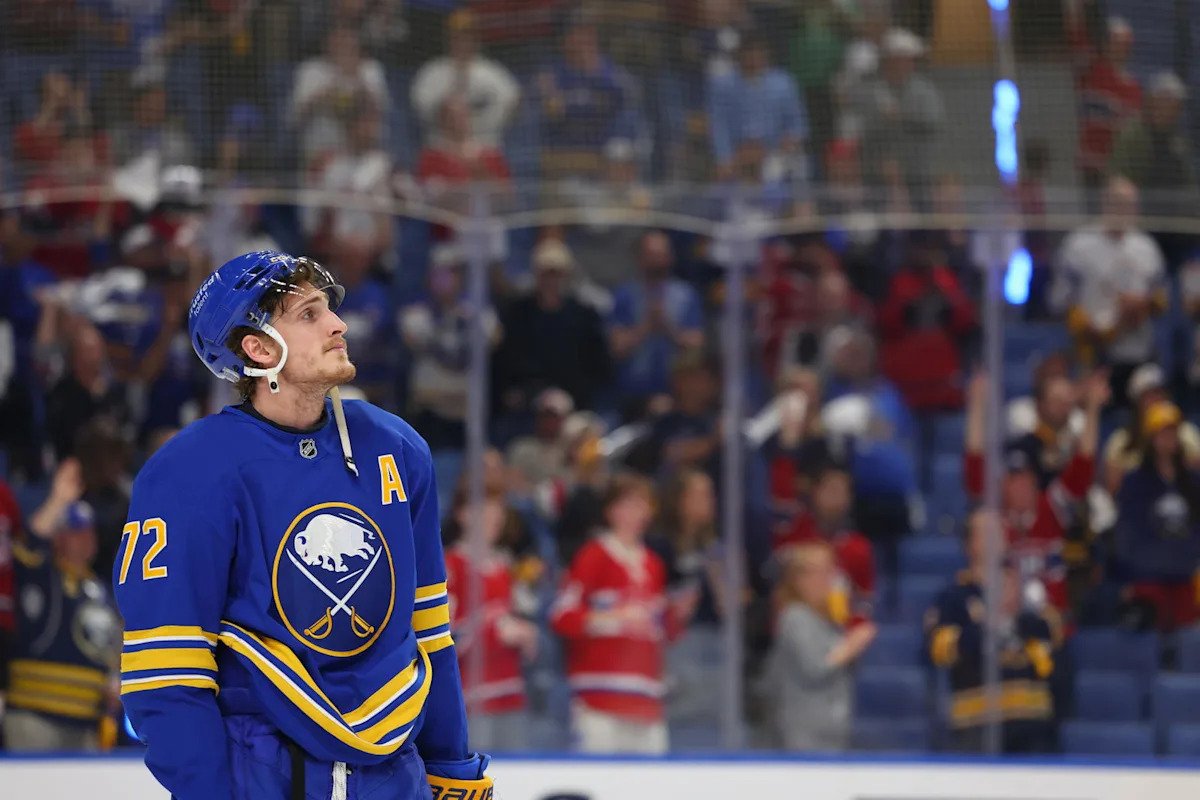
It’s a painful thing to watch a city hold its breath, believe for just a split second that the moment has finally arrived, and then have it snatched away before the celebration even starts.
That’s exactly what happened to the Buffalo Sabres on Monday night, and for a fanbase that has been waiting longer than most for something to cheer about, it landed like a gut punch.
Advertisement
Game 7 against the Montreal Canadiens. Everything on the line. And a puck that crossed the goal line — that genuinely, physically crossed the goal line — that didn’t count.
The Sabres had dug themselves out of a 2-0 hole to tie the game in the third period and were pressing hard, playing some of their best hockey of the series when defenseman Bowen Byram unleashed a shot from the point on Canadiens goaltender Jakub Dobeš. The save was made, but the puck didn’t stay buried. Buffalo players swarmed the crease, jabbing at it relentlessly until it squeaked free and slid across the goal line. The Sabres erupted. The building erupted. And then the referee’s hand went up, the goal was waved off, and the noise turned into something much harder to describe.
Here’s the part that stings most: the officials weren’t wrong.
Advertisement
A referee had already blown the whistle before the puck crossed the line, killing the play dead in real time. It was audible on ESPN’s broadcast — clearly, unambiguously audible — and it came just ahead of the puck crossing. Infuriating as it was to witness, the call had a rulebook to lean on.
NHL Rule 31.2 exists precisely for moments like this one, and it reads in a way that gives referees significant cover:
“As there is a human factor involved in blowing the whistle to stop play, the Referee may deem the play to be stopped slightly prior to the whistle actually being blown. The fact that the puck may come loose or cross the goal line prior to the sound of the whistle has no bearing if the Referee has ruled that the play had been stopped prior to this happening.”
In plain terms, the rulebook acknowledges that referees are human, that their reaction time isn’t perfect, and that the moment they decide in their mind to stop play — not the moment the whistle sounds — is when the play is officially over. It’s a rule that has cost teams goals before, and it cost Buffalo one on Monday night.
Advertisement
Was it a quick whistle? Sure. The kind that makes you wince regardless of which team you’re rooting for, because there’s something instinctively wrong about a puck crossing a goal line and nothing counting for it. Sabres fans have every right to be furious, and that frustration isn’t irrational — it’s a completely human response to watching something that looked like a goal not be treated as one. However, it wasn’t an egregious call.
The bottom line is that the letter of the law was followed. The referee made a judgment call in a fraction of a second, blew the whistle with intent, and the rulebook backed him up. Buffalo wasn’t robbed by a bad call. They were burned by a fast one — and in a Game 7, in the third period, with a season hanging on every shift, fast is sometimes all it takes.
But Sabres fans should be proud one way or another. This team fought valiantly and they’ll certainly be back next season stronger than ever.
Image

