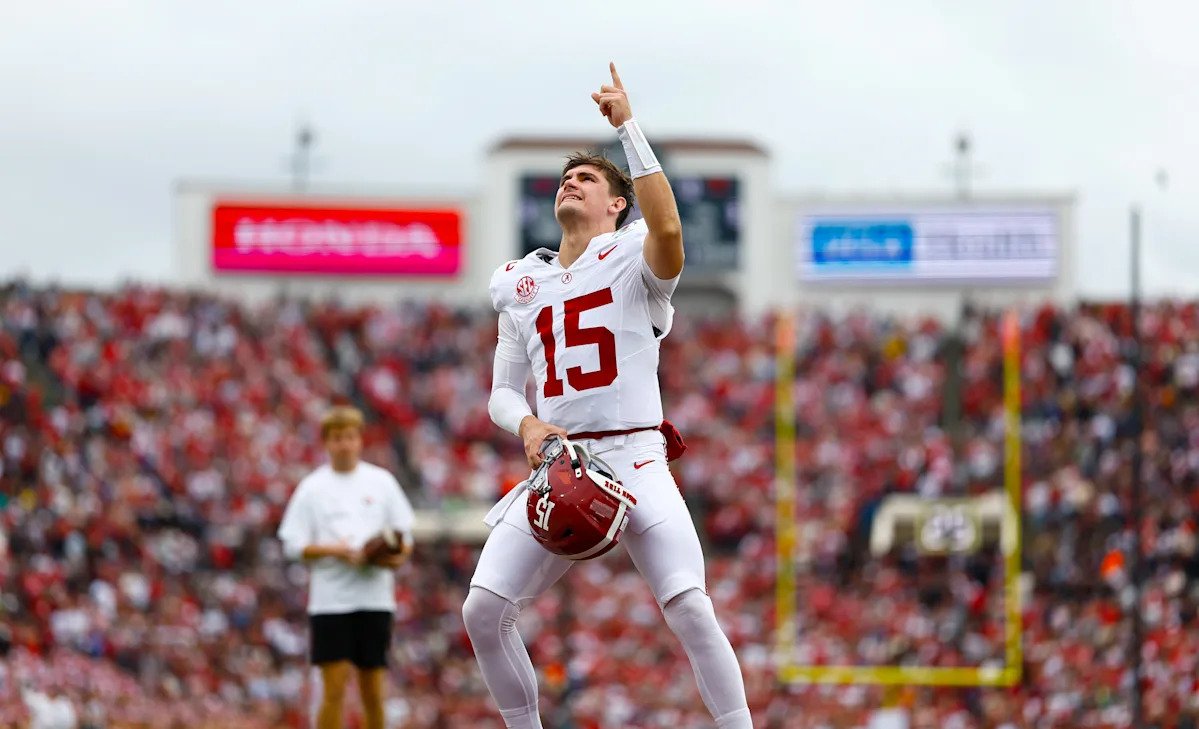
People are getting it wrong on the Los Angeles Rams, Ty Simpson, and Matthew Stafford. Partly this is because LA’s selection of Simpson with the 13th overall selection in last month’s NFL Draft was unexpected and jarring to many fans of the team.
But NFL history is littered with examples of franchises futureproofing football’s most valuable position, even if the only parallel the consensus seems to draw is between Aaron Rodgers and Jordan Love.
Advertisement
Drafting Simpson is not a desperation move for the Rams. It’s a long-term strategy and one the NFL has seen be successful many times over.
Let’s look at every recent example I could think of where a team drafted a new quarterback to replace a great.
Drew Brees —> Philip Rivers (2004)
Drew Brees was a different quarterback with the San Diego Chargers than how we remember him for his time with the New Orleans Saints. The Chargers knew Brees was solid but questioned his abilities to remain healthy and emerge as a top echelon quarterback.
San Diego drafted Brees in the second round (32nd overall, now considered a first-round pick) in 2001. He demonstrated promise but was briefly benched in 2003. The Chargers drafted Eli Manning first overall in 2004 then traded him to the Giants in exchange for Philip Rivers plus draft picks. Rivers then held out most of his rookie training camp in a contract dispute.
Advertisement
Brees went on to have the best season of his young career in 2004, Rivers’ first season as the understudy. However, with the Chargers eliminated from the playoffs the following year, Brees suffered a major shoulder injury in the regular season finale after a sack by now 49ers general manager John Lynch.
This made for a natural transition to Rivers. Brees left in free agency for the Saints. The remainders of their careers were historic.
Brett Favre —> Aaron Rodgers (2005)
Two decades before Aaron Rodgers saw himself replaced by Jordan Love, he also was drafted to replace a quarterback who couldn’t make up his mind about retirement. Similar to Stafford, Favre was on a year-to-year timeline and often left the Packer hanging in the balance with his intentions to play or not to play.
Advertisement
So when Rodgers surprisingly fell to the 24th pick in the 2005 draft, Green Bay couldn’t help themselves. Did they truly need a quarterback? Probably not. But it’s smart to buy insurance for the most important position in the sport.
Favre continued playing through 2010 and had stints with the Jets and Vikings. Rodgers took over full-time in 2008 and led Green Bay to the Super Bowl in his third year as the leading man.
Peyton Manning —> Brock Osweiler (2012)
The Broncos drafted Osweiler in the second round in 2012 as the heir apparent to Manning at age 36. Osweiler sat behind the legend for roughly three years before splitting time as the starter with Manning in the veteran’s final season in 2015. That year’s team won the Super Bowl despite lackluster quarterback play.
Advertisement
It was a worthy attempt at securing a long-term quarterback even if the rest of Osweiler’s career is not noteworthy.
Tom Brady —> Jimmy Garoppolo (2014), Jacoby Brissett (2016)
With Tom Brady in his late 30’s, the Patriots were intent on finding his long-term replacement before he hung up his cleats. They took two throws at the dart board in Garoppolo and Brissett. Brady is perhaps the only player in NFL history to successfully hold off Father Time for as long as he did.
Garoppolo didn’t get his shot to start until Brady was suspended to start the 2016 season. Garoppolo played well in relief but suffered an injury and gave way to Brissett. He was traded to the 49ers the following offseason.
Advertisement
With parallels to Rodgers and Stafford, Brady had been vocal about his emotions following New England drafting Garoppolo. Still, Brady maintained his competitive edge while embracing the role as a mentor.
Aaron Rodgers —> Jordan Love (2020)
Rodgers watched the Packers take Jordan Love in the first round in 2020 and then used it as motivation to win MVP.
The Packers own the blueprint for drafting a quarterback before you need one. They’ve done it twice successfully with Favre and then Rodgers. The Rams are attempting to emulate Green Bay’s magic.
Kirk Cousins —> Michael Penix (2024)
The jury is still out on this one. Penix was a shocking pick early in the first round fresh off of the Falcons signing Cousins to a large deal in free agency. Cousins tore his Achilles towards the end of his career with the Vikings and the Falcons were sensible for keeping their options open. Of course, Cousins’ career in Atlanta did not match the level of success he had in Washington or Minnesota.
Advertisement
Penix is battling with Tua Tagovailoa for the Falcons’ starting role in 2026.
Examples that aren’t quite the same
Alex Smith —> Patrick Mahomes (2017)
Similarites to Stafford/Simpson:
Smith was 32 when the Chiefs drafted Mahomes. Kansas City doesn’t exactly have a rich history of quarterback play. Smith is still one of the better quarterbacks in recent Chiefs history, even if his production pales in comparison to Mahomes’.
Differences from Stafford/Simpson:
Drafting Mahomes was an attempt to get better at quarterback. Smith was fine but left meat on the bone. The Chiefs were a solid team that came up short in the playoffs annually. They needed to take a shot at an elite signal caller.
Advertisement
Jimmy Garoppolo —> Trey Lance (2021)
San Francisco tried to copy Kansas City’s transition from Smith to Mahomes and wildly missed. They gave up a huge haul of draft picks in order to land Trey Lance, and were bailed out a little while later when they selected Brock Purdy with the final pick in 2022. Maybe it was blind luck. Purdy changed the trajectory of the franchise.

