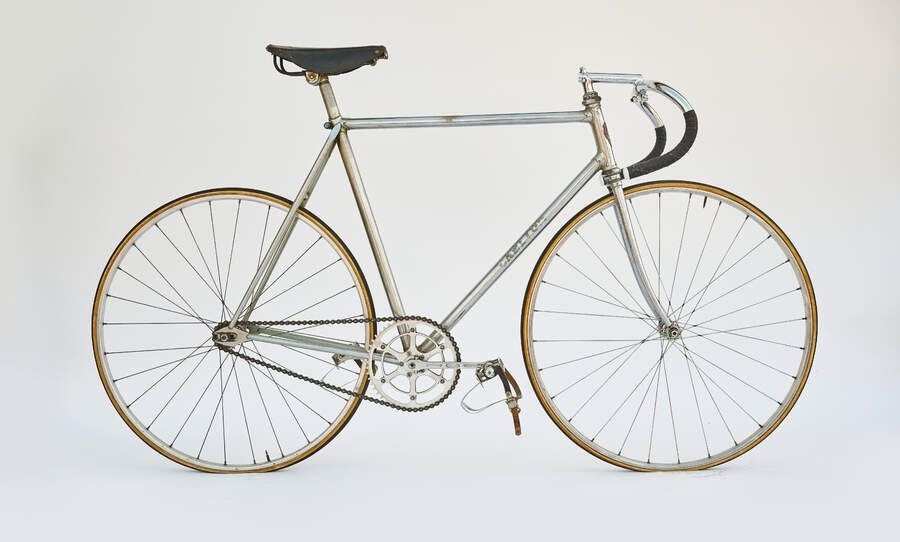
This is the bike Tom Simpson rode to a silver medal in the individual pursuit during the 1958 Commonwealth Games. However, the 1965 road world champion lost ownership following a card game.
“Tom had a good friend called Graham Plumber,” explains Dave Marsh, of the Universal Cycle Centre, Rotherham. “The two played cards together in local cafes, which is how Graham won this bike from Tom. I doubt Tom was too bothered – if he ever needed a bike, Gerald O’Donovan, manager and designer at Carlton, was very happy to oblige.”
Simpson – whose palmares included wins at Milan-San Remo and the Tour of Flanders – and O’Donovan were also good friends; in fact, O’Donovan was Simpson’s best man. Marsh recalls the now legendary tale that, after picking this bike up from O’Donovan’s home in Carlton Road Worksop, Simpson rode a local time trial road course in 19 minutes. That’s a phenomenal time on a 1950s teel fixie with no brakes!

“Tom was loyal to Carlton almost until the end,” remembers Marsh. “Most of his Peugeot bikes were rebranded Carltons. However, late in his career, he did switch to Italian builder Alberto Masi, whose frames were also disguised as Peugeots.”
Carlton Cycles was founded in 1898, by Fred Hanstock. Its growth surged with the arrival of Dan O’Donovan, who joined the company from the motorcycle industry before taking over in 1939, later joined by his son Gerald. The company was bought by Raleigh in 1960 and ceased trading in 1981.
The Carlton Flyer was the jewel in the brand’s crown, and as well as being the bike that powered Simpson to his 1949 silver medal in the World Championships individual pursuit, is was also the machine he used to claim a bronze in the 1956 Olympic team pursuit.
The Carlton Flyer was the brand’s top-tier bike. Beyond the norm – Reynolds 531 Double Butted tubing, Fiamme rims laced onto 28/28 small flange Airlite hubs, Stronglight chainset and cranks – Simpson’s bike has a few quirks.
“Tom specified notoriously steep tube angles,” confirms Marsh, who now owns the Carlton. “I think this one probably has a 74° head tube angle and a 73° seat tube angle. He modified the Brooks Champion Narrow saddle too, cutting away leather at the rear. The huge drop on the bars, plus the under slung stem, enabled him to tuck into an imposing stance.”

