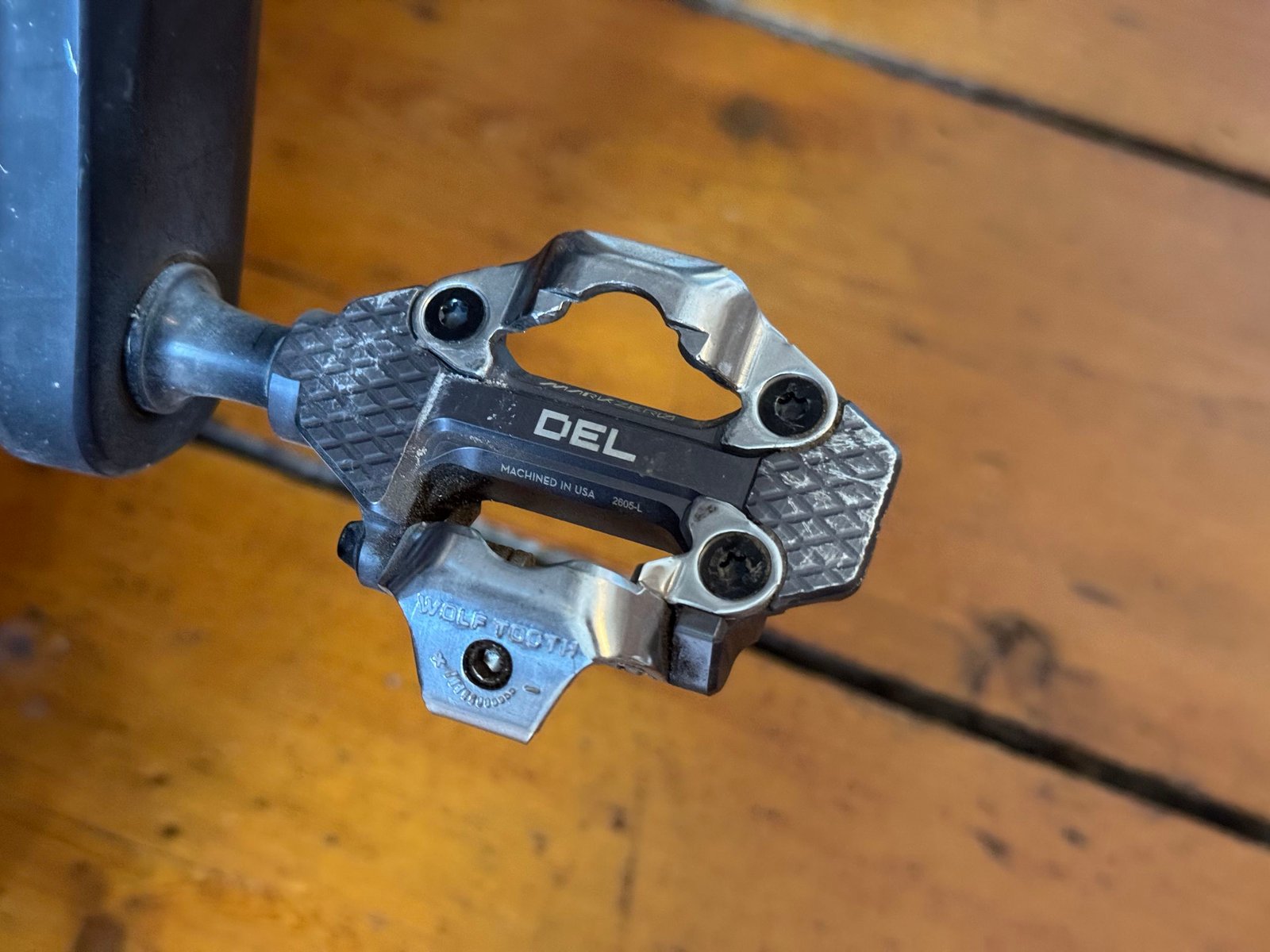
Wolf Tooth sparked an influx of race-specific gravel bike pedals when it launched the DEL pedals in 2025. Featuring a single-sided entry, rather than the traditional two-sided design seen on Shimano SPD pedals, it aimed to lower stack height and increase pedal surface area for a gravel-race-specific pedal.
Our tech editor used the regular Wolf Tooth DEL pedals at Gravel Burn in South Africa last year and was impressed by their performance, durability, and lightweight efficiency over seven days of demanding gravel racing.
With the Mk0 version, things have ramped up considerably in the performance stakes.
Understated packaging belies how precious the contents are
(Image credit: Future – Andy Turner)
Design details
The Wolf Tooth Mk0 DEL pedals are very similar to the standard DEL pedals. A wider platform design means that with the tread of most gravel shoes or a pontoon system on the Shimano RX910, the pedals have a contact surface area of 559mm2. Shimano XTR 9200, for example, sits at 144mm². More contact is only part of the equation; the other is the total area this contact patch covers, and the wide platform of the DEL pedals means there is minimal float when clipped in.
Latest Videos FromCycling Weekly
Wolf Tooth has also designed this pedal to be resilient. A five-year warranty is included, while every component of the pedal can be replaced, should you damage it. There are also user service tutorials to ensure maintenance is easy and that the life of the pedal is prolonged.
Other notable attributes include the “igus bushing with a custom radial seal that protects internal components from debris”, effectively limiting the chance that dirt will get into the axles and reduce bearing performance.

Stainless steel cleat hardware and shims are included
(Image credit: Future – Andy Turner)
Although functionally the same as the regular DEL pedals, a lot of work has gone into reducing the weight to 174g (172g on my scales) for the pair. DLC-coated Ti axles, PVD-coated Ti hardware, and aggressive machining have saved 43g compared to the standard DEL pedals. Just the one colour is available, rather than the coloured variety Wolf Tooth usually offers. The 6061 aluminium pedal bodies are machined in-house by Wolf Tooth, and do give a premium feel.
Wolf Tooth has also carried over the adjustable Q-factor of these pedals. There are 51, 55, and 59mm options available, and the swapping process is fairly straightforward; you unscrew the spindle, then adjust the three inner bearings and two spacers to set your width.
At just 14.5mm, the pedal is also very thin, which aids ground clearance through corners, while the open design helps shed mud. Stack height is also just 14.7mm, making it comparable to most road-race pedal systems and lower than pretty much any other gravel-specific pedal system available.
The SPD-style cleats are included, along with shims so that shoes with taller tread can still be used; however, the shims do not grip the shoe soles perfectly and can twist and move out of position when unclipping. The cleats have five degrees of float, and retention is adjustable via a hex screw.
The pedals are rated at a max rider weight of 90kg owing to the lightweight hardware used in the construction.
Performance
The Wolf Tooth Mk0 DEL pedals are, in terms of shape and functionality, identical to the standard DEL pedals, so the single-sided entry remains.
First and foremost, fitting the pedals is very easy. As with all pedals, you need to grease the thread, even more so when it comes to titanium, to avoid any binding. (It is recommended not to use these with titanium cranks). Clipping in using the supplied SPD-compatible stainless steel cleats, or standard Shimano ones, is effortless. There is no need to catch the pedal lip as such – instead it’s an easy stamp-in job.
There is some concern that removing the second side of the pedal makes clipping in more difficult, but fortunately the pedal remains in place and doesn’t spin too freely on its axles. Additionally, riding on proper gravel trails rather than single track or more technical terrain, there is virtually no situation where I ever unclip, so the potential time lost from the single-sided element is negated in other ways.
The improved ground clearance is a great feature. Riding in ruts or even over large stony terrain, having a bit more clearance for the pedal to avoid strikes is handy. It also means you can pedal through corners a bit more easily, which is useful for maintaining traction over loose terrain.

The machining of the pedals makes them a work of art, and every piece is replaceable should you damage anything
(Image credit: Future – Andy Turner)
That huge contact patch of the pedals is also exceptionally good for pedalling performance. On standard Shimano pedals, I have felt that my foot moves around somewhat when putting the power down. On the DEL pedals, there is no such issue. I have found these comparable to the stability of road pedals and exceptional for power transfer.
I used them together with Nimbl Urano shoes, which worked a treat as the tread sits nicely on the pedals while the cleat is engaged. However, using the Northwave Extreme X shoes, the tread was higher, so I needed the plastic shims under the cleat. The problem here is that the plate has less bite against the sole of the shoe than just the cleat, so when unclipping from the pedals I found the cleat often twisted. This meant I needed to loosen the retention a fair bit for these shoes or plane the tread off.
I’ve not actually needed to adjust the Q factor, but it is very easy to carry out. Simply unscrew the spindle and adjust the spacers and bearings. This carries over to all the individual parts of the pedal should they get damaged and require replacement. Given the price of the pedals, it is great that each individual part can be purchased and replaced rather than requiring an entirely new set of pedals.

The single-sided entry has not proved an issue, while pedalling stability and power transfer is exceptional
(Image credit: Future – Andy Turner)
Weight is a big area where these pedals are impressive. At just 172g for the pair, and the cleats adding only a small amount of weight, these are lighter than a few road systems. It’s not noticeable when riding, admittedly, but for those cutting weight everywhere on the bike, there is scope to reduce a large amount of rotational mass. I also have to say that these pedals are an absolute work of art in terms of aesthetics. The machined aluminium is just brilliant, and the single colour choice is also not a bad thing, given the DEL pedals tend to lose some color after exposure to the elements and from shoe scuffs. In this gunmetal colour, wear and tear is far less noticeable.
My only real gripe with these pedals is that most of the performance and functionality of the Mk0 DEL is identical to the standard DEL, save for the lighter weight.

Some tarnishing is likely due to metal-on-metal contact points
(Image credit: Future – Andy Turner)
Value
Unfortunately, the Mk0 DEL pedals don’t represent great value at £310/ $365. In terms of performance and functionality, there is virtually nothing separating the Mk0 pedals from the standard DEL offering, which is also fairly expensive at £189/ $220. I have been using the Shimano M520 pedals for years, and they do the job well enough at £49.99.
The Wolf Tooth MK0 are a classic case of diminishing returns on investment, but the fact is there is a return. This is the lightest, highest-contact gravel pedal on the market, and for those looking at cutting every gram possible, there isn’t a pedal that comes close.
The replacement parts, warranty, and serviceability all improve the value of these pedals, as you are unlikely to ever require a replacement set. But the same is true of the standard DEL pedals, which offer better value at a slightly higher weight.
If you want the best gravel options on the market, you can’t go wrong with the standard DEL pedals, but if you’re looking to unlock marginal performance gains and have the money to burn, the MK0 makes a convincing case.
Tech spec
- Price: £310/ $365
- Weight: 172g (pair, actual)
- Q-factor: 51 mm/ 55 mm/ 59 mm (user adjustable)
- Body: CNC-machined 6061-T6 aluminum
- Spindle: Titanium with DLC coating
- Bearings: Low-friction cartridge bearings x3
- Float and release: 5 degrees/ 12 degrees
- Cleat Compatibility: SPD

