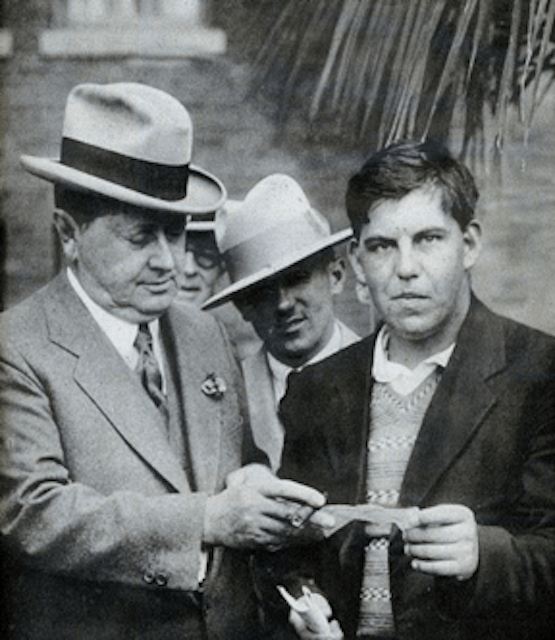
When Marathon Swimming Star George Young Stood Alongside Lou Gehrig and Charles Lindbergh
By Ned Denison, IMSHOF
In the late 1920s, what would $25,000 buy?
The $25,000 figure was the salary of New York Yankees star first baseman Lou Gehrig in 1928. “The Iron Horse” played in 2,130 consecutive games during his career, a record that stood for 56 years. In 1928, attendance for Yankees home games in Yankee Stadium was 1,072,132. More, Gehrig’s batting average was .374, and finished the year with 27 home runs and 142 RBIs. New York won the World Series after totaling 101 wins during the regular season. Gehrig’s salary at the time was $28,000.
Around the same time, airman Charles Lindbergh became the first individual to fly nonstop from New York to Paris, completing the feat in 33 hours, 30 minutes. This accomplishment earned him the $25,000 prize established in 1919 by the French hotelier Raymond Ortega. An estimated 150,000 spectators watched him land on May 21, 1927 at Le Bourget Aerodrome. He went on to become a Pulitzer Prize-winning author, World War II pilot and technical advisor who helped launch commercial air travel.
In the water, Canadian George Young became the first person to swim from Catalina Island to the mainland near Los Angeles in 1927. For that effort, he collected the $25,000 prize offered by chewing gum magnate Willliam Wrigley Jr. More than 100 of the world’s finest swimmers started the race in 54-degree water (13 Celsius) water. Young was the only finisher, and there was no prize for second place. It took Young 15 hours and 44 minutes to perform the swim.
Very few spectators witnessed his landing at 3:06 a.m. When he returned to his hometown of Toronto, an estimated 150,000 people attended his parade. The Catalina race, which caught the public’s interest and continued to receive annual purses from Wrigley, made marathon swimming a staple of the Canadian National Exhibition for nearly three decades.
Unlike Gehrig and Lindbergh, Young didn’t leave a popular legacy. Sadly, fewer than 1% of current marathon swimmers would recognize his name. He was inducted into the International Marathon Swimming Hall of Fame’s (IMSHOF) inaugural Class of 1963 and was enshrined into the International Swimming Hall of Fame’s Class of 2014. The Catalina race is recognized in the sport of marathon swimming as the first true World Championship (now called a Major) and Young is known as its first superstar. The swim was approximately 22 miles.
Here are a few metrics for amusement from the era:
| Age | $ per mile | $ per day | |
| Gehrig | 25 | 3 | 139 |
| Lindbergh | 25 | 7 | 13,333 |
| Young | 17 | 1,136 | 38,095 |
Finally, $25,000 in the late 1920s would be equivalent to $470,000 in 2026.

