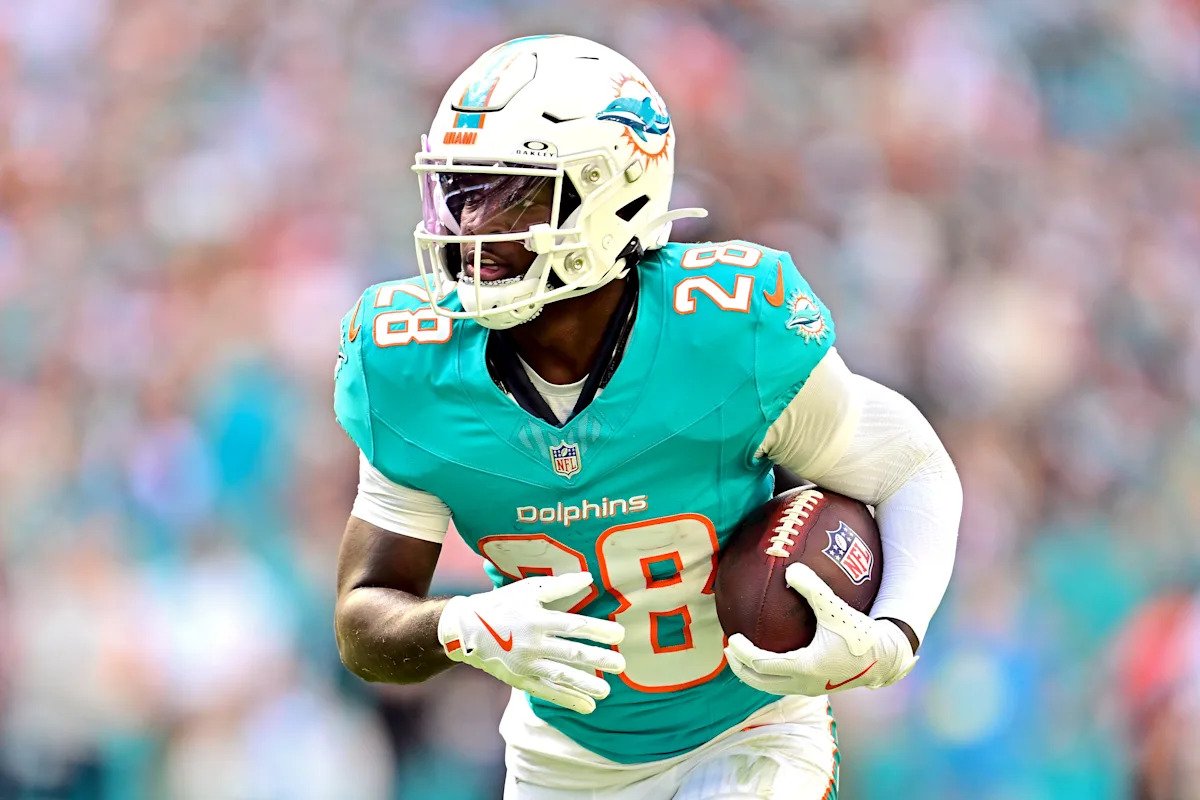
The Miami Dolphins seemed ready to tear everything down on their roster this offseason, with one exception. They refused to entertain a trade of running back De’Von Achane.
It seemed odd. The devaluation of running back around the NFL has been a notable trend. But the Dolphins, who traded away receiver Jaylen Waddle to the Denver Broncos this offseason, wouldn’t budge on moving their young running back.
Advertisement
Then Achane got a contract extension from the Dolphins, and maybe it makes more sense.
Achane signed a four-year, $64 million deal on Wednesday. Achane did get a lot of money … for a running back. He’s the third highest-paid running back in the NFL in terms of value per year, behind Christian McCaffrey and Saquon Barkley. But among offensive playmakers, $16 million per season is perfectly reasonable for someone who can impact a game like Achane. He’s a highly paid running back but his contract would be a good value among receivers.
Is it possible that the devalued running back has turned into the new bargain in the NFL?
De’Von Achane of the Miami Dolphins signed a big four-year extension this week. (Photo by Julio Aguilar/Getty Images)
(Julio Aguilar via Getty Images)
De’Von Achane’s impact
As running back values in the draft and in free agency lessened, the market for receivers skyrocketed.
Advertisement
Alec Pierce might be the best example of it. Pierce was a second-round pick in 2022 and had little impact for the Indianapolis Colts through two seasons, never reaching 600 yards in a season. He took strides in 2024, leading the NFL in yards per reception and catching seven touchdowns, then in 2025 he built off that and had his first 1,000-yard season. Pierce had 1,003 yards and six touchdowns, then signed a four-year, $114 million deal to stay with the Colts before he hit free agency this offseason.
There’s no question that Pierce, who has averaged more than 21 yards per catch the past two seasons, has a big impact and is an ascending player at an important position. But Achane’s deal is 56% of what Pierce got. Achane had almost twice as many touches last season (305) as Pierce has had in four seasons combined (156). Achane had 12 touchdowns last season, compared to 17 for Pierce’s career, and put up 1,838 yards from scrimmage. It’s not like Achane wasn’t efficient; he averaged a league-best 5.7 yards per carry.
It’s reasonable to argue that a receiver like Pierce can impact defenses in different ways, and his value over replacement is higher than even the best running backs. But is Achane really just 56% the offensive player that Pierce is, as the contracts would indicate?
Achane’s deal would be mundane among RBs
Achane’s new deal would rank him 30th among receivers in terms of money per season, according to Spotrac. Among the players he is behind: Calvin Ridley, Michael Pittman Jr., Jerry Jeudy, Wan’Dale Robinson and Romeo Doubs. He is also behind Rashid Shaheed, who signed a deal this offseason with the Seattle Seahawks at $17 million per season. Shaheed has tremendous value as a returner, but in half of a season with the Seahawks he had 15 catches and no touchdowns on offense. Does he have more value than Achane, who had 238 rushing attempts and led the league in yards per carry? The NFL thinks so. Money talks.
Advertisement
Last season, the NFL’s shift toward the running game became a significant trend. More teams began running multiple tight end sets to attack defenses that got smaller over the years to cover spread attacks. Many blocking tight ends got good contracts this offseason, and many were drafted highly in April. Teams want to get explosive plays in the running game against defensive schemes with two deep safeties designed to eliminate those big plays in the passing game. It seems reasonable those offenses would covet elite running backs to maximize that approach.
Achane is clearly elite. He is an explosive runner who is excellent in the passing game as well. He’s also just 24 years old. There could be concerns about whether he’ll hold up over the length of a long extension, especially considering he’s only 191 pounds. But in a salary cap world, the Dolphins decided that paying a running back $16 million per season was so valuable it was worth not entertaining trade offers for him, even as it traded a young receiver in Waddle. The NFL market would probably say Waddle is worth about twice as much as Achane if he was to hit free agency, as it did with Pierce.
When the Dolphins said they would not trade Achane, the NFL world was confused. Maybe Miami has figured something out before the market catches up.

