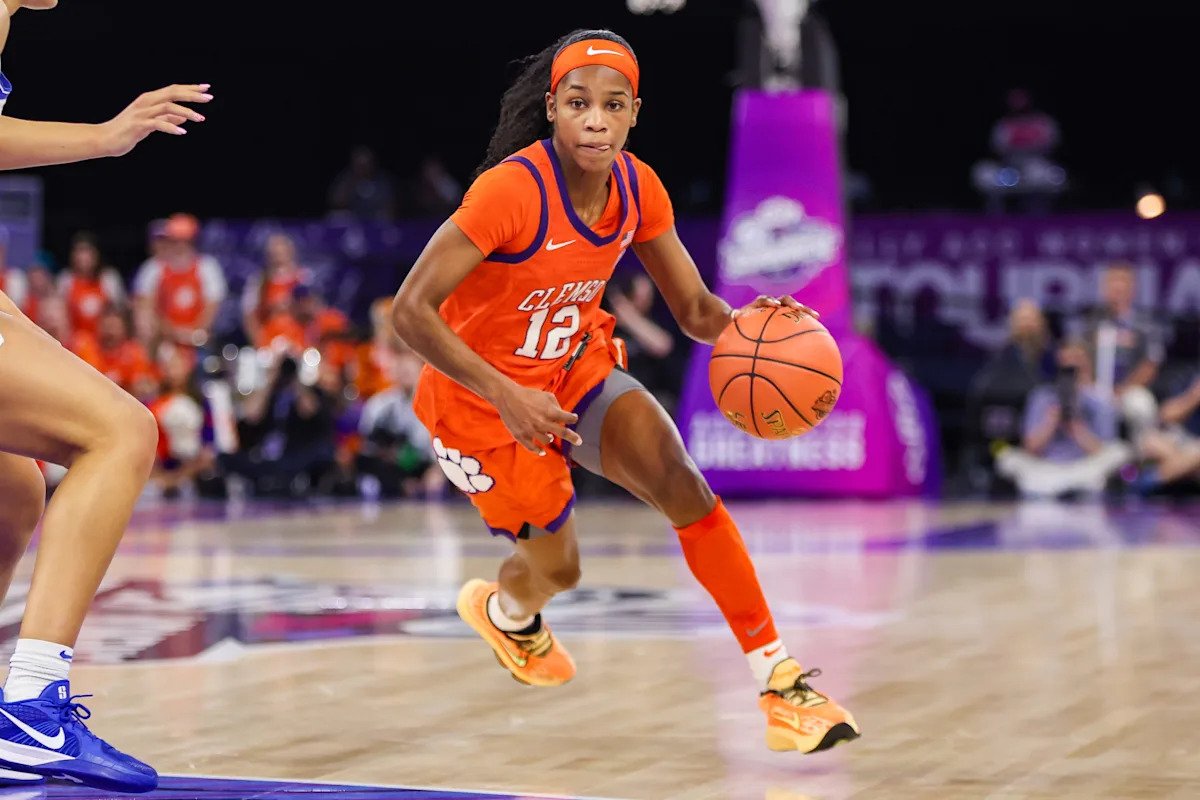
Heading into Shawn Poppie’s third season at the helm of Clemson’s women’s basketball program, the Tigers have again assembled a talented roster.
Clemson is returning starter Rusne Augustinaite, who was one of the top 3-pointers shooters in the nation, ranking 19th with a 42.1% shooting clip from behind the arc. The Tigers are also bringing in a freshman class that features three ESPN Top 60 recruits, and their transfer portal haul was impressive. Clemson added players with size, some with high potential, and then a proven point guard in Virginia Tech’s Mackenzie Nelson — who ranked second nationally in assist-turnover ratio this past season.
Advertisement
There’s a chance that this roster could receive one more boost. The Tigers are just awaiting a decision from the NCAA.
Clemson has submitted a waiver to get senior guard Mia Moore an extra year of eligibility. This past season, the All-ACC selection led the Tigers in scoring and passing with 13.3 points and 4.7 assists per game. She also averaged 5.4 rebounds per game and shot 37% from 3-point land.
“It was really hard to build the roster knowing that Mia has a waiver out there, because she’s such a big piece,” Clemson coach Shawn Poppie told USA TODAY Sports. “Mackenzie Nelson, we think can play alongside Mia Moore, no doubt. But if you don’t have Mia, I really feel like Mackenzie is capable… But you add Mia in there — she’s an unbelievable kid, an unbelievable teammate and an unbelievable worker. She would literally be the face of Clemson women’s basketball if she were to get this extra year.”
More: Hannah Hidalgo shares why she’s returning to Notre Dame for senior year


Clemson’s case is based on Moore’s redshirt freshman season at Mississippi State, where she played a total of just 11 minutes across four games while battling an injury that ultimately sidelined her for the remainder of the year. However, the final game Moore played in during that season was on Jan. 19, 2023.
Advertisement
The guidelines the NCAA usually follows when considering whether to grant a medical redshirt are based on both how often the athlete played and when their final game was before being sidelined for the year. Typically, the player can’t have participated in more than 30% of the games in that season and the injury that rules them out for the year has to occur within the first half of a season. Mississippi State played 33 games in the 2022-23 campaign, making the halfway point at game 16. Moore played in game No. 19 of that season, complicating her case.
“We’re sitting here waiting. It’s been a long process,” Poppie said. “Hopefully that gives us a little bit more encouragement and optimism that she’ll get (a waiver) passed… The way the rules have always been in the waiver process, we feel very confident that she should be granted an extra year.”
As Clemson is fighting to get Moore one extra season of eligibility, the NCAA is considering a rule change that would make cases like hers moot.
In April, the NCAA’s Division I Board of Directors recommended to advance an age-based eligibility concept that would give athletes up to five years of eligibility beginning the academic year after they turn 19 or graduate from high school, whichever happens earlier.
Advertisement
Put more simply, every NCAA athlete would have five years to play five seasons of college sports. Widely called the “5-in-5” rule, it would also eliminate traditional redshirts and waivers for extra eligibility, aside from special circumstances like pregnancy, military service or religious missions. The rule would also set clear guidelines on how much eligibility a foreign-born player would have if they played professionally in another country before coming to college, based on their age.
According to a recent report from Yahoo Sports, a vote on the “5-in-5” rule is not expected during the upcoming Division I Cabinet call on Friday. Discussion is expected to continue at their next meeting the week of June 22.
The proposed rule change — which has the full-throated support of NCAA President Charlie Baker — comes during an era in college athletics where the NCAA is constantly finding itself in courtrooms dealing with eligibility challenges. According to Sportico, there have been more than 70 eligibility-related lawsuits brought against the NCAA by athletes after having played four seasons within five years, with many of them hoping to continue to earn money through NIL or revenue sharing.
Several women’s basketball coaches that USA TODAY Sports spoke with during ACC Spring Meetings in Amelia Island, Florida last week seem to be in favor of the “5-in-5” rule, or simply accept its inevitability.
Advertisement
“I think it’s great,” Louisville coach Jeff Walz said. “I’d love to figure out a way to — let’s stop all the waivers, you know? I see some kids get turned down and then I see other kids get a waiver to play. So let’s just do five-for-five and simplify the process. I’m a huge fan of it.”
Some coaches did caution about the trickle-down effect that the “5-in-5” rule might have. SMU coach Adia Barnes made the case that, in the immediate future, a rule change like this could make things difficult for incoming recruits. It could also create more chaos in the transfer portal.
“It’s going to really hurt high school kids. I think that they’re going to have less opportunities, I think they’re going to make less money, but I think it’ll even out,” Barnes said. “I think where it’s going to really help is all of these waivers — there’s like 1,600 of them sitting there. I think it’s going to eliminate all that, and I think it’s going to also affect (professional players) overseas (wanting to come play in the NCAA), because then you can’t be a 24-year-old freshman.”
Barnes added: “The new model, it doesn’t address transferring. So, you can go to five schools in five years, which is going to be insane…But people don’t care about the degree, they care about the money.”
This article originally appeared on USA TODAY: NCAA weighs ‘5-in-5’ rule while Clemson fights for eligibility for women’s basketball player

