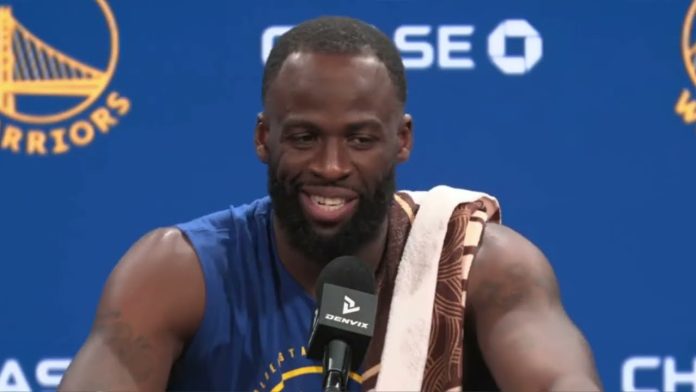
Draymond Green has weighed in on the growing debate over whether winning an NBA MVP should be valued more highly than winning a championship, arguing that the comparison changes when the title is led by a team’s primary option.
Speaking on The Draymond Green Show, Green rejected the idea that critics are comparing an MVP to a championship won by a player with a minor role. Instead, he focused on the accomplishment of leading a team to a title as its No. 1 option.
“That’s the actual argument. Not, oh, is it 11 or 12th men on the team. That’s not the argument. And no one’s trying to argue that. That’s bullsh*t. But a first option, a la Jalen Brunson or MVP. I would love to know Dirk who won one championship and won MVP. I would love to know which one he loves most. Which one gave him the higher sense of accomplishment? One thing’s for certain, I know people talk about Dirk’s championship in 2011 far more than they talk about Dirk’s MVP in ’07.”
Green’s comments came after Tracy McGrady supported Kevin Durant’s position that an MVP carries greater individual weight than a championship. McGrady argued that a title depends on variables beyond one player’s control, including roster construction, coaching, management decisions and injuries.
“The MVP of the regular season has more weight than a championship because it’s of course the whole team,” McGrady said while speaking with Vince Carter on Cousins. “This is not just team, but its ownership, it’s management, it’s health, all this sh*t that plays into winning the championship. So, yeah, I mean, MVP, bro, thats you putting in some work.”
McGrady’s argument separates individual recognition from team achievement. The MVP is awarded for a player’s performance over an 82-game regular season, while a championship requires surviving four playoff rounds and depends on contributions throughout an organization.
Green, however, narrowed the discussion to players who carry the largest responsibility for a championship contender. His example was Dirk Nowitzki, who won the 2006-07 MVP after averaging 24.6 points, 8.9 rebounds and 3.4 assists per game for a Dallas Mavericks team that finished with a league-best 67-15 record.
Nowitzki later led Dallas to the 2011 NBA championship, averaging 26.0 points and 9.7 rebounds during the postseason. The Mavericks defeated the Miami Heat in six games in the Finals, with Nowitzki averaging 26.0 points and 9.7 rebounds in the series to win Finals MVP.
The distinction is central to Green’s argument. An MVP recognizes an individual season, while a championship led by a clear first option requires that player to sustain elite production through the postseason while helping his team navigate four series against the league’s strongest opponents.
McGrady’s own career illustrates the other side of the discussion. He won consecutive scoring titles in 2002-03 and 2003-04, averaging 32.1 points per game for the Orlando Magic in the first season and 28.0 in the second.
He never won a regular-season MVP or NBA championship and did not advance beyond the first round until 2012-13, when he reached the NBA Finals as a reserve with the San Antonio Spurs.
Green, a four-time NBA champion with the Golden State Warriors, is therefore drawing a distinction between simply being part of a championship team and serving as the player expected to lead one. His position is that for a true No. 1 option, winning a championship belongs in the same conversation as earning the league’s highest individual regular-season honor.

